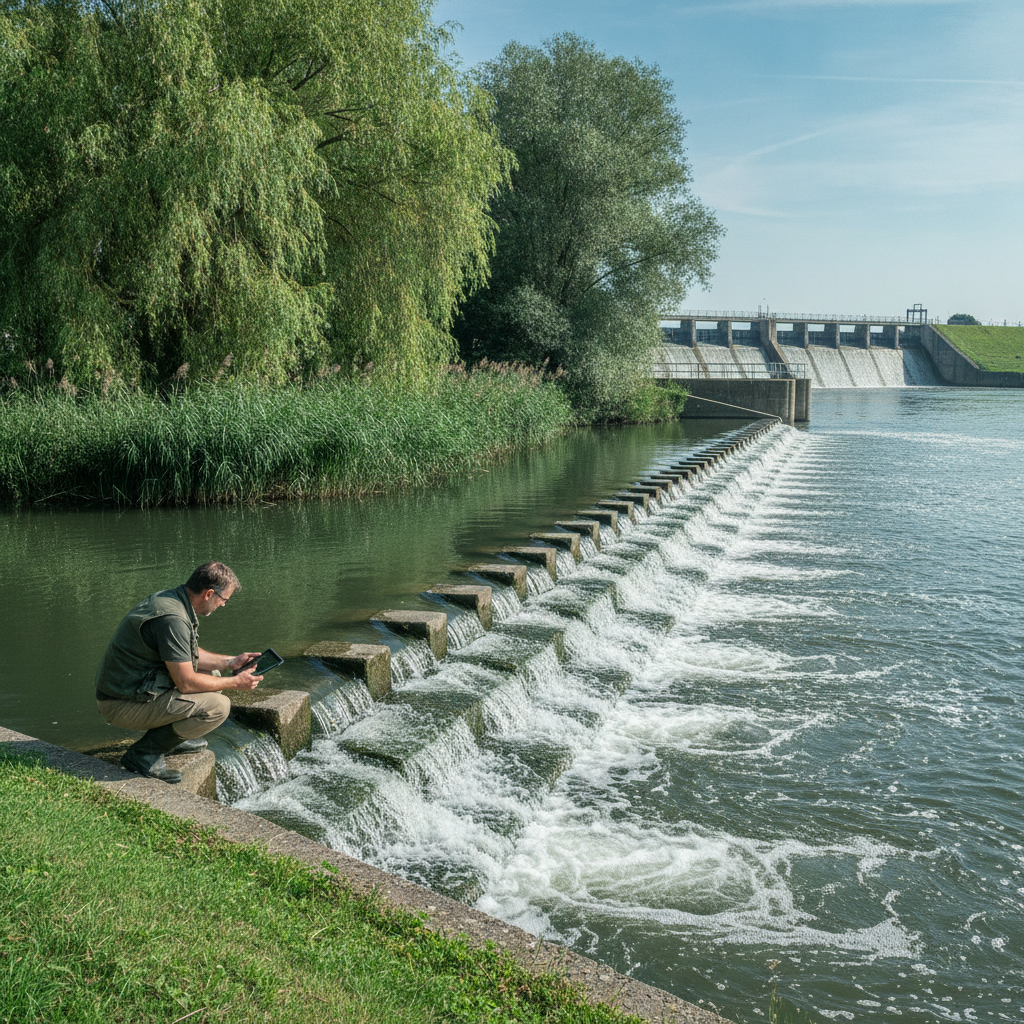
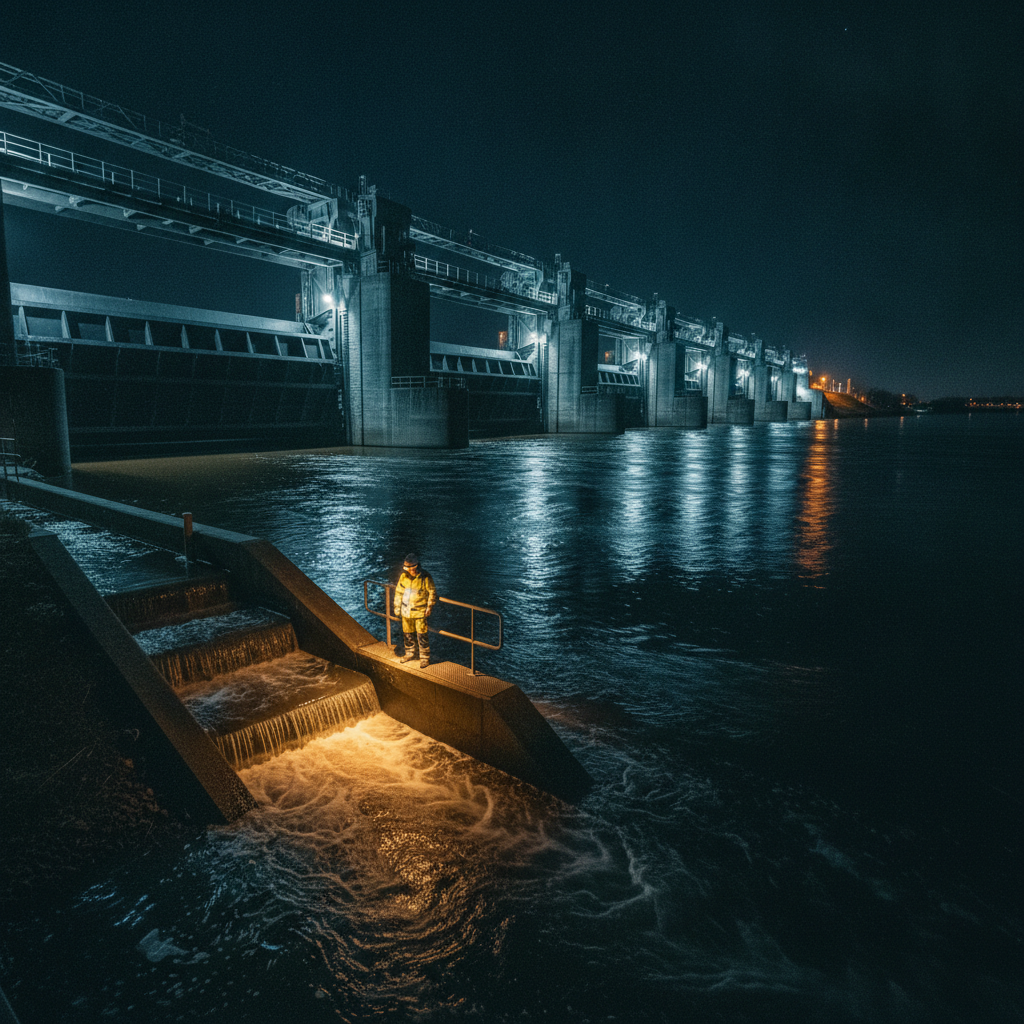
On 9 July 2026, Rijkswaterstaat awarded a €13 million contract to contractor Ploegam: renovate seven existing fish passages along the Meuse and build a second fish passage at the Lith weir. It is the eighth ecological restoration contract Rijkswaterstaat has tendered under the banner of the Water Framework Directive. The news barely made the regional pages: a fish ladder is, after all, less spectacular than a high-voltage pylon. Yet that award marks something significant. Behind the fish migration lies a second legal deadline that could hit the Dutch infrastructure sector in the coming years as hard as the nitrogen crisis has done since 2019.
Because in 2027, the Netherlands must meet the objectives of the European Water Framework Directive (WFD). And as things stand, that will not happen for many water bodies. For the stakeholder manager who has spent recent years learning to live with nitrogen, the question is not whether the WFD will affect their projects, but when, and whether they can carry the lessons of one dossier across to the other. This comparison lays the two regimes side by side.
Regime A: nitrogen, the deadline with no year
The sector now knows the nitrogen regime from the inside. Its core is the Nature Conservation Act and the European Habitats Directive: an activity that increases nitrogen deposition on an already overburdened Natura 2000 site requires a nature permit, and that permit only holds up if the adverse effects on nature are excluded or compensated. Anyone who fails to substantiate that watertight runs into the administrative court.
That is precisely what the sector feels in practice. The annulment of the Ring Utrecht route decision in April 2026 was not about a threshold value, but about the substantiation of the nitrogen calculation. The nitrogen package the government presented in June 2026, with a mathematical lower threshold from late 2027 at the latest, helps small interventions, but not the construction phase of a bridge, tunnel or 380 kV connection, which deposits far above any threshold.
What is peculiar about nitrogen is that there is no hard end date. The deadline is diffuse: every permit application, every route decision is its own moment at which a court can intervene. That makes the regime erratic and reactive. There is no clock counting down to a single day; there is a permanent legal uncertainty that has to be removed afresh for each project.
Regime B: the Water Framework Directive, the deadline with a year
The WFD works in a fundamentally different way. This European directive from 2000 obliges member states to bring all their water bodies (rivers, lakes, coastal and groundwater) into good ecological and chemical status. There have been three planning cycles to achieve this, with extensions running to 2027 at the latest. After that year, the option to invoke exemption grounds lapses in principle: member states will have had more than a quarter of a century.
The task is not solely chemical (nutrients, plant protection products, industrial discharges) but also physical. A water body only scores well when fish can migrate through it unhindered, when banks are naturally designed and when streams meander rather than run canalised. Hence the fish passages at Lith: a weir is a physical barrier, and the WFD forces Rijkswaterstaat to make that barrier passable. Rijkswaterstaat reported earlier in 2026 that the counter for the Meuse stands at 83 percent of the WFD measures: well advanced, but the final percentages are often the hardest.
The sanction is more concrete than with nitrogen. If the Netherlands fails to meet the objectives, the European Commission can launch an infringement procedure, with penalty payments that can run to over two hundred thousand euros per day and fines in the order of tens of millions. More important for the infrastructure sector is the national knock-on effect: a water body that does not meet the WFD makes it harder to grant water permits for projects that put water quality under further pressure. That is the parallel with nitrogen the sector cannot afford to miss: the risk shifts from a fine in Brussels to a permit that stays on the shelf here.
The comparison on four points
1. Legal force and enforcement. Nitrogen has no end date but a permanent test: the court intervenes already, project by project. The WFD does have an end date, but sharp enforcement only begins after 2027, when the exemption grounds fall away. Nitrogen is an acute present; the WFD is an approaching, still-underestimated moment. That difference tempts people to postpone, and that is exactly the trap.
2. The spatial claim. Nitrogen is essentially a mathematical and atmospheric problem: it concerns deposition and emission, invisible flows. The WFD is physical and spatial. A fish passage, a nature-friendly bank, a re-meandering: these are interventions that require land, space and sometimes land acquisition. Where nitrogen can block a project, the WFD calls for projects that themselves take up space. For the stakeholder manager that means: not only removing an obstacle, but fitting a new physical intervention into the landscape.
3. The stakeholder field. With nitrogen, the conversation broadly revolves around farmers and nature organisations. With the WFD, the circle is broader and different in composition: water authorities as co-competent authorities, agriculture because of nutrient and pesticide run-off, drinking water companies worried about their sources, professional and recreational fisheries, recreational boating, and nature managers. These stakeholders sit partly at different tables than with nitrogen, which means a stakeholder manager has to rebuild their network, not recycle it.
4. Predictability. This is the sharpest contrast. Nitrogen took the sector by surprise in 2019 like a legal earthquake and forced reactive crisis management. The WFD deadline, by contrast, has been on the agenda since 2000. It is not a surprise: it is an announcement. That is an opportunity nitrogen never offered: the time to do the area-based process well before the deadline rather than rushing through it.
What one dossier teaches the other
Lay both regimes side by side and the conclusion is uncomfortable but clear: the WFD is more predictable than nitrogen, yet the infrastructure sector still treats it as a technical checklist of measures rather than a stakeholder challenge. That is the same mistake that cost years with nitrogen. The fish passages at Lith are no engineering feat: the complexity lies in the permits, the fluctuating river discharge, the coordination with shipping at the lock, and local support for work in and along the water.
Three lessons from the nitrogen dossier transfer directly. First: do not treat the deadline as grounds for delay. Anyone who waits until 2027 to schedule the final WFD measures is doing the same as those who, with nitrogen, waited until the court had spoken. Second: treat the ecological restoration as an area-based process, not a stand-alone contract. A fish passage or nature-friendly bank affects landowners, water authorities and river users: start that conversation before the design is fixed, not after. Third: make the water quality task part of the design of every water project, just as nitrogen has become part of every construction project. A bridge or weir renovation that takes the WFD task along is cheaper and more durable than an intervention that has to repair it later.
Nitrogen taught the sector the hard way that a European directive is not an abstraction but a permitting reality. The Water Framework Directive offers the chance to apply that lesson on time, just once. The clock is ticking, but this time we know what hour it is.
Sources
- Rijkswaterstaat - Renovation and construction of Meuse fish passages awarded to Ploegam
- Infrasite - Ploegam awarded €13 million WFD contract for Meuse fish passages
- Europa decentraal - Progress on the Water Framework Directive in the Netherlands
- Rijkswaterstaat - Implementation of the Water Framework Directive
- Rijkswaterstaat - WFD Meuse: ‘The counter stands at 83 percent’