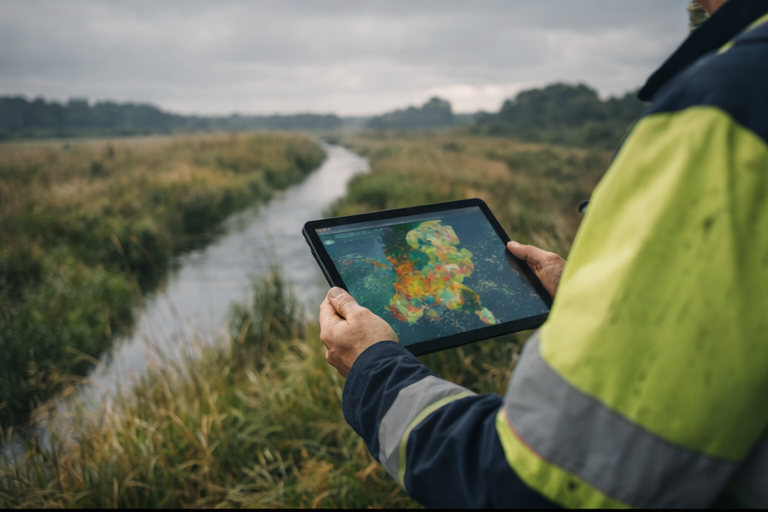
Nitrogen regulations in the Netherlands have a major impact on infrastructure projects. Almost every large project, from road widening to underground cable routes, will eventually face the question: what is the nitrogen impact on nearby Natura 2000 areas? In this article, we share our practical experience and provide a hands-on guide for project teams.
Why nitrogen is so complex
The Netherlands has a dense network of protected nature areas. Many infrastructure projects lie within or near the sphere of influence of these areas. The combination of strict European legislation (Habitats Directive) and the Dutch system of critical deposition values means that even relatively small projects may require an extensive nitrogen assessment.
The core of the problem: nitrogen-sensitive habitats are becoming overloaded by the cumulative deposition of nitrogen from traffic, industry and agriculture. A new project may not, in principle, make a significant contribution to this, and demonstrating this requires a tailored approach.
Step 1: start early in the process
A common mistake is engaging a nitrogen specialist too late. When a project is already in the implementation phase and no permit turns out to exist for the nitrogen emissions, the consequences are severe: delays, legal proceedings and costly modifications.
At Innovom, we advise conducting a preliminary assessment as early as the exploration phase. This allows you to identify risks early and, if necessary, adapt the project design accordingly.
Step 2: using AERIUS Calculator correctly
AERIUS Calculator is the legally required calculation tool for nitrogen depositions in the Netherlands. Applying it correctly requires specific knowledge:
- Source data: emission factors for construction equipment, traffic movements and temporary installations must be entered accurately.
- Construction phase vs. operational phase: both phases must be assessed separately. The construction phase is often more intensive but shorter; the operational phase is lower but structural.
- Offsetting and internal offsetting: in some cases, nitrogen space can be freed up by withdrawing old permits or optimising operations.
Step 3: integrated assessment and permitting strategy
A nitrogen calculation rarely stands alone. It forms part of a broader permitting procedure, such as an environmental permit or a project decision under the Environment and Planning Act. It is essential to integrate the nitrogen assessment into the broader environmental substantiation of the project.
Innovom guides clients in preparing the full permitting documentation, conducting pre-consultation with competent authorities and, if necessary, handling objection and appeal procedures.
What practice has taught us
After dozens of projects in which nitrogen played a role, a number of lessons keep coming back:
- Communicate early with the competent authority. Much uncertainty about the scope of the assessment can be resolved in an early pre-consultation.
- Document every assumption. Calculation methods and input data are intensively scrutinised in objection and appeal proceedings. Transparency is crucial.
- Think in alternatives. Sometimes a small adjustment to the route or planning is enough to stay outside the sphere of influence of a vulnerable area.
Conclusion
Nitrogen deposition is a challenge that isn’t going away, but with the right approach and timely expertise, it is very manageable. Innovom helps project teams navigate complex regulations, from initial exploration to final permit.
Do you have questions about a specific project? Feel free to contact us.