
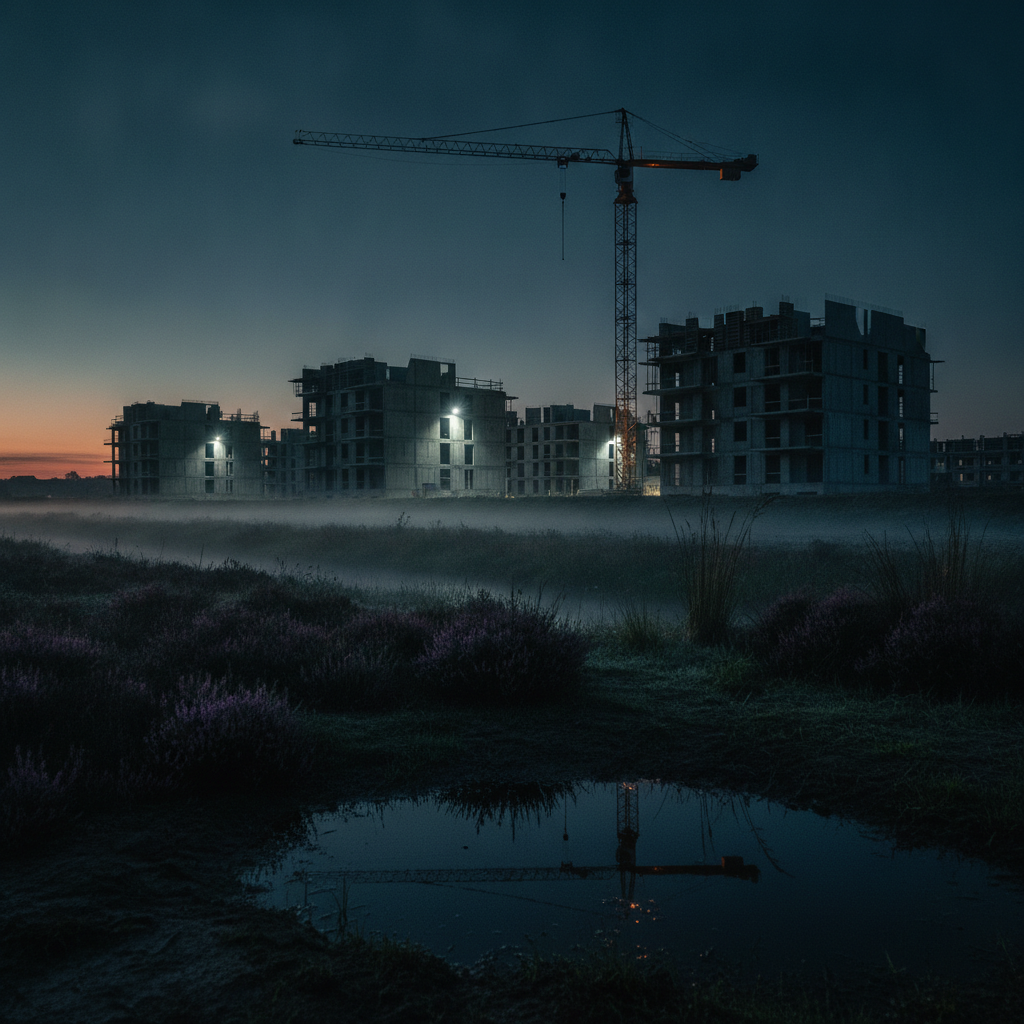
A permit that lapses is not yet a bridge that gets built. That distinction is at risk of disappearing in the optimism surrounding the nitrogen package the Dutch government presented on 26 June 2026. The message was grand: the Netherlands is coming “off the nitrogen deadlock”, with room again for farmers, nature and construction. To anyone who wrestles with permits daily, that sounds like deliverance. But whoever reads the package as the end of the environmental work around infrastructure projects is mistaken. The package moves the brake; it does not remove it.
What has been announced
The core of the package is the announcement of an arithmetic floor (in Dutch, rekenkundige ondergrens, RKO): a legally defensible threshold below which activities with nitrogen deposition no longer require a nature permit. The government intends to introduce it by the fourth quarter of 2027 at the latest, and explicitly ties a prospect to it for housing, infrastructure and the energy transition. Around that sits a broader structure: targets at the farm level, a norm for a better balance between livestock and land, additional measures in the areas where nature is under the greatest pressure, and investment in nature restoration. In total, the government is earmarking some twenty billion euros for nitrogen reduction and nature towards 2035.
The direction is defensible and, in places, even sensible. Nature organisations called the package “finally hope for nature”; industry bodies in transport and construction spoke of a “clear course” that still needs elaboration. That last point is the heart of our objection. The course is clear; the delivery, and the environment in which that delivery must land, is anything but.
Why the floor does not save the major works
The arithmetic floor helps precisely the projects that needed help least. A dormer window, a heat pump, a small business extension: these will fall below the threshold and be freed from the permit requirement. That is a gain, and not a small one.
But the renewal agenda this country faces (the replacement of bridges, tunnels and locks, the construction of 380kV connections, the landing of offshore wind, large-scale housing sites) consists of works that, during construction, cause nitrogen deposition far above any workable floor. Running diesel cranes, pile drivers, thousands of lorry movements, years of construction logistics next to vulnerable Natura 2000 areas: for those projects the permit requirement does not change. The floor is a threshold for the small cases, not an escape for the large ones. It is exactly the projects that are supposed to be the engine of the package that remain subject to permitting.
And for those projects, the permit has never been the only brake. The ruling with which the Council of State quashed the route decision for the Ring Utrecht motorway in April 2026 was not about a missing threshold but about an underpinning that did not hold up. Speed without a sound ecological basis and without public support fails at the administrative court, floor or no floor.
The hidden dependency: no nature restoration, no defensible threshold
Here is the point that gets buried in the euphoria. An arithmetic floor is legally defensible only as long as it is plausible that nature in the areas concerned is actually improving. A threshold that grants exemptions while conservation objectives slip further out of reach will not survive judicial review: that is the whole lesson of ten years of nitrogen case law. The promise of “permit-free construction below the threshold” therefore rests entirely on the promise of nature restoration above it.
And nature restoration is not a matter of transferring money. The twenty billion has to land in areas where farmers will keep fewer animals, where land changes function, where hydrology is restored and where residents and businesses ask what it means for them. That is, from start to finish, an environmental and stakeholder challenge. If that area-based process fails to get off the ground, and the troubled history of earlier area programmes is not reassuring, the nature gains fail to materialise, and the legal ground beneath the floor gives way. The construction sector’s permit exemption is, in other words, borrowed from public support in the rural areas. Whoever wants the first must invest in the second.
The counter-argument, taken seriously
The sharpest objection to this position runs: this is exactly what construction has asked for over the years (fewer procedures, more pace) and now the environmental manager complains that it is becoming too easy. That deserves an honest answer.
Yes, for the broad middle ground of small interventions this is real progress, and it would be nonsense to wave it away. But we have no interest in preserving complexity; we have an interest in projects that go ahead and stay standing. A floor that is struck down at the Council of State in 2028 because the promised nature restoration was not delivered sets construction back further than where it stands now, with a lost year of false certainty on top. The greatest threat to pace is not the environmental manager who asks for public support. It is the assumption that public support has become superfluous.
What this means in practice
For everyone driving the major works, three sober consequences follow from this package.
Do not count on the floor for your major project. Keep designing out construction-phase deposition, keep organising offset capacity and low-emission equipment, and keep treating the nature assessment as a watertight underpinning. For the renewal agenda, little changes legally; those who relax now will run aground later.
Use the freed-up room to do the area-based process better, not to skip it. Where permitting pressure falls away for smaller components, time and attention are created. Invest that in early participation, in taking desiccation and disruption seriously, in explaining choices: precisely the things that keep a project standing once the procedure is no longer the automatic lightning rod.
Treat nature restoration as the load-bearing environmental challenge, not a side issue. The success of the entire package, and with it the durability of every threshold construction is counting on, depends on whether the area-based process with farmers, landowners and nature managers succeeds. That is not an agricultural file far removed from infrastructure. It is the foundation beneath it.
The nitrogen package is not an endpoint but a shift. It moves the bottleneck from the permitting desk to the area: to public support, delivery and restoration. That is precisely the terrain on which stakeholder and environmental management proves its worth. The legal brake comes off; the real work only begins.
Sources
- Rijksoverheid - Government takes the Netherlands off the nitrogen deadlock with a robust package
- Natuur & Milieu - New nitrogen package finally offers hope for nature
- TLN - Government presents nitrogen package: clear course, further elaboration needed
- PONT Omgeving - Government announces integrated approach to agriculture, nature and nitrogen