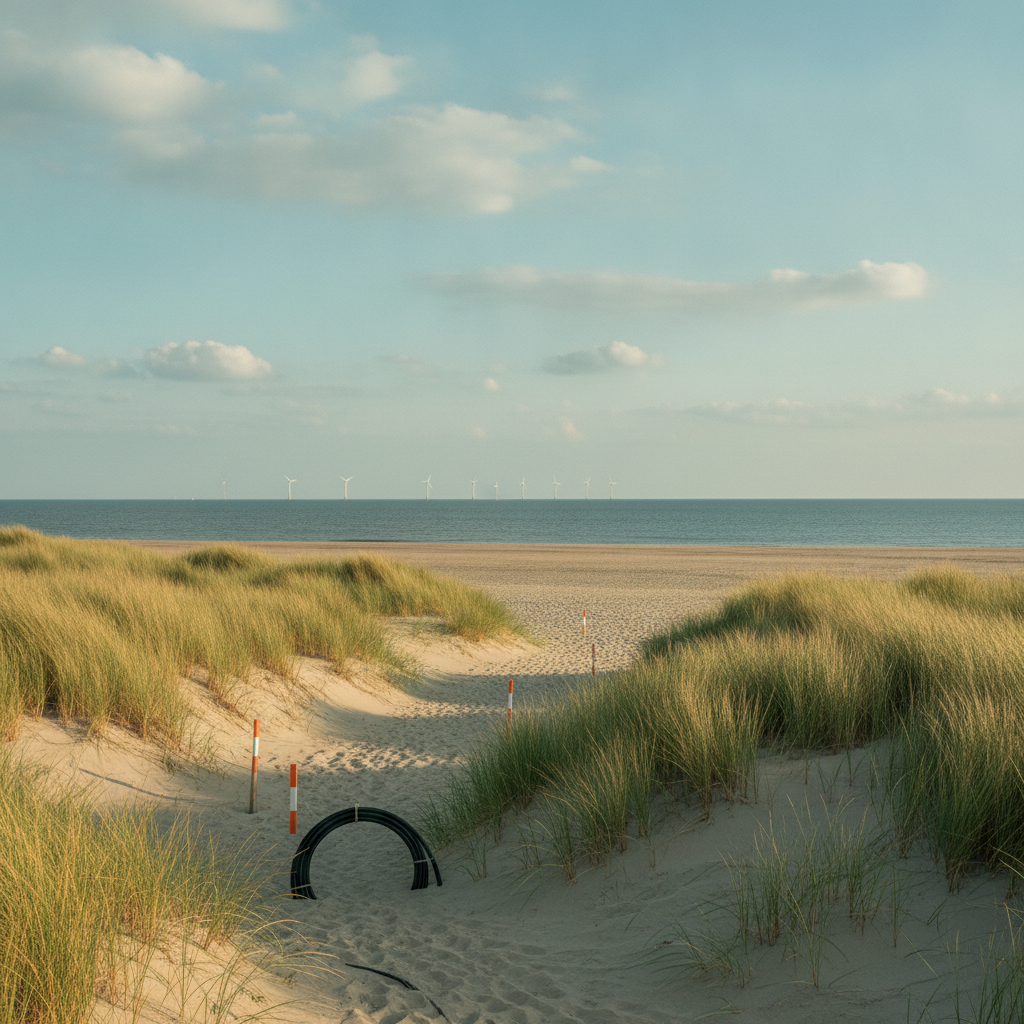
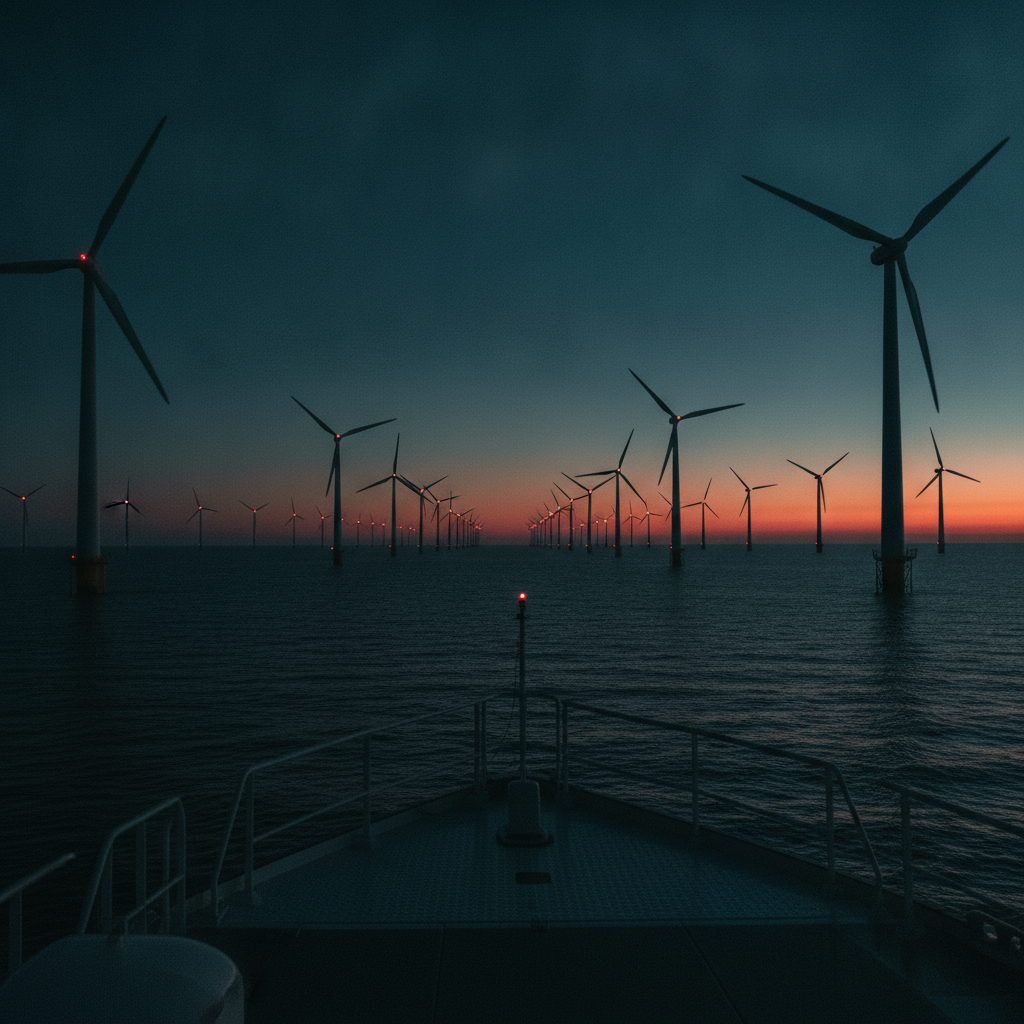
From 22 May to 2 July 2026, the draft programme Connections for Landing Offshore Wind (VAWOZ) 2031-2040 is open for public review. It is a document that barely registers in the national press, yet for five coastal regions it is decisive for the coming decade. VAWOZ answers one seemingly technical question: along which routes and at which locations will the power from future North Sea wind farms be brought ashore? Behind that question lies a stakeholder and environmental challenge that deserves the attention the underground cable route itself does not get.
The logic is familiar. Dutch ambitions for offshore wind are growing towards tens of gigawatts by 2040. That power has to come ashore somewhere, through thick underground cables that run inland from the beach or dunes to a converter station, and from there onto the high-voltage grid. Every landing point means a cable corridor through farmland, nature or built-up areas, and a substantial converter station at a new location. It is precisely at that point, where the offshore infrastructure meets the land, that stakeholder management begins.
A programme that lands in five regions at once
VAWOZ examines landing points in five regions: North Holland (from Julianadorp to IJmuiden and Velsen-Noord), South Holland (including Wateringen, Simonshaven and the Europoort), Zeeland (the Sloe area near Borssele and Zeeland Flanders near Terneuzen), North Brabant (Moerdijk) and the northern Netherlands (the routes towards the Eemshaven). The draft programme contains preferred alternatives, but explicitly only for the electrical landing points; the hydrogen routes have been paused until after 2030.
The fact that the programme plays out in several regions simultaneously is not a detail. It means that the same national decision-making lands in five completely different local contexts. A cable corridor through Zeeland Flanders touches different interests than a landing in urbanised North Holland or a route towards the Eemshaven. The national government runs a single programme; the local community experiences five very different projects. For grid operator TenneT and the Ministry of Climate and Green Growth, that is a coordination problem: how do you hold a consistent national line without overruling regional identity?
The burden that accumulates in a single region
In some regions the challenges pile up. Zeeland is the sharpest example. The Sloe area and Zeeland Flanders are already heavily burdened with industry, high-voltage lines, pipelines and earlier landing points. For residents and administrators there, a new landing does not feel like a stand-alone project but like yet another claim on the same space. The province of Zeeland has therefore previously drawn up its own regional advice on where new landing points do and do not fit.
This is precisely the core of stakeholder management within VAWOZ: support for an individual route is not determined by that route alone, but by the cumulative burden a region already carries. A landing that would meet hardly any resistance in an unburdened area can be the tipping point in a saturated region. Anyone who judges the programme purely cable by cable misses that. The question “can this connection go here?” must be asked as “can this region take on yet another challenge?”.
The converter station is the real spatial intervention
In communications, the emphasis is often on the cables. But underground cables are largely invisible once laid; the real, lasting spatial intervention is the converter station. It is an industrial complex of considerable size that lands somewhere in the landscape, often in an agricultural or peri-urban area that had not counted on it. Noise, visual impact, magnetic fields and the value of surrounding property then become the themes around which the debate concentrates.
For environmental managers this means that the siting of the converter station must be guided at least as carefully as the cable route. It is tempting to treat the station’s location as a derived technical optimisation: as close as possible to the existing grid, with the shortest possible cable. But for the immediate surroundings, the station is the project. A choice that is logical on the drawing board can, locally, make the difference between acceptance and years of legal conflict.
Nature as a hard constraint, not an afterthought
The landing points touch protected nature on almost every route: the coastal zone, the Wadden Sea on the northern routes, Natura 2000 areas inland. The draft programme explicitly defers the detailed ecological assessment to the later project procedures. That is procedurally defensible, but it carries a risk: if the nature assessment only becomes truly rigorous after the route is chosen, a selected preferred alternative may still founder later on an appropriate assessment or a nitrogen bottleneck.
The lesson from earlier infrastructure projects is unforgiving here. Routes that were insufficiently substantiated ecologically failed at the administrative court, with years of delay as a result. For VAWOZ this means the nature challenge must be carried as a hard constraint not in the project phase, but already in the programmatic weighing of options. Otherwise the problem merely moves forward in time, to a moment when reversing course is far more expensive.
The consultation phase: steer now or pay later
The window open until 2 July is not a formality. It is the moment when residents, businesses, municipalities and provinces can submit their views before the cabinet finalises the programme at the end of 2026. After that, TenneT starts the project procedures per connection, in which the chosen routes are worked out in detail. Anyone who only swings into action in that later phase is negotiating over a choice that has, in essence, already been made.
That is exactly where it pinches. A public review with information evenings is, formally speaking, participation. But the distance between “you can respond to a national programme with preferred alternatives” and “you have a say over what is coming to your neighbourhood” is large. For most local residents, a programme document running to hundreds of pages is not an invitation but a barrier. The art of stakeholder management in this phase is to bridge that distance: to translate the abstract programme into what it concretely means for a specific area, and to explain to people in good time that this is the moment when steering still pays off.
Conclusion: landing is a stakeholder challenge, not a connection question
It is tempting to read VAWOZ as a technical-logistical problem: how many gigawatts, which cable, which station, the shortest route to the grid. But the real complexity does not lie in the technology; that is largely mature. It lies in the question of whether five regions are willing to bear the challenge, whether the cumulative burden is shared fairly, whether the converter station gets a location the community can accept, and whether the nature assessment is made rigorous in time rather than postponed.
The offshore energy transition stands or falls with the landing on land. And the landing on land stands or falls with the quality of stakeholder management in precisely this phase, now, while the choices are still open and the views still count. Anyone who underestimates that will discover, a few years from now at the administrative court, what it costs to force through a landing that never truly landed with the people around it.