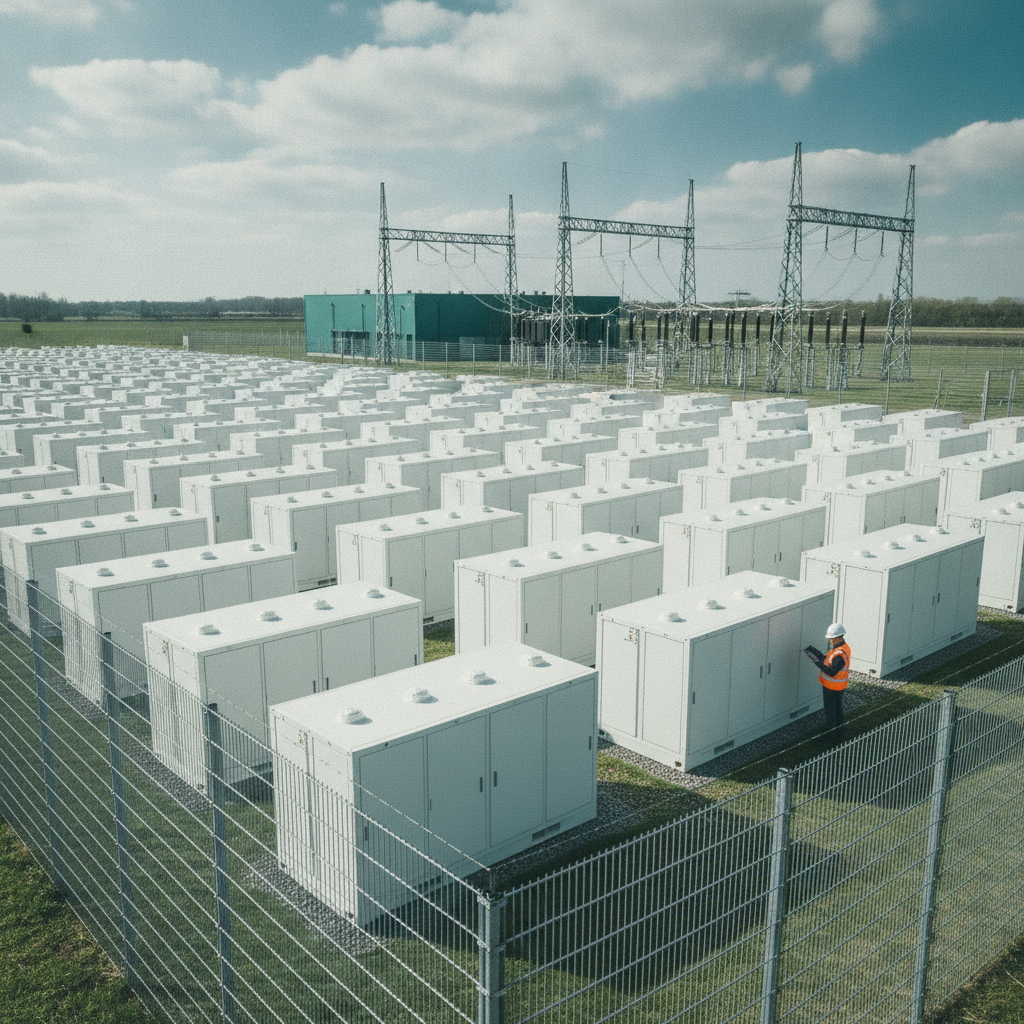
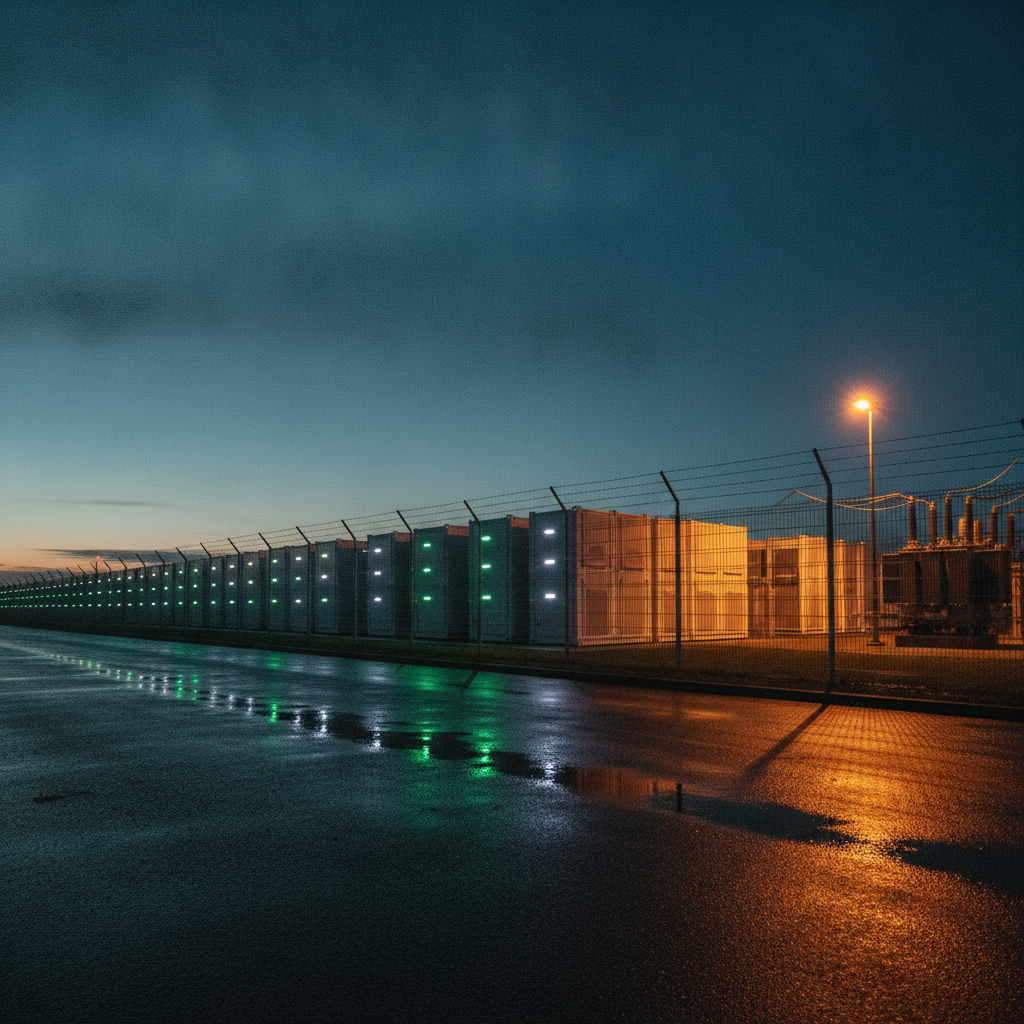
On the edge of an industrial estate near Oosterhout, an installation is rising over the next two years that you could easily miss from the road: rows of white, container-like cabinets behind a fence, with a transformer station beside them. Yet Sequoia (200 megawatts of power, 800 megawatt-hours of storage, built by Green Energy Storage) is one of the most important building blocks of the Dutch electricity grid for the coming decade. The battery stores surplus power during production peaks and releases it again when demand is high, freeing up space on a grid that is completely full across large parts of the country.
On 10 June 2026, TenneT, together with Energy Storage NL, delivered a message that underlines the urgency: large-scale batteries are becoming ever more important for relieving the grid, but on their own they are not enough to prevent the power shortages that could rise rapidly from 2030 onwards. TenneT now counts on roughly 6.7 gigawatts of battery capacity by 2030. That means dozens of Sequoias, spread across the country. And each of them has to stand somewhere: beside a village, an industrial estate, or out in the countryside. That makes large-scale battery storage no longer merely a technical or contractual matter, but a stakeholder and environmental challenge.
What Sequoia actually does
Sequoia is notable because it is the first battery TenneT is contracting as a targeted congestion reliever. The arrangement combines two instruments: a time-bound transport right (TDTR), under which the battery only uses grid capacity at moments the network allows, and a capacity-steering contract (CSC), with which TenneT can control charging and discharging. During a production peak (plenty of sun, little demand) the battery charges instead of loading the grid further; during scarcity it feeds back. The result is that physical space frees up on the network for other parties on the waiting list, without a new high-voltage connection having to be built.
This fits the ACM prioritisation framework that grid operators have been permitted to apply since 2026: solutions that relieve the grid, such as large batteries and flexible generation, get priority for connection. For the grid operator, then, a battery is not an ordinary customer but an instrument. Sequoia is expected to be operational in 2027.
The bottleneck shifts to the location
Here lies the paradox that matters for the stakeholder manager: the battery meant to save the grid relocates the problem. Grid capacity is no longer the bottleneck: the question becomes where such an installation may go, and whether the surrounding community accepts it.
Three issues decide that. The first is safety. Lithium-ion batteries carry a small but real risk of thermal runaway: an uncontrollable, self-sustaining fire that is hard to extinguish. A recent guideline, PGS 37-1, sets requirements for fire prevention, early detection and safe distances to buildings. For local residents this is often the first and hardest question: what happens if that thing catches fire? A stakeholder manager without a clear, honest answer to it, including the role of the safety region and the fire service, loses the conversation before it ever reaches energy.
The second is regulation lagging behind practice. The national anchoring of energy storage systems in the Environmental Activities Decree (Bal) has been postponed; experts reckon on entry into force around 1 July 2027. Until then the picture is fragmented: municipalities may set their own rules in their environmental plan and sometimes impose a permit requirement, and provinces such as Flevoland have developed their own assessment framework in which the environmental service, safety region and fire service have a say. For a developer that means no national recipe, but a bespoke administrative and legal process per location.
The third is public support, and that varies strongly by place. On an existing industrial estate a battery park is generally accepted reasonably well; in the countryside, between homes and landscape, resistance is far greater. Sequoia’s choice of an industrial estate is, in that light, no accident but stakeholder management: choosing the least contentious location saves years of procedure.
Stakeholder management decides between 2027 and 2032
What distinguishes a battery project that runs in 2027 from one that gets stuck in objection procedures? Rarely the technology; almost always the process around it. Three things prove decisive in practice.
First: involve the safety chain early, not as an afterthought. The fire service, safety region and environmental service are not parties you have sign off on a permit at the end, but partners who help shape the site layout, the fire-water supply and the distances. Bringing them to the table early prevents costly redesigns and simultaneously builds credibility towards residents.
Second: make safety the first subject of resident communication, not the awkward topic you avoid. Fear of fire is legitimate and cannot be wiped away with the message that a battery “makes space on the grid”. Explain what measures PGS 37 prescribes, what the fire service does, and be honest about what is and isn’t possible. Transparency about risks builds more trust than reassurance.
Third: give the community a stake. Financial participation (a residents’ scheme, an area fund, local ownership) turns the battery from something that happens to the neighbourhood into something the neighbourhood shares in. For wind turbines and solar parks this is now established practice; for battery storage it is still in its infancy, while the effect on public support is at least as great.
Outlook: from one battery to a nationwide task
Sequoia is the beginning. If TenneT does indeed need nearly seven gigawatts of batteries towards 2030, dozens of projects like this will be added in the coming years, and the debate over location, safety and public support will repeat itself in as many municipalities. The technology is largely proven; the contract forms such as TDTR and CSC are worked out; the ACM framework gives batteries priority. What remains is whether the community moves with it.
That makes battery storage a textbook example of the shifting nature of stakeholder management in the energy transition. Each time a technical or regulatory bottleneck is solved, the next one appears on the stakeholder manager’s desk: not whether it can be done, but whether it is allowed somewhere and who will support it. The battery that relieves the grid ultimately depends just as much on a successful area process as on a successful charge cycle.
Sources
- Energy Storage NL - TenneT: batteries increasingly important, but not enough to prevent future power shortages (10 June 2026)
- TenneT - Contract with Green Energy Storage for a large battery that frees up space on the grid in Brabant
- Greenwaste - PGS 37: new rules for the safe storage of batteries (in Dutch)
- Province of Flevoland - Assessment framework for large-scale battery storage (in Dutch)