Following the COB Tunnel Day 2026
On 5 February, the COB Tunnel Day 2026 took place at the ECC in Leiden — the annual gathering of the Dutch tunnel community. Alongside the launch of the new tunnel programme 2026–2031, with development tracks including Maintenance, Renovation, New Build, Civil & Science and Sustainability, there was notable attention for a theme that traditionally falls outside the domain of tunnel builders: the energy transition. TenneT, the national high-voltage grid operator, was prominently present to learn lessons from the tunnel construction sector. Unsurprisingly, as the grid operator faces one of its most complex challenges: constructing a 380 kV high-voltage connection beneath the Western Scheldt. A project for which the expertise of tunnel builders is indispensable — and for which the tunnel sector in turn sees an entirely new type of client emerging.
This article explores the technical feasibility of a cable and pipeline tunnel beneath the Western Scheldt, the options for the cross-section and the landing possibilities.
The energy transition presents Zeeland with a remarkable infrastructural challenge. To decarbonise industry in the Zeeland-Flanders canal zone, a new 380 kV high-voltage connection between Zuid-Beveland and Terneuzen is necessary. This connection must cross the Western Scheldt — an estuary with strong currents, a dynamic seabed and intensive shipping traffic. At the same time, demand is growing for underground transport of hydrogen, ammonia and CO₂ for the industrial clusters around North Sea Port. The question arises: is a cable and pipeline tunnel beneath the Western Scheldt feasible?
Why a tunnel?
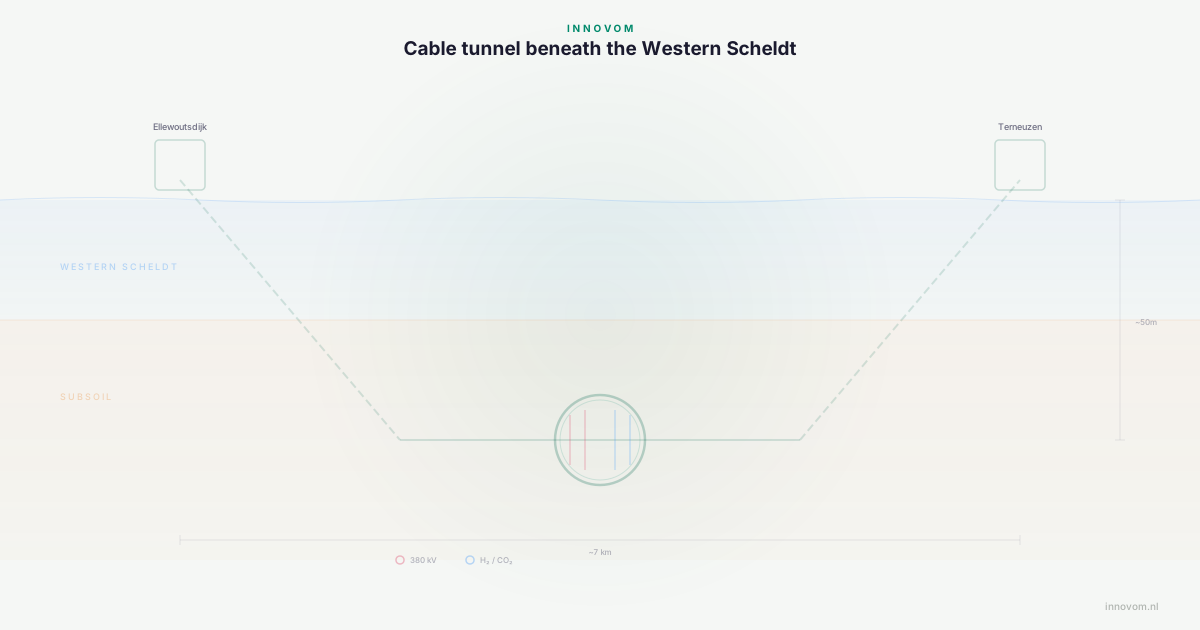
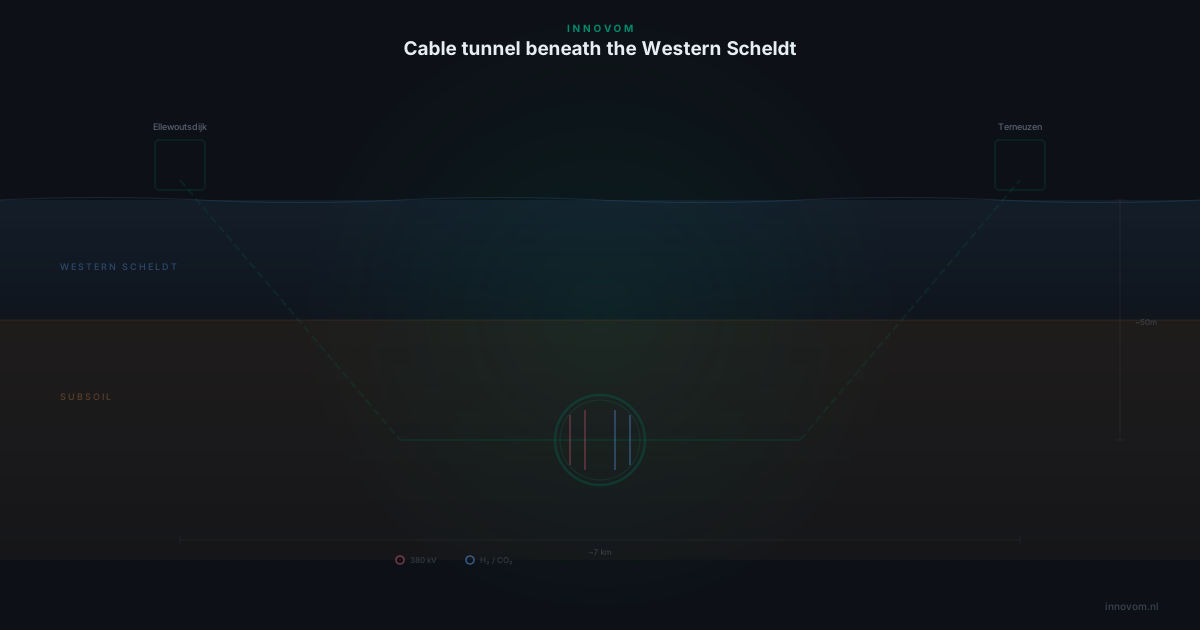
At its narrowest point near Ellewoutsdijk, the Western Scheldt is approximately seven kilometres wide. The water reaches depths of up to 50 metres in the Pas van Terneuzen, with an extremely dynamic seabed that shows variations of several metres in bed level over periods of a few decades. Laying cables directly in the riverbed is therefore risky: they can become exposed through erosion or become inaccessible for maintenance due to sedimentation.
An overhead crossing with high-voltage pylons would require towers of approximately 220 metres in height to allow shipping to pass. For comparison: that is over twice the height of the Lange Jan tower in Middelburg. Both the municipality of Borsele and the municipality of Terneuzen have spoken out against overhead crossing options. Rijkswaterstaat (the national infrastructure agency) and the Pilotage Service have also raised objections due to the effects on shipping safety.
A tunnel offers an attractive alternative: no visual impact on the landscape, no obstruction to shipping, protection of cables and pipelines against external influences, and — if well designed — the possibility of bundling multiple modalities.
The MUK study: lessons from the feasibility analysis
In 2023, the Dutch ministries of Economic Affairs and Climate (EZK) and Infrastructure and Water Management (I&W) published an extensive technical feasibility study into a Multi-Utility Crossing (MUK) beneath the Western Scheldt. The idea was ambitious: a single tunnel combining both a 380 kV high-voltage connection and pipelines for ammonia, hydrogen and CO₂.
The conclusion was clear: that combination is not an option. Studies into heat generation, electromagnetic compatibility (EMC), occupational safety and external safety showed that combining high-voltage cables with pipelines for hazardous substances in a single tunnel tube creates too many conflicting safety requirements.
Specifically, the following bottlenecks proved decisive:
Heat generation. High-voltage cables of 380 kV generate considerable heat. In an enclosed tunnel environment, dissipating this heat is critical. When the ambient temperature in the tunnel rises too high, the transmission capacity of the cables decreases and risks arise for nearby pipelines carrying flammable or toxic substances.
Electromagnetic radiation. The strong electromagnetic fields around 380 kV cables can interfere with control systems and measuring equipment of pipelines. Shielding is possible but requires substantial additional structural provisions that significantly increase the tunnel cross-section and costs.
External safety. Combining an electricity source (with fire risk from cable faults) with pipelines for ammonia (highly toxic) or hydrogen (highly flammable and explosive) creates escalation scenarios that are difficult to manage in an enclosed tunnel environment. Escape routes and intervention options are limited.
Occupational safety. Maintenance on high-voltage cables requires different safety zones and protocols than maintenance on pipelines carrying hazardous substances. Working simultaneously in the same tunnel space is extremely complex from a health and safety legislation perspective.
The MUK study led to a significant change of course: further exploration focuses on separate tunnels — one or more tubes exclusively for high voltage, and a separate tunnel option for bundling pipelines.
Cross-section options
The cross-section of a cable and pipeline tunnel is determined by its function, construction method and safety requirements. Broadly speaking, three main variants are conceivable.
Bored tunnel with circular profile. This is the most obvious option, given Zeeland’s experience with the existing Western Scheldt Tunnel. A tunnel boring machine (TBM) produces a circular tube lined with prefabricated concrete segments. The existing road tunnel has an internal diameter of approximately 11 metres. A cable tunnel could be considerably smaller: for a 380 kV connection with two circuits, an internal diameter of 4 to 6 metres is realistic, depending on ventilation provisions and maintenance access. The circular profile is structurally efficient under the high water pressures occurring at 50 metres depth, and the boring technique is proven in Zeeland’s subsoil of sand and clay.
Immersed tunnel with rectangular profile. In this method, tunnel elements are built in a dry dock, floated to the location and sunk into a pre-dredged trench. The rectangular cross-section offers more usable space per square metre of external dimension and enables a logical division into compartments — for example, a separate cable compartment and a pipeline compartment with a partition wall between them. However, the challenge at the Western Scheldt is the great water depth and strong current. When an immersed tunnel was considered for the road connection in the 1970s, the jetting method proved inapplicable at this location. The dynamic seabed also poses a risk to the bed cover of immersed elements.
Horizontal directional drilling (HDD) or microtunnelling. For individual cables or smaller pipelines, horizontal directional drilling can be considered. In this method, a borehole is drilled from a launch shaft beneath the Western Scheldt, after which the cable or pipeline is pulled into the borehole. The maximum diameter for HDD techniques is approximately 1.5 metres; for microtunnelling, this is up to 3.5 metres. The advantage is that no large launch shafts or tunnel boring machines are needed, but the disadvantage is that each pipeline or cable group requires a separate bore, maintainability is limited and the length of the crossing may approach the technical limits of HDD.
For a future-proof solution that offers space for multiple systems and is accessible for maintenance, a bored tunnel with a diameter of 5 to 7 metres appears to be the most promising option. Within such a profile, an internal layout can be created with cable racks, pipeline consoles and a minimum free headroom of 2 metres for maintenance personnel — comparable to the cable duct of the Rotterdamsebaan tunnel in The Hague.
Landing options
The choice of landing point is determined by the width of the Western Scheldt (which determines the tunnel length), the connection options to the existing or future grid, the soil conditions and the available space for a launch or reception shaft.
North side: Ellewoutsdijk – Borssele. The narrowest point of the Western Scheldt, at Ellewoutsdijk, is the logical candidate for the northern landing. Here the crossing distance is approximately 7 kilometres. The existing 380 kV route between Borssele and Rilland lies nearby, enabling a short above-ground or underground connection. The disadvantage is the relatively limited polder space for a launch shaft and the proximity of the Western Scheldt dyke, which creates geotechnical challenges when excavating the shaft.
North side: Hoedekenskerke – Baarland. Slightly further east, the shore at Hoedekenskerke offers more space, but the crossing distance increases to approximately 8 to 9 kilometres. The connection to the high-voltage grid requires a longer onshore route. This option could come into view if the 380 kV route on Zuid-Beveland is connected further east.
South side: Terneuzen – Mosselbanken. The new 380/150 kV high-voltage substation will probably be located in the vicinity of Terneuzen. The Mosselbanken polder, near Dow Chemical, is one of the preferred locations. A landing in this zone connects directly to the new substation. The soil conditions in the Ghent–Terneuzen Canal area are well documented due to earlier large construction projects.
South side: Paulinapolder. The municipality of Terneuzen has expressed a preference for landing at the Mosselbanken with a possible extension to the Paulinapolder. This area offers more space and is further from residential areas, but requires a longer route to the high-voltage substation.
The optimal combination appears to be a tunnel between Ellewoutsdijk and the Mosselbanken/Paulinapolder: the shortest water crossing combined with direct connection to both the existing 380 kV grid on the north side and the new high-voltage substation on the south side.
Costs and planning
The cost estimates from the MUK study provided insight into the order of magnitude. Three variants were estimated: a two-tunnel variant (separate tubes for high voltage and pipelines), a three-tunnel variant and a pipelines-only variant. The costs for a bored cable tunnel beneath the Western Scheldt quickly run into the hundreds of millions to over one billion euros, depending on the number of tubes, the diameter and the complexity of the landing structures.
TenneT expects a preferred decision on the crossing method and route in 2026. The connection should be ready by 2034. Given the lead times for permit procedures, environmental impact assessments and actual construction, this is an ambitious but not impossible schedule — provided decision-making is not further delayed.
Comparison with other tunnel projects
The Netherlands has relevant experience with comparable projects. The existing Western Scheldt Tunnel (6.6 km, two tubes, 11 m diameter) proved that boring in Zeeland’s complex subsoil is possible, albeit with considerable technical challenges — the deepest point lay 60 metres below water level. For the Wadden Sea, a 27-kilometre tunnel is being studied for landing cables and hydrogen pipelines from offshore wind farms. And the Rotterdamsebaan in The Hague demonstrated that an integrated cable duct within a tunnel functions well for protecting and maintaining cables and pipelines.
TenneT and the tunnel sector: a new partnership
TenneT’s presence at the COB Tunnel Day underscores an important shift. The energy transition is forcing grid operators to step beyond their traditional expertise. Building overhead high-voltage pylons is core business for TenneT — building tunnels is not. At the same time, the Dutch tunnel sector has built up decades of experience with precisely the type of projects now needed: bored tunnels in soft ground under deep water, in a complex environment with strict safety requirements.
The COB network offers an ideal platform for this. The new tunnel programme 2026–2031 explicitly focuses on new construction and knowledge sharing, including actively engaging new types of clients. The New Build development track focuses on building knowledge for tunnels yet to be constructed — and a cable tunnel beneath the Western Scheldt is a prime example. For tunnel builders, it is an opportunity to deploy their expertise for the energy transition. For TenneT, it is an opportunity to learn from a sector that knows how to build safely and reliably at 50 metres below sea level.
Conclusion: separate but bundled
The question is not whether a tunnel beneath the Western Scheldt will be built, but how many and for which function. The MUK study made clear that the dream of a single all-in-one tunnel has foundered on safety considerations. But the concept of separate tunnels — each optimised for their specific function — does offer real prospects.
For the 380 kV connection, a bored tunnel with a diameter of 5 to 6 metres appears technically feasible. For the pipeline infrastructure (hydrogen, CO₂, possibly ammonia), a second, separate tunnel can be considered. The landing locations around Ellewoutsdijk and the Mosselbanken/Paulinapolder form the most logical combination.
The energy transition in Zeeland is not waiting. With industrial clusters in the canal zone urgently needing more electrical capacity, the growing hydrogen economy and the decarbonisation of North Sea Port, a future-proof crossing of the Western Scheldt is one of the Netherlands’ most urgent infrastructure projects. The technical feasibility is there — now it takes the administrative courage to make the decisions.
Innovom B.V. advises on environmental management for complex infrastructure projects. Get in touch for more information about our services.