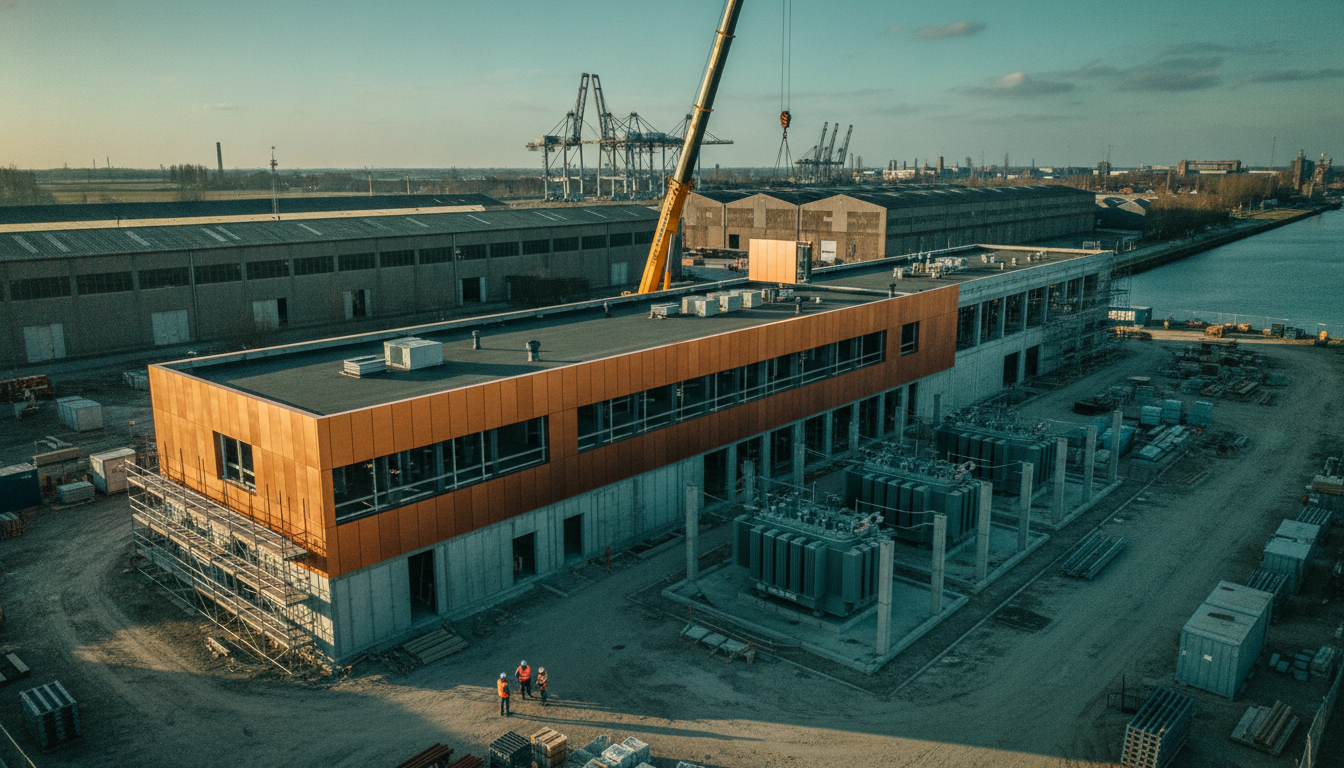
On the site where the Hemweg power station stood until 2019, the coal-fired plant Amsterdam residents called the Cloud Factory, Liander and TenneT have this month begun building the city’s largest joint electricity substation. The new substation on the Nieuwe Hemweg will provide around 1 gigawatt, comparable to the current consumption of two large cities. It replaces a 1960s substation that has reached its technical limits. The first phase is due to be in service around 2030.
A day earlier, the same grid operators announced that the Rozenburg-Zuid substation near Schiphol is complete after two and a half years of construction. And in the city centre, the municipality of Amsterdam is preparing the renewal of two substations at Hoogte Kadijk, a programme of eight to ten years in the middle of a residential neighbourhood.
These three projects do not stand alone. Amsterdam expects to use three to four times as much electricity in 2050 as it does today. To accommodate that, Liander is building twenty new substations in the city, expanding nineteen more and laying some 1,600 kilometres of cable. TenneT adds around five new substations, seven expansions and 750 kilometres of cable. The same is happening elsewhere in the Netherlands, only less concentrated. That makes substations one of the largest spatial programmes in existing urban areas this decade. What do the first projects teach us about the stakeholder side?
1. The easiest substation is on a site that was already an energy site
The Hemweg has been an energy location since 1952. First the coal plant with its 175-metre chimney, later a gas-fired plant, and throughout that time a distribution substation. The area lies in Westpoort, between the port and an industrial estate. There are no immediate neighbours losing a view, and nobody needs to be told why electricity is distributed here.
That is not luck but a strategy that deserves more attention. Existing substation sites, former power stations and industrial plots with an energy history are scarce and therefore valuable. A municipality that releases such plots for housing or business before the grid operator knows its space requirements makes the next site selection harder. The first stakeholder decision is therefore which sites you do not give up.
2. Put transmission and distribution on one plot
At the Nieuwe Hemweg, TenneT (150 kV) and Liander (150/50/10 kV) are building side by side. Rozenburg-Zuid is also a joint project. That saves space and cabling, but the stakeholder benefit is at least as large: one construction period instead of two, one set of site logistics, one point of contact and one story.
For the local community it makes no difference which grid operator builds which part. Residents and businesses see a construction site, and when two organisations work on the same spot one after the other, it feels like a project that never ends. Agree in advance who leads stakeholder communication, even if the contracts remain separate. In Amsterdam, the grid operators, the municipality, Port of Amsterdam and Qirion work together; that partnership also needs to be visible to the outside world as a single front door.
3. Reserve space in a framework, long before there is a design
With its Electricity Supply Development Framework Amsterdam 2035, the city has put all new and expanding substations on a single map, partly as fixed sites and partly as search areas. The Buikslotermeer substation, for example, will be built on the park-and-ride site next to Noord metro station. A framework like this does something an individual permit procedure cannot: it shows that a substation is part of a citywide programme rather than the result of a random choice in one neighbourhood.
The lesson for other municipalities is to draw that map early and carry it through into the local environment plan. A substation that only starts looking for a site once the connection queue is already pinching has to make do with what is left. That is rarely the site with the least impact.
4. Be early and honest about what is fixed
At Hoogte Kadijk, the municipality chose a clear scope. According to neighbourhood association 1018, residents cannot advise on the location during the information phase, only on limiting disruption and on communication. Building design and site layout only come up in the later integration phase, and even then technical and safety requirements take precedence.
That scope is defensible in itself. A substation cannot go just anywhere, and pretending there is a choice when there is none is worse. The problem lies in the sequence. The key decisions were taken confidentially at the end of 2025 and announced on 26 March 2026, on the day of the first information meeting. Residents therefore heard, all at once, that a project was coming, that it had already been decided and that the location was not up for discussion.
If you narrow the room for participation, share the reasoning more widely, not less. Explain which sites were examined, why they were rejected and what the technology requires. And start the conversation about disruption and design early enough for it to make a difference. With a construction period of eight to ten years, that is not a detail.
5. A substation is also a building
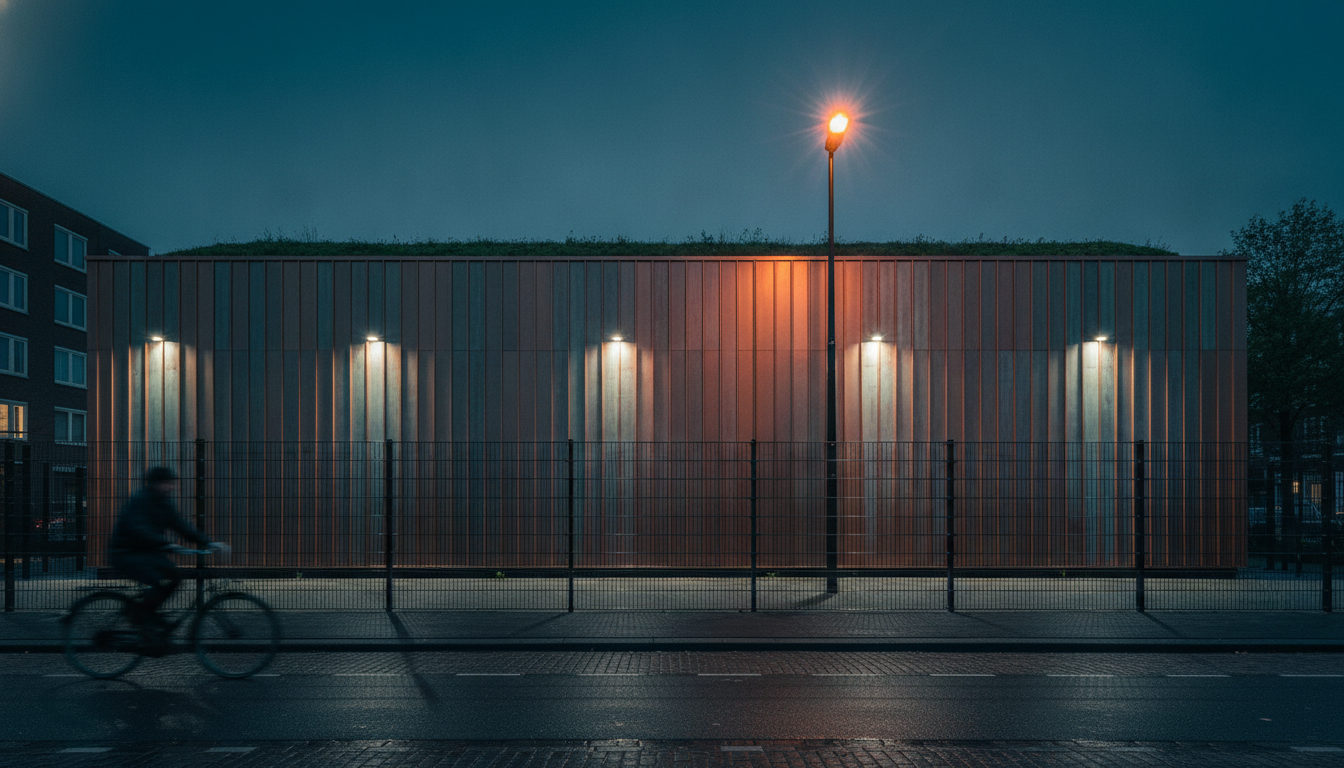
Liander’s new substation at the Nieuwe Hemweg is 105 metres long and 18 metres wide, with copper cladding that references electrical components, a sedum roof with solar panels and two bioswales for rainwater. Rozenburg-Zuid is 75 metres long, 25 metres wide and 12 metres high. These are buildings the size of a distribution centre, and where most new substations will go, they will not sit in a port but between homes, schools and parks.
There, architecture largely determines how a substation is received. A blank box behind a three-metre fence sends a different message from a building that engages with the street. Design quality, greenery, the position of the entrance and the route for maintenance traffic are topics on which residents can meaningfully contribute, precisely because the location is fixed. Reserve budget and design time for this in the project, and not only after the technical layout has been frozen.
6. The substation is the start of clearing the queue, not the end
In the area served by the Nieuwe Hemweg, 399 customers are waiting for a new or heavier connection, 308 of them in Amsterdam. Liander is candid that the substation creates grid capacity, but that many of those customers will also need further secondary substations and cables. When Rozenburg-Zuid was completed, the message was the same: extra capacity, but the waiting lists remain a concern.
That is exactly the expectation gap stakeholder managers end up in. A business owner who has looked at a construction fence for years expects a connection when it is finished. A resident who accepted the disruption because it was necessary expects it to be over afterwards. But the cable routes follow the substation, and they affect far more streets than the substation itself. Explain from the outset what the substation does and does not solve, and in what order the rest will follow. A concrete schedule per sub-area is worth more than a national promise of acceleration.
Conclusion
The substation programme will only become more urgent in the coming years, while at the same time formal moments for the community to speak up are disappearing. The Dutch government intends to exempt the construction and expansion of high and medium voltage substations from permit requirements, as we discussed earlier. That puts even more of the burden of public support on the stakeholder work of grid operators and municipalities.
The Nieuwe Hemweg shows how it can be easy: a site with an energy past, two grid operators on one plot, attention to the building. But most of Amsterdam’s twenty new substations will not be on such a site. For those projects, the lessons from Hoogte Kadijk matter more: start early, share the reasoning, and be clear about what is fixed and what is not. A substation is a building for thirty years or more. The first public meeting often determines how the neighbourhood looks at it for all that time.
Sources
- Liander - Liander and TenneT start construction of Amsterdam’s largest joint electricity substation
- Liander - Expansion of the Nieuwe Hemweg electricity substation
- De Westkrant - Grid operators build new substation on the site of the Cloud Factory
- TenneT - Rozenburg-Zuid high voltage substation
- Neighbourhood association 1018 - Major plans for renewal of the Hoogte Kadijk substations
- City of Amsterdam - Electricity Supply Development Framework Amsterdam 2035
- Liander - New Buikslotermeer electricity substation