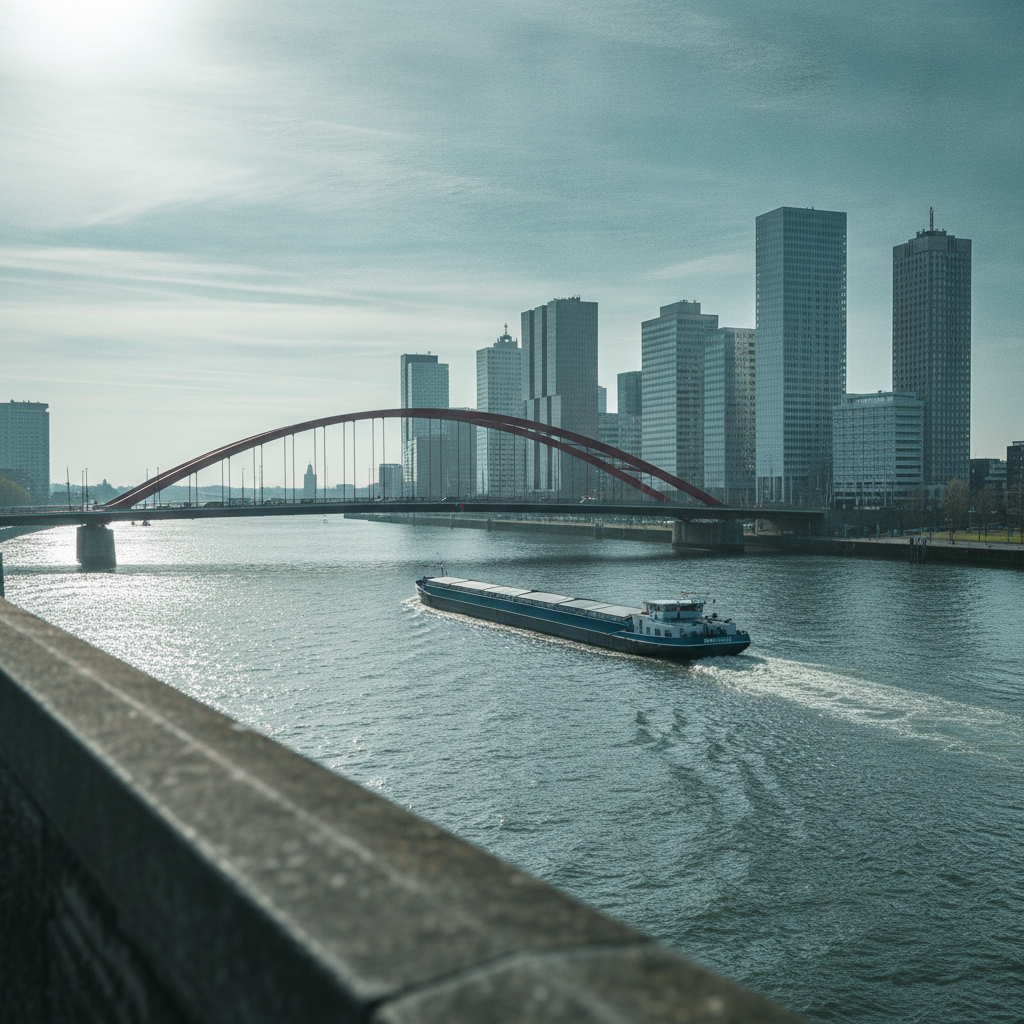
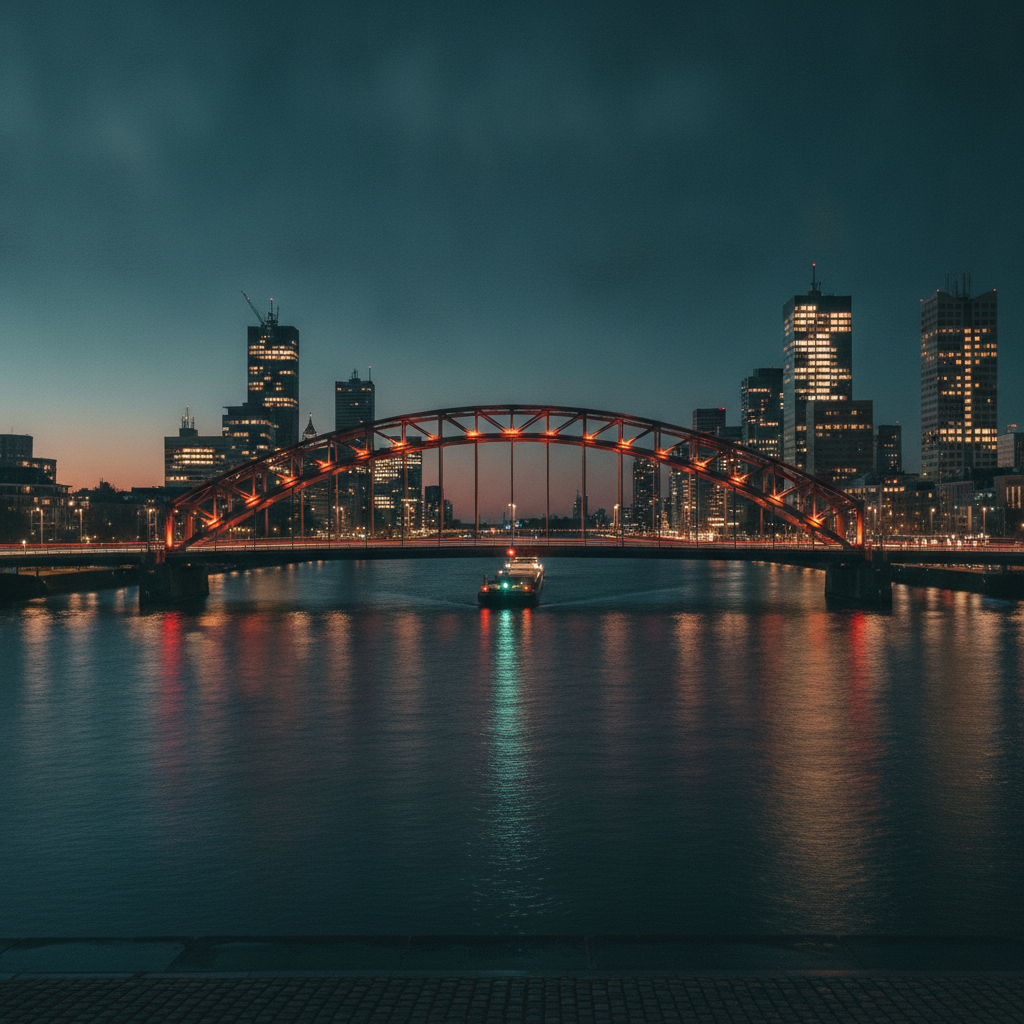
Around 250,000 vehicles cross it every day, and more than 120,000 vessels pass beneath it every year. The Van Brienenoord Bridge, carrying the A16 motorway across the Nieuwe Maas in Rotterdam, is one of the busiest connections in Europe, and over the coming years it will be largely renewed. In early June 2026, Rijkswaterstaat awarded the first major contract, for the movable section, to contractor FCC Construcción. That marks the start of a project running until around 2033, with a total estimated cost of €1.5 to €2 billion.
For anyone who lays the figures side by side, it quickly becomes clear that engineering is not the biggest challenge here. The real question is how you keep a connection of this scale open for five years, for both motorist and skipper, without bringing the region to a standstill. That is, at its core, a stakeholder and environmental management challenge.
The bridge and the task
The Van Brienenoord Bridge is more than half a century old. The eastern arch dates from 1965, the western arch from 1990. The structure consists of two striking steel arch spans and three bascule bridges, is 1,320 metres long and carries two separate carriageways of six lanes each. When the bridge was designed, traffic was lighter and less frequent than it is today. Heavier lorries and higher traffic volumes have loaded the steel and the moving parts for decades. The renewal is a textbook example of the broader replacement and renovation (R&R) task facing Rijkswaterstaat in the decades ahead: a whole generation of post-war structures is reaching the end of its technical lifespan at the same time.
The project has a striking, partly circular phasing. After preparatory work from 2027, the bridge leaves and operating machinery will be renewed in 2029. In 2030 a new western arch will be installed; the old western arch will then be refurbished and reused in 2032 as the new eastern arch. The work is due to be completed in 2033. Reusing an entire arch structure is technically impressive, but (at least as important for public support) it is also a story that lends itself well to being told to a community that will have to live with the works for years.
A tender with a history
The contract Rijkswaterstaat has now awarded did not come about easily. An earlier tender failed, after which the work was put back on the market at the end of 2025. That FCC Construcción came out best this time, on cost control, technical risk management and planning, provides some reassurance, but the history also reveals something more fundamental: the market for this type of complex R&R project is tight, and the risks are considerable.
The first contract, worth €300 to €500 million, covers not only the movable section but also the asphalt, lighting and traffic systems across the entire bridge, plus four years of maintenance of the movable parts. Rijkswaterstaat has deliberately chosen to keep the coordinating role over the various sub-contracts itself, rather than tendering the whole job in one go. That gives more grip on planning, risk and execution, but it places the coordination burden between contractors, and towards the surrounding area, firmly with the client.
Disruption over road and water alike
What makes this project unusual for the stakeholder manager is the double disruption. Most R&R projects hit either road traffic or shipping hardest. Here, both converge in a single location.
On the road side, this is one of the most heavily loaded corridors in the country. Every lane that temporarily closes translates directly into congestion on the A16 and diversion behaviour onto the secondary road network and surrounding routes. On the water side, the Nieuwe Maas is a busy shipping route to the Port of Rotterdam, with more than 120,000 vessels a year and around 150 bridge openings. Work on the movable section affects precisely that function. Restrictions to navigation or to operation have consequences felt far beyond Rotterdam, reaching into the logistics chains of shippers and inland skippers.
Managing those two flows demands more than a good diversion map. It calls for early coordination with the port authority, municipalities, emergency services, hauliers and trade associations, and for honest communication about what lies ahead in the coming years. No one expects a renewal of this scale to pass without disruption. What the community does expect is predictability, timely information and an accountable party.
Not just this one bridge
The Van Brienenoord Bridge does not stand alone, either. In the Rotterdam-Drechtsteden region, several major interventions are running at the same time over the coming years. The Papendrecht Bridge on the N3 will close for months from the summer of 2026, a lorry ban has applied to the Zwijndrecht Bridge since this spring, and across the Drechtsteden and Alblasserwaard, numerous bridges and tunnels will be renovated over the next eight to ten years. For the individual road user or skipper, what counts is not a single project, but the sum of all the works in their area.
That shifts the task from the object to the corridor. The question is no longer only “how do we keep this bridge accessible”, but “how do we keep the whole region accessible while work is going on in ten places at once”. That requires coordination between projects that are formally separate, and a shared picture of the cumulative disruption. It is exactly the kind of question that regional partnerships such as Zuid-Holland Bereikbaar were created to address, and where accessibility management and stakeholder management merge into one another.
Five years is no temporary inconvenience
Finally, there is the factor of time. A construction period of around five years, embedded in a project schedule running to 2033, is not a temporary interruption that people simply “put up with”. It is a new reality for an entire region, long enough for expectations to shift and patience to wear thin. The greatest reputational risks in projects of this duration rarely arise from the disruption itself, but from the feeling that the disruption is not acknowledged, that information arrives too late, or that “temporary” keeps being stretched.
For Rijkswaterstaat, holding the reins itself, that is a task reaching well beyond engineering. The renewal of the Van Brienenoord Bridge will ultimately be judged not only on whether the steel lasts another half-century, but also on whether the surrounding community felt taken seriously for five years. The bridge is replaced in concrete and steel. Trust is maintained in conversations.