
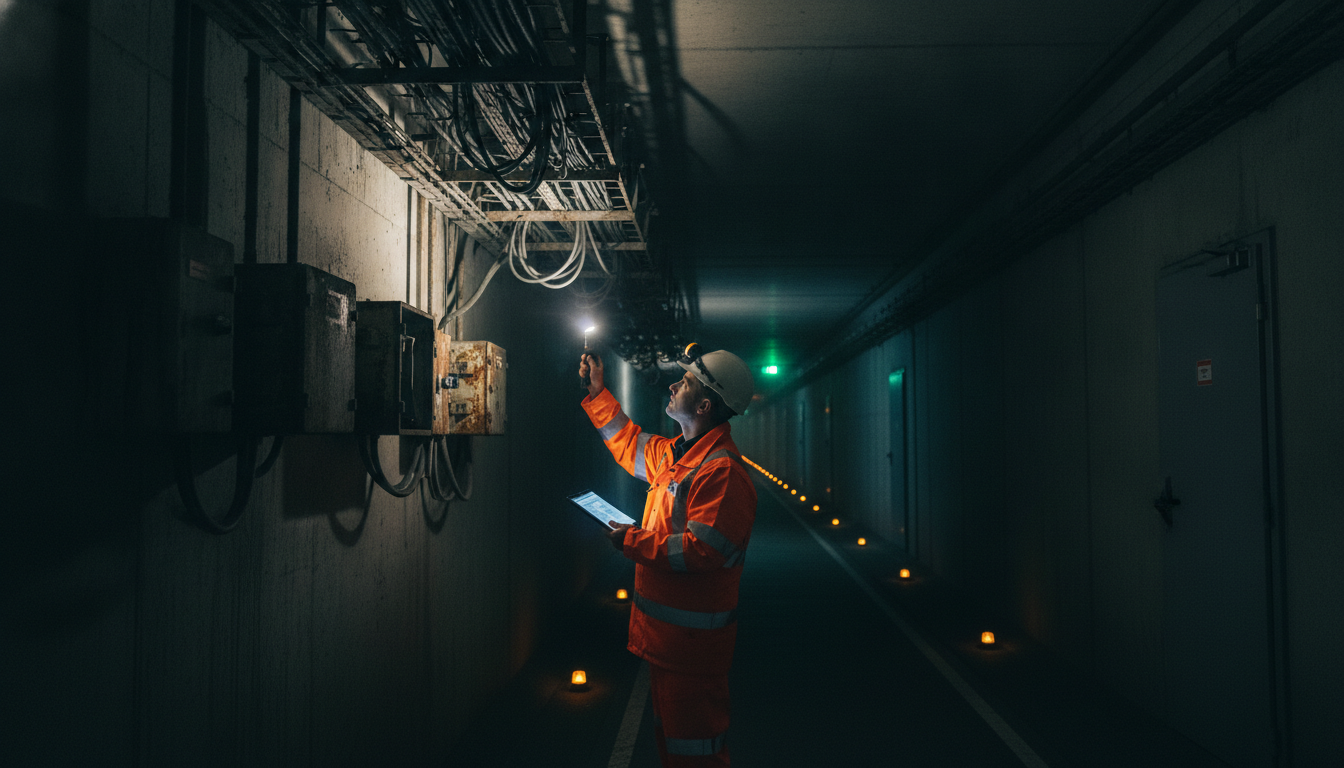
Seventeen months. That is how long passed between the award of the Noordtunnel renovation contract and the formal go-ahead for construction. On Monday 5 October 2026, Rijkswaterstaat, the Dutch national infrastructure agency, and contractor Ballast Nedam Infra, working with Croonwolter&dros, closed the exploration phase (in Dutch: doorgrondingsfase). Not a single cable was replaced in that period. The parties investigated, designed, calculated and negotiated.
To the daily tunnel user this looks like lost time. To anyone responsible for stakeholder and environmental management on such a scheme, it is the phase that determines what you will be able to promise later. The contract model is therefore more than a procurement matter. It decides when a closure gets a date, who is at the table when a municipality asks for something, and what happens when the concrete turns out to be in worse condition than assumed. This article sets two approaches side by side: a fixed price up front, and a price agreed after exploration.
Approach A: price up front
In the classic integrated contract (design and construct), the client writes out the requirements, including those on disruption: how many weekends the road may close, in which periods, and with what penalty per hour of overrun. Contractors compete on a fixed price and a programme. The winner has committed before seeing the inside of the asset.
For the surrounding community this has an attractive side. Disruption is capped at tender stage, and the client can publish a schedule early. The downside is that the schedule rests on assumptions. In renovation work there are many: the state of the concrete behind the cladding, cables that are not on any drawing, systems that are only just still working. When reality differs, the conversation moves from the site to the question of who pays. The community experiences that as delay announced late. The Afsluitdijk is the best known Dutch example: changed design assumptions led to years of delay and a settlement, as we described in our piece on its delivery.
Approach B: price after exploration
Under the two-phase model, Rijkswaterstaat selects a contractor before the price of the most uncertain parts is fixed. In the first phase, client and contractor investigate the asset together, develop the design and map the risks. Only then is the construction price agreed. If the parties cannot agree, they can part ways.
The Noordtunnel is a textbook case. The tunnel on the A15 between Alblasserdam and Hendrik-Ido-Ambacht, east of Rotterdam, is 530 metres long, has two tubes of three lanes each and has been in use since 1992. Nearly all technical systems need replacing, and the concrete, asphalt and heat resistant cladding are being upgraded as well. Rijkswaterstaat awarded the work in May 2025 and set aside 118.3 million euros. The exploration phase was then expected to take 15 months. It took about 17.
The contract is also a portfolio contract. If the Noordtunnel goes well, talks follow on the Beneluxtunnel (A4) and the Second Heinenoordtunnel (A29). Ballast Nedam remains responsible for maintenance until the end of 2039. The programme now on the table: work that needs no closure until mid 2028, and closures in the summer periods of 2027 and 2028, plus a few shorter weekend closures.
Four criteria from the community’s point of view
1. When does the disruption schedule become firm?
With a price up front, the schedule is known early and reliable late. With a price after exploration it is the other way round. During the first phase the stakeholder manager can commit to very little, because the construction method is not yet settled. For the Noordtunnel this meant a year and a half in which “summer 2027” was the most precise answer available. That is awkward for hauliers who plan a year ahead. On the other hand, the schedule now being published was drawn up by the party that will carry out the work and has examined the tunnel.
2. Is there room for stakeholder wishes?
A fixed price turns every change into a variation. A request from a municipality or an emergency service that surfaces after award then costs a disproportionate amount of money and goodwill. In an exploration phase the design is still open and the contractor is at the table. Different phasing, or a shorter full closure instead of months of night work: it can all be costed before the price is closed. That window opens only once. Consulting stakeholders after pricing means giving away the main advantage of the model.
3. What happens when there is a setback?
The purpose of the two-phase model is to find surprises before they cost time and money. That does not always work, but the likelihood of a dispute in the middle of a closure goes down. The model has a risk of its own: the exit option. If the parties fail to agree a price, the client starts again, and the community waits along with it. For an asset nearing the end of its life, that is not a theoretical point.
4. Who holds the conversation, and for how long?
Traditionally the client leads stakeholder engagement until award, after which the contractor largely takes over. In the two-phase model both teams work side by side for a full phase. With a portfolio contract that includes maintenance until 2039, the same people also stay in the area for years. In the Drechtsteden region that is worth a great deal. There, the Bridge over the Noord, the Papendrecht Bridge, the Noordtunnel, the Drechttunnel and the Dordrecht road bridge follow one another until 2032, and Rijkswaterstaat expects 30 to more than 60 minutes of extra travel time during works.
| Criterion | Price up front | Price after exploration |
|---|---|---|
| Disruption schedule | Known early, based on assumptions | Known later, based on investigation |
| Stakeholder wishes | After award, every wish is a variation | Can be included until pricing, not afterwards |
| Setbacks | Risk of dispute and late notice of delay | Found earlier, but with a chance of exit and restart |
| Counterpart | Handover from client to contractor at award | Joint for one phase, and the same party for years under a portfolio |
No silver bullet
Rijkswaterstaat itself is sober about the model. Its Transition Monitor 2025, published on 11 June 2026, examined 19 projects under 13 contracts. Its conclusions: preparation by the client is decisive, cost conscious design gets too little attention, and the two-phase model should be used only where it is really needed. An earlier analysis of ten contracts by AT Osborne called for more standardisation.
What strikes us is that the surrounding community barely features as a theme of its own in these evaluations. The monitor is about client and contractor. Yet for third parties the first phase is the hardest one: long, largely invisible and without firm dates.
Which approach when?
A price up front suits work with few unknowns and a community that mainly needs certainty about dates: resurfacing, or a new structure in an empty field. A price after exploration suits the renovation of an asset in use, where the condition is uncertain and the disruption is large. Most of the Dutch replacement and renovation programme falls into the second category.
Anyone doing the stakeholder work on a two-phase project has, in our view, three things to arrange:
- Make the exploration phase visible. Explain what is being investigated and when dates will come. Otherwise a phase without a spade in the ground is, to the community, a phase of silence.
- Collect the wishes before the price is closed. Put the phasing options to hauliers, municipalities and emergency services while there is still a choice to make.
- Be explicit about what is conditional. As long as there is no construction price, there is no project with an end date. Saying so honestly is better than promising a schedule that still depends on a negotiation.
At the Noordtunnel that negotiation is now complete. The next test is not a technical one: it is whether the summer of 2027 unfolds for the Drechtsteden as is now being promised.
Sources
- Rijkswaterstaat - A15: start of Noordtunnel renovation after exploration phase (5 October 2026)
- Rijkswaterstaat - First South Holland tunnel renovation contract awarded
- Rijkswaterstaat - Renovation of bridges and tunnels in Drechtsteden and Alblasserwaard
- Rijkswaterstaat - Transition Monitor 2025
- Ballast Nedam - A15 Noordtunnel renovation
- AT Osborne - Analysis of two-phase contracts for Rijkswaterstaat