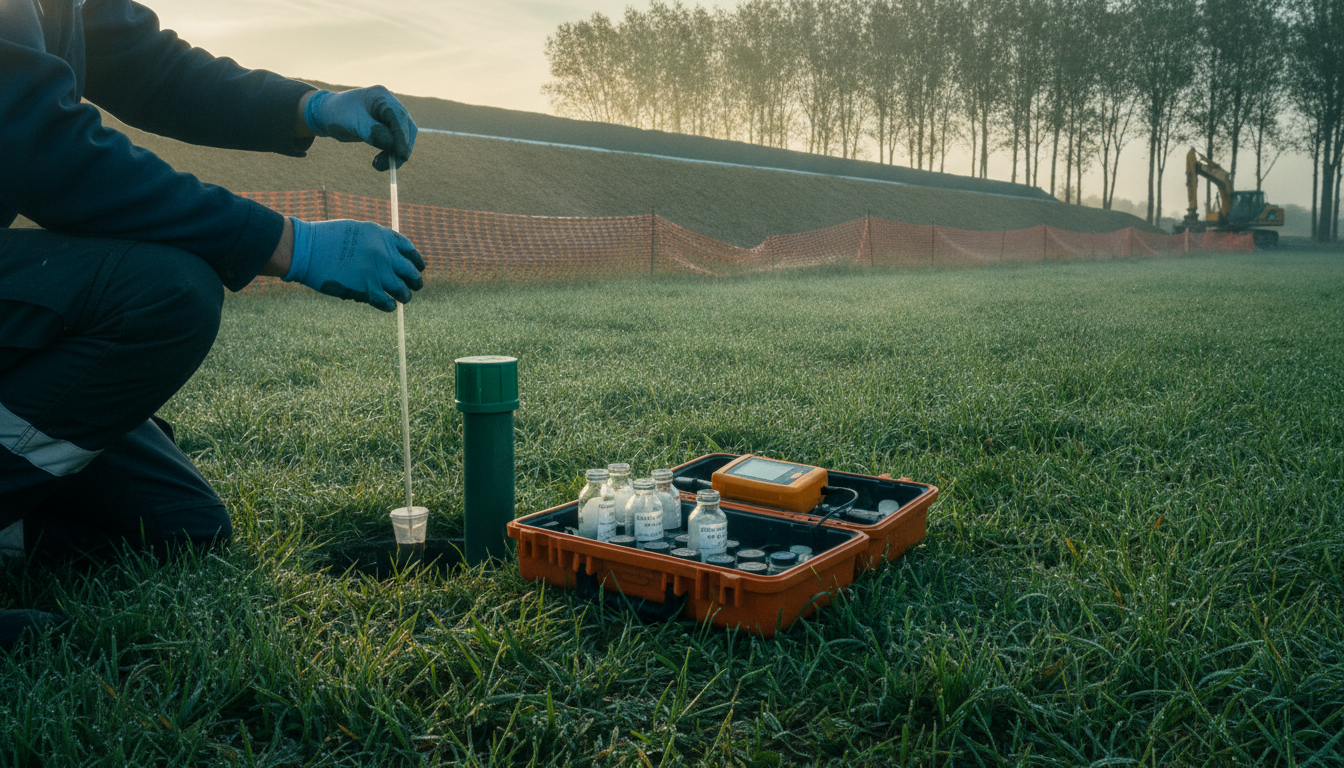

Between Echt and Roosteren, the A2 runs across one of the places where central Limburg draws its drinking water. Drive along the verge and you see earth embankments, site fencing and, near Oud-Roosteren, a water company relocating a main before the earthworks can start. What you do not see is what this region has been arguing about for two years: the half metre of fill material that is to go under the new carriageway.
On Friday 25 September 2026, the Limburg Provincial Council made a decision on it. When adopting the new provincial environmental ordinance, it removed a transitional rule that would have allowed pending permit applications to be assessed under the old, more lenient regime. In practice that rule had only one beneficiary: the application by contractor Boskalis to use Beaumix in the groundwater protection zone near Roosteren. That application will now be assessed against the new standard, which is strict: in such zones, Beaumix and comparable soil-like materials may only be used where there is a major public interest and no alternative is available. Tighter rules also apply to metal slags.
The project: eighteen kilometres, the only motorway between south and central Limburg
The A2 between the Het Vonderen and Kerensheide interchanges is the only motorway link between central and southern Limburg. Rijkswaterstaat, the Dutch national roads and waterways agency, is widening roughly eighteen kilometres from 2x2 lanes with a peak-hour lane to 2x3 lanes with a hard shoulder. Boskalis signed the contract on 5 October 2023. Construction started in August 2025 and will continue at various locations until the end of 2029. Eleven overpasses and underpasses are being demolished and rebuilt, and the widening is combined with a so-called parkway: tree lines, restoration of the Geleenbeek stream and wildlife crossings.
To fit the works in, the project has scheduled seven weekend closures between 2025 and 2029. The next one, from 8 to 12 October 2026, has already been extended by a day; towards Maastricht, the road between Het Vonderen and Roosteren closes on the Thursday evening.
The project has been delayed by nature before. In 2024 it emerged that there were eleven badger setts along the A2 and that Geoffroy’s bats crossed the motorway at eleven points between Echt and Urmond. Boskalis had to adjust its schedule. But where badgers and bats are a planning issue, the construction material became a trust issue.
The challenge: a circular choice above a water catchment
Beaumix is washed and sieved bottom ash from waste-to-energy plants: the residue of incinerated household waste, processed into a material that national rules treat as freely applicable. For a contractor it is attractive: cheap, widely available and in line with government policy to reduce the use of primary raw materials. According to Rijkswaterstaat, a layer of up to half a metre will be placed under the road on 14 of the 18 kilometres. The total quantity is 350,000 to 500,000 tonnes.
The Limburg Nature and Environment Federation, action groups and a growing number of municipal councils see it differently. They point to heavy metals, salts, plastics and battery residues in the ash. In February 2025, according to local reporting, tests on a batch of Beaumix stored in the port of Stein showed PFAS levels around fifty times higher than permitted for ordinary sand in a groundwater protection zone. For local residents, that was the moment a technical discussion about standards turned into a question about drinking water.
This puts the project in a classic tension. Legally, the application on most of the route was in order. Socially, it was not.
What happened over the past fifteen months
The debate moved rapidly across three tiers of government:
- June 2025, House of Representatives. A motion by NSC MP Natascha Wingelaar, herself from Stein, was adopted. The government was to prevent Beaumix from being used on the A2 while research into its risks was ongoing.
- 11 November 2025, State Secretary. State Secretary Aartsen (Infrastructure and Water Management) informed Parliament that the rules for Beaumix were being applied correctly and placed responsibility with the contractor, Boskalis, and the client, Rijkswaterstaat. No dedicated Beaumix study was carried out; there is only broader research into secondary materials. Application on the 14 kilometres outside the protection zone went ahead. The remaining stretch near Roosteren requires a separate provincial permit.
- Late July 2026, province. Boskalis applied for that permit. The same month, the draft ordinance included a transitional rule (Article 17.6) placing pending applications under the old regime.
- August and September 2026, municipalities and Provincial Council. The action group Stop A2 Verbreding protested on 28 August at the provincial government building in Maastricht, ahead of an extra committee meeting. The municipal council of Echt-Susteren asked the province to scrutinise the application very critically and to refuse it if groundwater contamination cannot be entirely ruled out, and sought support from Sittard-Geleen and Stein. On 25 September the Provincial Council removed the transitional rule.
The key lesson for stakeholder managers: legitimacy is not a compliance check
What makes this project instructive is that almost every step was formally defensible, and trust still declined. Three mechanisms stand out.
Material choice has become a stakeholder decision. In many projects, the choice of fill material is the contractor’s business within the contract requirements. Above a water catchment that no longer works. Residents do not ask whether the material meets the standard, but whether their drinking water will still be safe in thirty years. That is a different question, and it requires different evidence: long-term monitoring, an independent party, and the water company at the table.
Responsibility that is passed on ends up with the project. The State Secretary pointed to Boskalis and Rijkswaterstaat; Rijkswaterstaat pointed to the national rules; the province had to decide on a permit. For residents it felt like being sent from one counter to the next. In that situation, the project organisation becomes the face of the decision, even when it formally does not own it.
A rule that benefits only one project is read as a tailor-made exemption. Transitional provisions are legally standard: anyone who has already applied is assessed under the rules in force at that time. But in an ordinance meant to tighten groundwater protection, with the A2 as its sole beneficiary, the public read it as a bespoke exception. That perception cost more support than the rule could ever have delivered.
Current status: the burden of proof has shifted
Removing the transitional rule fundamentally changes the project’s position. Opponents no longer need to show that Beaumix is harmful; the applicant must show that there is a major public interest and no alternative. The latter is difficult, because primary sand and gravel are available, though more expensive and with their own environmental footprint. How the province will ultimately assess the application, and what that means for the schedule and cost of the Roosteren section, is not yet known.
Meanwhile, Rijkswaterstaat faces a second question: what do you tell residents along the fourteen kilometres where Beaumix has been or is being used? The risk is that the provincial decision is read as proof that the rest of the route is unsafe too. That calls for a separate, factual explanation of the differences between protected and unprotected areas, and ideally a monitoring programme with publicly available results.
Outlook: circular construction needs a stakeholder chapter
The A2 in Limburg is not an isolated case. Government wants the construction and infrastructure sector to use fewer primary raw materials, and secondary materials such as bottom ash, slags and recycled aggregate are indispensable to that goal. At the same time, sensitivity around PFAS, groundwater and drinking water sources is growing, as the debate on drinking water shortages showed earlier this year. These two ambitions will clash more often, and first of all in projects that sit above vulnerable ground.
For clients and stakeholder and environmental managers, this means that the choice of materials belongs at the front of the stakeholder analysis, not at the back of the construction plan. In practice:
- Map sensitive subsurface conditions during route analysis: groundwater protection zones, water catchments and soil contamination, with the drinking water company as a standing partner.
- Make the material choice explicit and traceable, including alternatives and their costs, so that the trade-off between circularity and precaution is visible.
- Publish monitoring data on the batches used and on groundwater, rather than referring only to the standard.
- Be wary of arrangements that favour a single project, even when they are legally routine.
Circular construction is a sound ambition. The A2 near Roosteren shows that it only holds up if the people living above the ground can trust it too.
Sources
- Infrasite: Limburg tightens rules for the use of Beaumix (25 September 2026)
- L1 Nieuws: Limburg tightens rules for controversial Beaumix in A2 widening
- VML Nieuws: Concerns about Beaumix, Echt-Susteren wants no groundwater risk at all
- L1 Nieuws: Beaumix allowed after all in A2 widening
- Infrasite: Parliament wants to keep Beaumix out of the A2 widening (June 2025)
- Elsloo.info: A2 widening, doubts about Beaumix grow in Stein
- Rijkswaterstaat: A2 widening Het Vonderen-Kerensheide
- Rijkswaterstaat: A2 extended weekend closure 8-12 October 2026
- VML Nieuws: Badgers, bats and Beaumix delay A2 widening (2024)