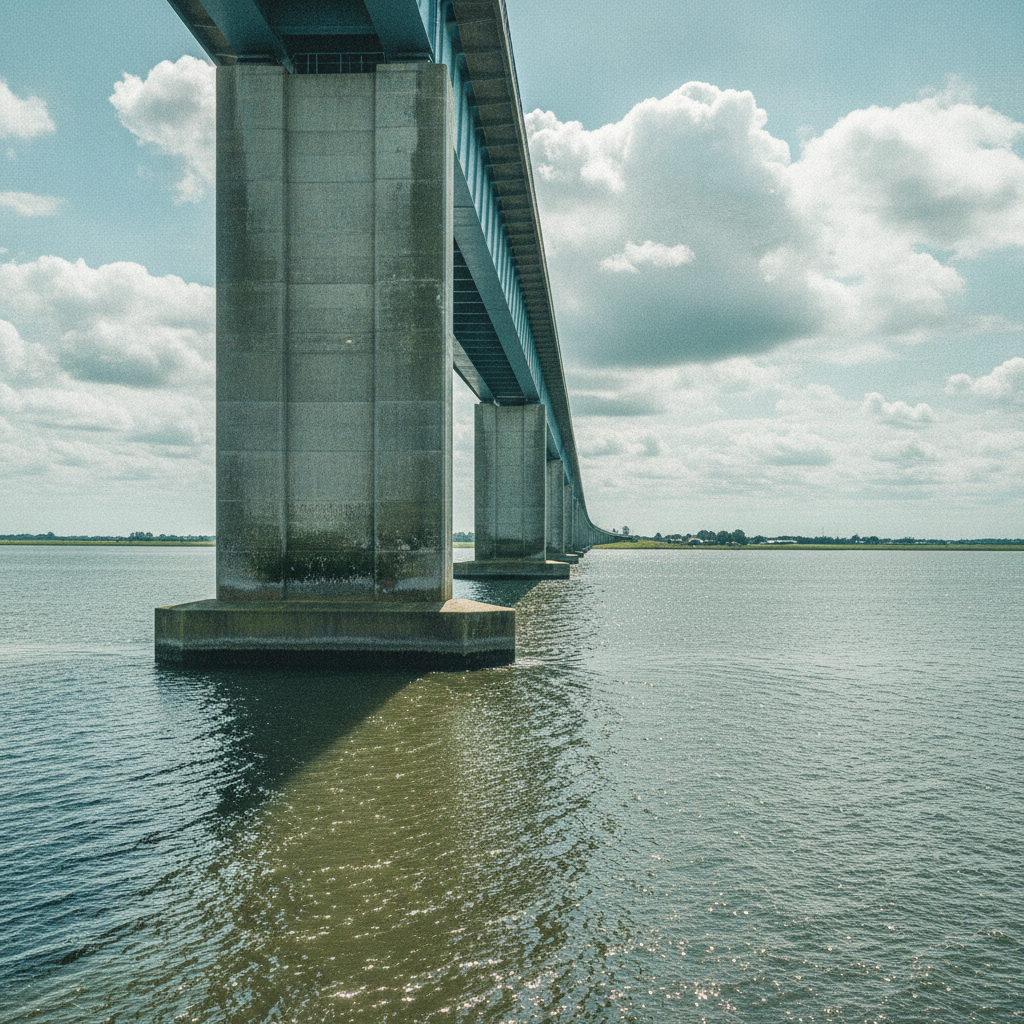

Five kilometres of bridge. That is the Zeelandbrug on the N256, built in 1965 and at the time the longest bridge in Europe. The connection between Noord-Beveland and Schouwen-Duiveland is not just any route for large parts of Zeeland: it is the only route. Without the Zeelandbrug, a driver travelling from Zierikzee to Goes faces a 40-kilometre detour via the Kamperland connection or the Veerse Gatdam.
And that bridge is wearing out. In 2026, Province Zeeland and the national government launched a joint variant study into the future of the Oosterschelde crossing. A combined budget of 2.4 million euros has been committed (1.2 million from the province and 1.2 million from the national government), with results expected by the end of 2026.
Two main variants are on the table: adapt what is there, or start entirely afresh. Both routes pass straight through one of the most protected natural areas in the Netherlands.
Variant A: renovate and extend
The most obvious response to a bridge approaching the end of its life is to extend its service life. In 2026, the province is already carrying out major maintenance on the basculebrug (the movable drawbridge section at the centre of the Zeelandbrug) to extend the life of that section by approximately thirty years. The fixed bridge sections receive concrete repairs, new asphalt and new expansion joints.
However, renovation as an end strategy means more than that. The structural question is whether the bridge in its current configuration (two traffic lanes on the fixed sections) can meet Zeeland’s accessibility demands for the coming decades. The bascule section creates a bottleneck: every bridge opening halts all N256 traffic. During the tourist season, that regularly causes queues on both banks.
A renovation variant that structurally repairs the fixed bridge sections without changing the configuration is probably the cheapest option. But it buys time, not capacity.
Variant B: a new Oosterschelde crossing
The second main variant is an entirely new crossing. The study examines three sub-variants: a new bridge, a tunnel or (in theory) a dam. The tunnel option illustrates the scale of the challenge: at an estimated cost of approximately one million euros per metre, five kilometres of tunnel carries a price tag of around five billion euros.
A new bridge could theoretically be built with a wider cross-section: 2×2 traffic lanes are included in the study. That resolves the capacity bottleneck at the bascule section and increases the resilience of the connection. The dam option is theoretically included but faces substantial ecological objections: the Oosterschelde is a Natura 2000 area where tidal currents and salt water are protected under international agreements.
Comparison across four criteria
1. Cost and financial risk
Renovating the existing bridge is the cheapest short-term option, but does not provide a structural solution if the bridge in its current state reaches its limits. A new five-kilometre tunnel is expected to cost around five billion euros, comparable to major national MIRT projects. A new bridge costs less than a tunnel but more than large-scale maintenance.
Financial risk: for a province the size of Zeeland, a replacement crossing as a standalone investment is not feasible. This project requires national co-financing and anchoring within the Mobility Fund, which determines the timeline for decision-making.
2. Accessibility and capacity
Renovation maintains the current bottleneck at the bascule section. With increasing tourism and potential redevelopment of Noord-Beveland, that is a vulnerability. A new crossing with 2×2 lanes doubles capacity and eliminates the need for a bascule function, structurally improving the reliability of the N256.
One concern: during construction of a new crossing, the existing bridge is the only alternative. This means that maintenance on the current bridge and construction of the new crossing must be carefully phased to preserve Zeeland’s accessibility during the construction period.
3. Environmental impact in the Natura 2000 area Oosterschelde
This is the most critical criterion. The Oosterschelde is a Natura 2000 area with strict protection rules for seagrass, cockles, mussels, wading birds and seals. Construction work in or above the water, for both a new bridge and a tunnel, inevitably affects the ecology of the tidal basin.
A tunnel requires piling or tunnelling machine use beneath the waterline, with impacts on underwater noise and sediment. A new bridge requires foundations in the Oosterschelde channel. Both routes require a formal appropriate assessment under the Nature Conservation Act (now the Environment and Planning Act) and almost certainly an environmental impact assessment.
Renovation of the existing bridge has the smallest ecological footprint: the footprint in the protected area remains limited to the current location.
4. Stakeholder and environmental management complexity
Renovation is more manageable from a governance perspective. The parties involved are known, the location is fixed, and the procedures are more straightforward. However, renovation creates periods of traffic disruption while the bridge remains in use. That requires active accessibility management, comparable to the approach for the Papendrechtsebrug.
A new crossing is a different story. Land acquisition for a new route, stakeholder processes involving Zeeland municipalities, landowners, the fishing sector and recreational organisations, permit procedures across multiple competent authorities. And all of this in a region where administrative capacity is structurally under pressure. Zeeland’s governance capacity is limited. That has consequences for the ability to manage a complex environmental process.
Conclusion: the variant study is itself a stakeholder management challenge
By the end of 2026, province and national government must form a judgement on which variant best serves as the future Oosterschelde crossing. But that decision is not only technical or financial: it is also political and communicative.
For Zeeland, the Zeelandbrug carries an emotional significance that is hard to overestimate. At the same time, the urgency is real: infrastructure processes of this scale take 15 to 20 years from initial exploration to opening. If the bridge reaches the end of its technical service life around 2035, and a successor can be ready at the earliest around 2050, there is no comfortable buffer.
The surrounding community deserves an honest picture of that timeline. Presenting the variant study as a decision about 2040 does not bring the people of the Oosterschelde along with the reality that this choice must be made now.
Sources
- Millions extra for infrastructure, accessibility and Zeelandbrug research - Province Zeeland
- Province and national government launch joint study into future of Zeelandbrug - Mobiliteit.nl (January 2026)
- Major maintenance on the Zeelandbrug basculebrug in 2026 - Province Zeeland
- Netherlands faces enormous challenge: bridges approaching end of service life - Reformatorisch Dagblad
- Zeeland and national government jointly explore Zeelandbrug alternative - Transport Online