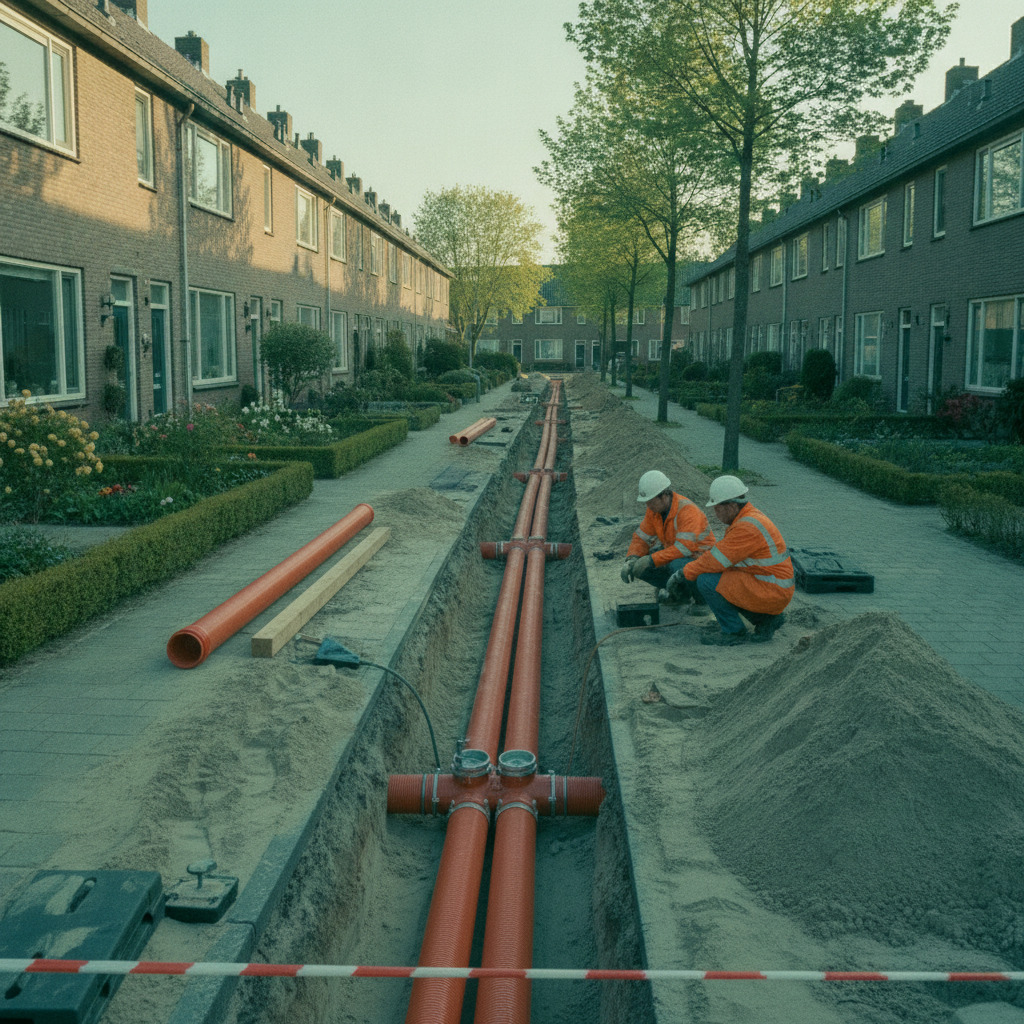

Can a municipality require residents to give up natural gas? Until now the answer was no: the Dutch heat transition ran on persuasion, subsidies and hope of voluntary participation. From 1 July 2026 that changes. The Municipal Heat Transition Instruments Act (Wet gemeentelijke instrumenten warmtetransitie, Wgiw) is expected to enter into force, together with its accompanying decree (Bgiw). Its core is the designation power (aanwijsbevoegdheid): a municipality can designate a neighbourhood in its environmental plan as a “heat transition area” where the use of natural gas ends on a fixed date.
For anyone retrofitting homes, that is a breakthrough. For anyone who has to carry the community along, it is mostly a heavier burden. A non-binding ambition need not be taken seriously; a decision with an end date for your gas connection certainly must. The designation makes the commitment hard, and so public support becomes not a marketing question but a legal precondition tested by the administrative court. Under the Wgiw, stakeholder and environmental management is no longer the final flourish, but the foundation the entire decision rests on.
This guide translates the new power into six principles for the stakeholder manager who has to carry such a process.
1. Start the area process before the designation, not after
The biggest mistake is to treat the designation as the starting gun. Legally it may be just that, but in practice the designation is the conclusion of a process that begins years earlier. The Wgiw obliges municipalities to demonstrate how they involved residents, businesses, landlords and civil-society organisations in the preparation. Anyone who only starts talking once the environmental plan is open for inspection has already lost the process: all that remains is the formal objection, and to residents that feels like being consulted after the fact.
The heat programme, which every municipality must adopt by 31 December 2027 and update every five years, is the instrument to structure this conversation. Treat it not as a technical planning document but as the place where the municipality explains which neighbourhoods are next, why, and in what order. Transparency about the sequence is stakeholder management avant la lettre: nothing erodes trust faster than the impression that one neighbourhood is, for unfathomable reasons, ahead of or behind the one next door.
2. Treat the timeline as the heart of the promise
The Wgiw prescribes a generous period between designation and actual disconnection: the guideline is eight years, set down in the environmental plan. That period is not a formality but the heart of the agreement with the neighbourhood. Eight years gives homeowners time to plan an investment around the natural replacement moment of their boiler, and gives the collective alternative, a heat network or a reinforced electricity grid, time to actually exist.
For the stakeholder manager this means the date itself is communication material. A neighbourhood that knows natural gas ends in 2034 can plan for it; a neighbourhood told only that it will happen “somewhere this decade” starts to resist the uncertainty. Make the timeline concrete, repeat it consistently, and, just as importantly, honour it. A designation that quietly slips later costs more trust than an honestly postponed date you explain in advance.
3. Make affordability the first subject, not the last
The act requires municipalities to take account of the “feasibility and affordability of the approach for residents and building owners”. In practice affordability is not one of the considerations: it is the consideration that every conversation in a neighbourhood reaches within five minutes. Anyone who opens a residents’ meeting with the engineering of a heat network and saves affordability for the end will lose the room.
Reverse the order. Start with the question everyone has: what will this cost me, and will my monthly bill be higher or lower? The act’s premise is that the investment pays for itself through lower energy costs, but that principle only convinces once it is made concrete for different types of household: the owner-occupier in a detached house, the tenant in a housing-association flat, the pensioner on a low income in a poorly insulated home. A stakeholder manager who does not have those figures to hand is missing the single most important instrument available.
4. Secure the opt-out as a right, not an exception
The Wgiw gives building owners an opt-out: anyone who does not want to connect to the municipality’s collective solution may choose their own sustainable alternative, provided it is “equally sustainable”. A heat pump instead of the heat network, for example. This right exists to make the designation acceptable: no one is forced into one particular technology, only away from natural gas.
The trap is treating the opt-out as an awkward exception to be smoothed away because it undermines the heat network’s business case. That is understandable from the perspective of running the collective network, but poison for public support. Residents sense unfailingly whether a freedom of choice genuinely exists or only on paper. Communicate the opt-out actively, explain honestly what it means for the neighbour who does connect, and accept that part of the neighbourhood will choose its own route. A designation that feels like a choice holds up; a designation that feels like coercion ends at the Council of State.
5. Align with the grid operator and heat company before naming a date
A municipality can designate an end date for natural gas, but it cannot deliver the alternative itself. That depends on the grid operator reinforcing the electricity network, or the heat company laying the network. Netbeheer Nederland published a guidance note in March 2026 specifically on the use of the designation power, precisely because a designation without an aligned timeline is an empty promise, or worse, a promise the grid operator cannot keep because of grid congestion.
For the stakeholder manager this is where the heat transition and grid congestion meet. Taking a neighbourhood off gas means a sharply higher electricity demand, exactly when the grid is already full. So never name a disconnection date you have not calibrated with the grid operator. The credibility of the entire designation, and with it the municipality’s standing as a reliable partner, stands or falls on whether the promised alternative actually arrives on time.
6. Treat the designation as a decision the court will review
The environmental plan in which the designation lands is subject to the usual legal protection: formal objections, and ultimately appeal to the Administrative Jurisdiction Division of the Council of State. That is no detail. It means the participation process, the affordability justification and the certainty about the alternative must hold up not only politically but legally.
This is where the stakeholder manager’s work literally ends up in the case file. A carefully and demonstrably conducted participation process will no longer be a “soft” component but evidence that keeps the decision standing. So document who was involved, what concerns were raised and what was done with them, not as a write-up after the fact, but as an integral part of the decision-making. A designation struck down in court because the participation was inadequate costs a neighbourhood years of delay and the municipality its credibility.
The trap: designating because you can
The greatest trap of a new instrument of power is using it because it exists. The designation power tempts the thought that the heat transition can finally be “pushed through”. That is a misunderstanding. The power changes nothing about the fundamental task: a neighbourhood only moves if residents understand why, trust that it is affordable, and see that the alternative is coming. The designation is the legal conclusion of that trust, not a substitute for it.
Therein lies the paradox of the Wgiw. The act gives municipalities more power, but makes good stakeholder management more decisive, not less. Because a designation without public support is not acceleration: it is an invitation to objection, appeal and years of delay. The municipalities that deploy the designation power most effectively will be those that treat it least as a lever of power and most as the conclusion of a careful area process.
Sources
- NPLW - Municipal Heat Transition Instruments Act (Wgiw)
- NPLW - Designation power for municipalities
- VNG - Act and decree on municipal heat transition instruments
- Dirkzwager - New powers for municipalities: the Wgiw and Bgiw explained
- Netbeheer Nederland - Guidance on using the Wgiw designation power (March 2026)