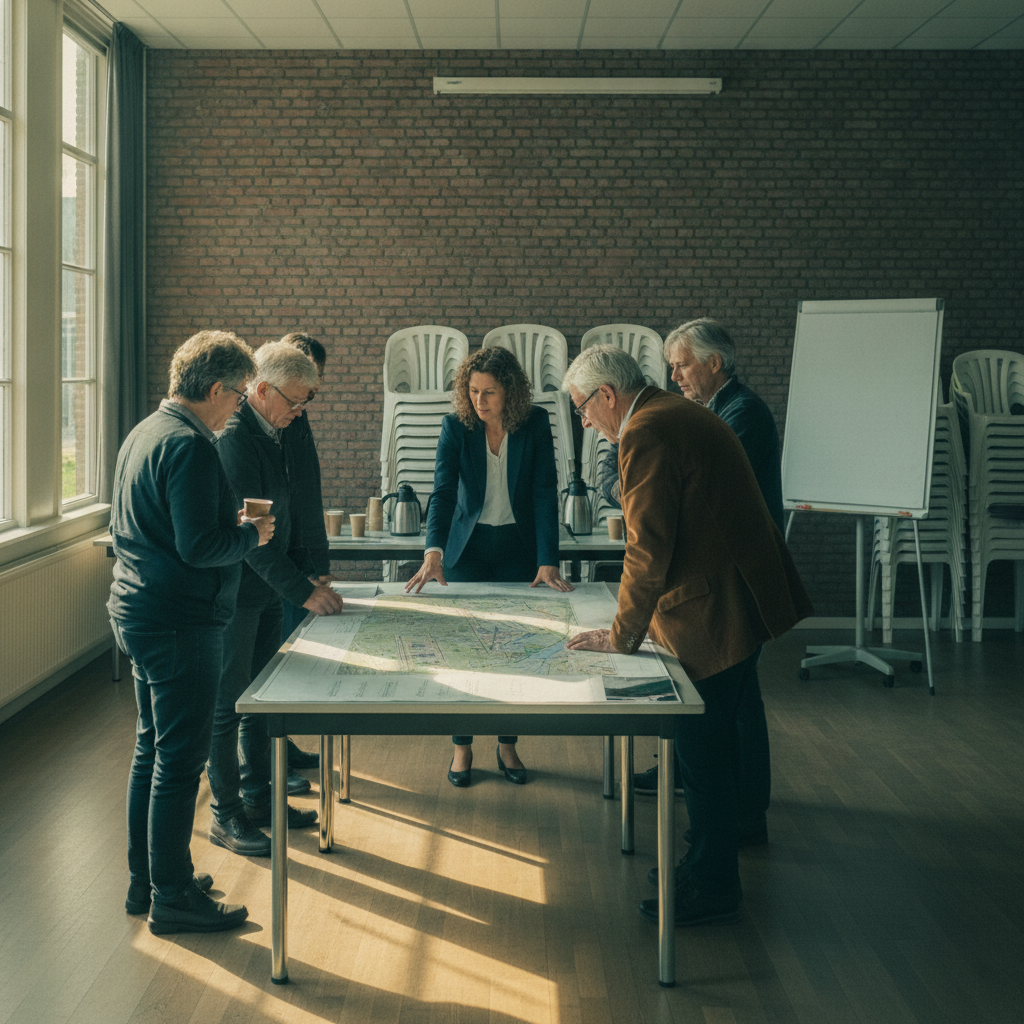
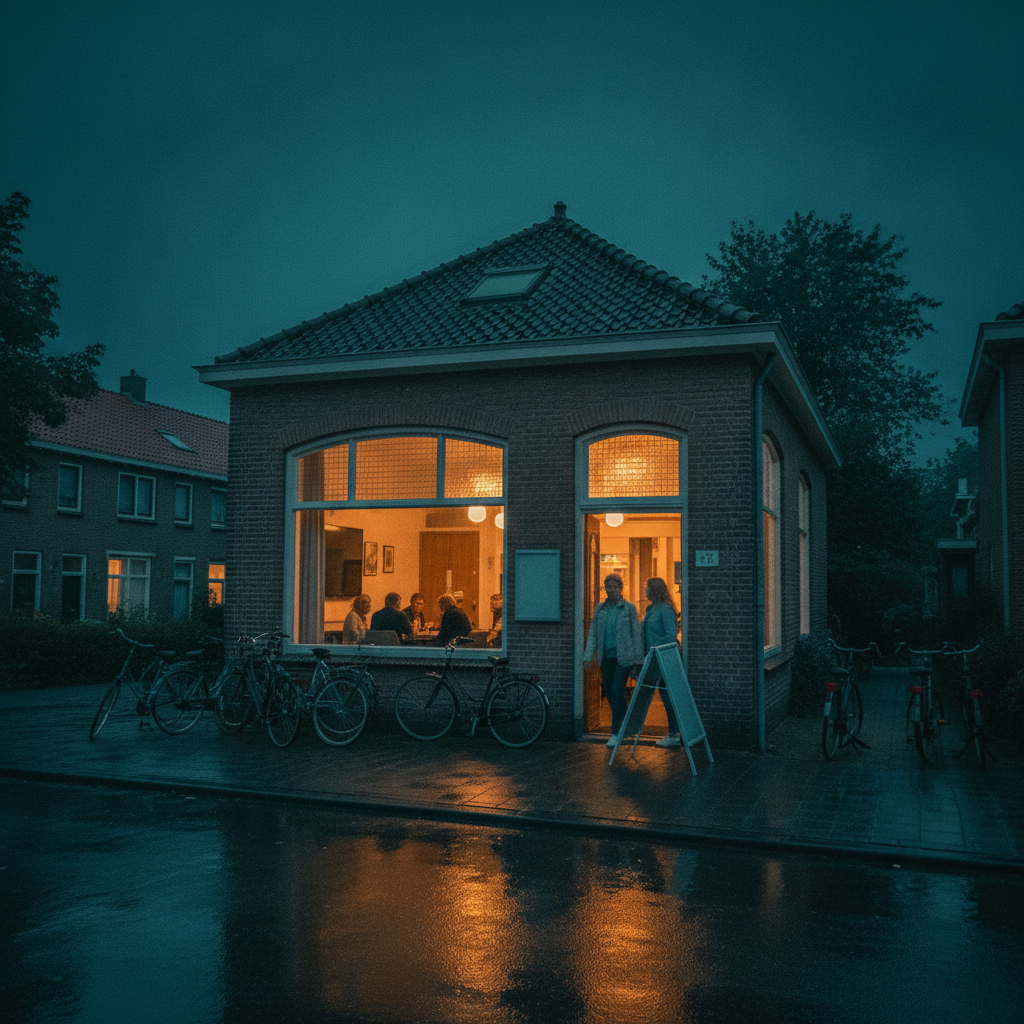
Six homes in Rhenen, twelve homes in Baarle-Nassau and a single distribution substation on a car park in Zeist. On those three modest cases, the Administrative Jurisdiction Division of the Dutch Council of State is about to hang a question that affects every infrastructure project in the country: what can be demanded of public participation when the law itself does not prescribe what it should look like?
In June 2026 the president of the Division asked Advocate General Nijmeijer for a so-called conclusie, an independent legal opinion that precedes the ruling. The three cases will be heard jointly on 15 October 2026, after which the Advocate General has six weeks to produce his opinion. By the end of 2026, then, there will be advice on whether participation, although free in form, must nonetheless meet minimum requirements. The opinion will also address whether participation must cover fundamental choices such as siting, and whether the competent authority may (partly) leave participation to the applicant.
For stakeholder and environmental managers this is not a legal footnote. It is the question of whether the participation process they are designing today will survive judicial review two years from now. Waiting for the answer is not an option: projects currently in preparation are running their participation trajectory under the present, unsettled regime. Below are six lessons that can be applied right now, based on what the Division wants to know and on what lower courts have already decided.
1. Free in form does not mean free of obligation
The most persistent misconception in practice is that “the law prescribes nothing” equals “we can do as we please”. The first part is true: neither the Environment and Planning Act nor the Environment Decree specifies how participation must take place. The second is not. Precisely because the legislator prescribed no form, it is the court that assesses afterwards whether the authority acted with due care and gave adequate reasons for its decision. The general principles of good administration fill the space the legislator left open.
The fact that the president of the Division is now explicitly asking whether minimum requirements can be formulated is telling. That question is not asked because the answer “no” is obvious. Anyone building a participation approach on the assumption that no floor exists is building on the weaker of two possible outcomes.
2. The bar is set by impact on the surroundings, not by project size
It is no accident that the Division has attached this question of principle to small cases. Six homes, twelve homes, one substation: these are exactly the interventions where project organisations tend to keep participation light. And they are exactly the interventions where the surrounding community reacts most sharply, because the effect is concentrated on a handful of immediate neighbours.
The lesson for major infrastructure projects is not that the bar is lower there, because it is higher. The lesson is that the standard about to be formulated is being developed on small-scale cases. A standard saying “for six homes you must at minimum do X” leaves little room to do less for a 400 kV connection or a lock refurbishment. Scale your participation effort to the impact as experienced by the community, not to the size of the decision or of your project budget.
3. Participation that starts once the location is fixed misses the point
One of the questions on the table is whether participation must also cover fundamental choices: where something is built, not merely what it looks like. That is the heart of the difference between participation and information provision.
In practice the pattern is constant. The route has been determined, the site for the substation has been chosen, and only then does the conversation with the community begin, about landscaping, planting and construction nuisance. That conversation is useful, but it is not participation on the choice that concerns residents most. Residents sense that difference unerringly, and by now so do the courts. If the authority must demonstrate that participation carried “some meaning”, the first test is: could the outcome still have changed at the moment the conversation started?
In practical terms: organise at least one participation moment before the preferred alternative is locked down, and document which variants were genuinely still open at that point.
4. Delegating to the applicant is allowed, looking away is not
The third case, concerning a distribution substation on a car park in Zeist, involves an out-of-plan environmental activity for which the municipal council made participation mandatory. That power, which lets a council designate cases in which an applicant must have organised participation before submitting an application, is precisely where the delegation question arises. May the competent authority leave participation entirely to the developer or grid operator?
The answer will most likely be nuanced: execution may be delegated, but responsibility for its quality remains with the body taking the decision. For municipalities that means: set out in advance what you expect from the applicant, and assess the outcome substantively rather than ticking off that “an evening was held”. For grid operators and contractors it means: the municipality cannot rescue your participation trajectory if it is deficient, and the decision your project rests on becomes vulnerable as a result.
5. The file is the evidence, and it is about the yield, not the turnout
The Environment Decree requires the competent authority, for decisions such as the environment plan, to set out how citizens, businesses and organisations were involved and what was done with the results. That second half is where case law shows things going wrong. In 2026 the District Court of Zeeland-West-Brabant annulled a decision in which resident participation had remained minimal and the outcome of the environmental dialogue had been processed only thinly, which breached the duty of care.
A report listing visitor numbers, dates and venue costs demonstrates that something happened. It does not demonstrate what it produced. The usable format is a response-note style overview: which points were raised, what was done with them, and where something was not adopted, with the reason attached. That last element is not a weakness but the strongest form of reasoning available: it shows the input was actually weighed.
6. Do not count on repair after the fact
Courts handle deficient participation differently. The District Court of Amsterdam held in late 2025 that the absence of mandatory participation is a defect that must be remedied. Other courts have passed over a comparable defect by applying Article 6:22 of the General Administrative Law Act, on the ground that interested parties were not disadvantaged by it. That divergence is one of the very reasons the Division is now seeking clarity.
As long as that clarity is missing, “we will repair it on appeal” is a gamble with the entire project schedule. An administrative loop or a corrective decision quickly costs months, and for a project with a procurement process, a waterborne execution window or a contracted rail possession, those are the most expensive months there are.
What this means for the renewal and grid programmes
It is tempting to dismiss these cases as housing case law. That would be a miscalculation. Over the coming years, thousands of distribution substations, transformer rooms, battery sites and temporary work compounds will be fitted into existing urban fabric, nearly all of them via out-of-plan environmental activities, in municipalities that increasingly make participation mandatory. The Zeist case is not an outlier; it is the archetype of a category that is only growing.
For project organisations working on the replacement and renovation programme and on grid reinforcement, the practical conclusion is simple: treat the participation file as part of the technical file. Not because a judge is watching, but because the quality the court will be testing, namely starting early, putting real choices on the table and visibly processing what comes back, is the same quality that earns a project its social licence.
The Advocate General’s opinion is due at the end of this year, the ruling after that. Anyone who organises participation in the meantime as though the strictest variant already applies runs no risk at all. Anyone doing the opposite is waiting for a standard that will land on their file retroactively.
Sources
- Council of State: Administrative Jurisdiction Division requests opinion on participation under the Environment and Planning Act
- Schulinck: Afdeling bestuursrechtspraak vraagt conclusie over participatie onder Omgevingswet
- Stadszaken: Raad van State roept hulp in voor vereisten participatie onder Omgevingswet
- Hys Legal: Participatie onder de Omgevingswet, verplicht, verstandig en in beweging
- Pels Rijcken: Participatie onder de Omgevingswet, welke handvatten hebben we inmiddels?