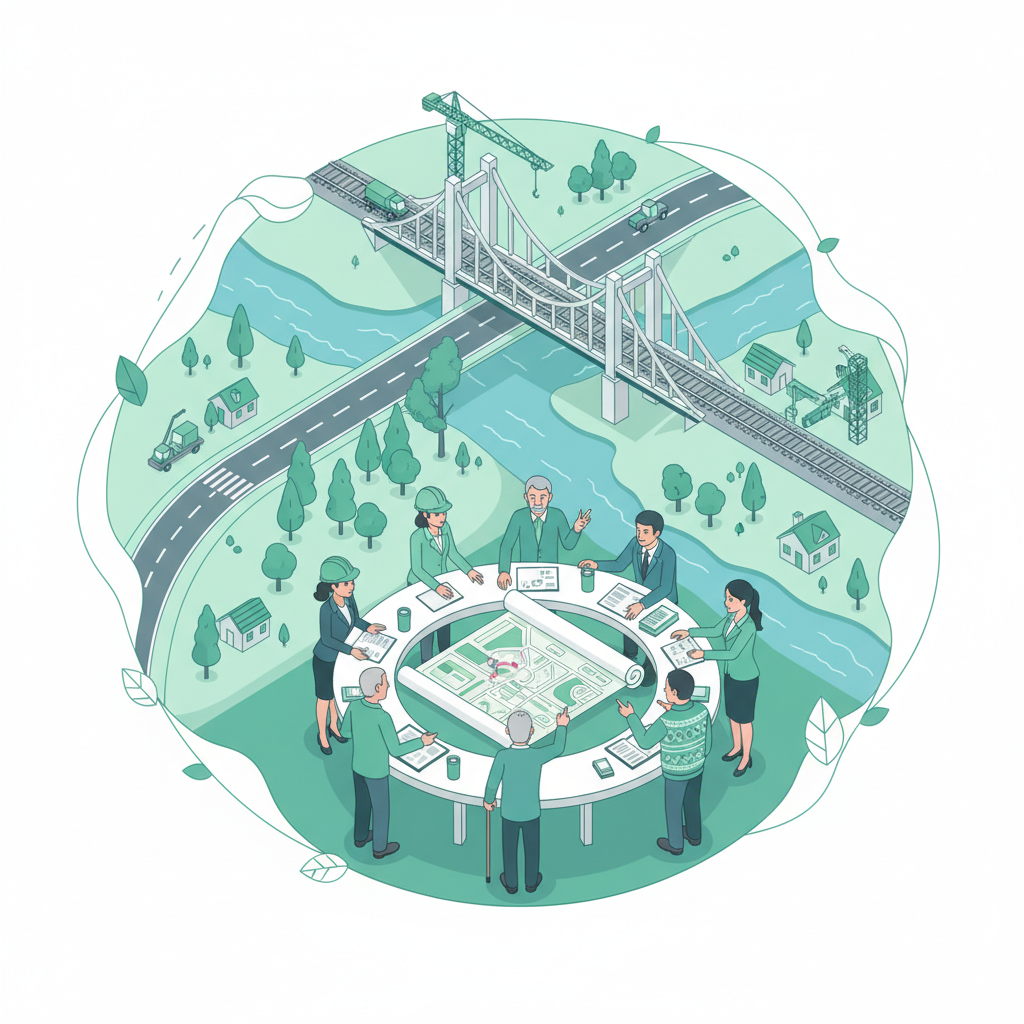

Since 1 January 2026, there is no turning back: the transition period of the Dutch Environment and Planning Act (Omgevingswet) has fully expired. Old notifications no longer have legal validity, and every activity classified as environmentally burdensome under the Act in principle requires a valid environmental permit. For project organisations, network operators and Rijkswaterstaat — working daily on the major infrastructure challenges facing the Netherlands — this has direct consequences for how they organise and document public participation.
Participation: an effort obligation, not a results obligation
A persistent misconception in practice is the idea that participation under the Environment and Planning Act constitutes a results obligation. This is not the case. Article 16.55 of the Act states that initiators must indicate, when submitting an application, whether and how participation has taken place — it is an application requirement. The competent authority may not refuse to process a permit application or reject it solely because no participation has taken place.
Courts have confirmed in multiple rulings that participation is an effort obligation. But that effort must have “some significance”. What this means in practice depends on the nature of the project and its impact on the living environment. For a large MIRT project — a new motorway, a railway alignment, a high-voltage connection — the bar for participation is accordingly much higher than for a smaller intervention.
This confronts project managers with a fundamental challenge: participation is form-free (the initiator decides how), yet must simultaneously be visible and demonstrable. The documentation must substantiate the quality of the participation process.
The Code for Public Participation and MIRT
For major national infrastructure projects, the Code for Public Participation applies alongside the Environment and Planning Act. The Minister of Infrastructure and Water Management established this code in 2014 for MIRT (Multi-year Programme for Infrastructure, Space and Transport) projects. Its essence is captured in three words: earlier, broader and better.
- Earlier: Involve the surrounding community from the exploration phase, before decisions have been made that are difficult to reverse.
- Broader: Attract a wider spectrum of stakeholders — not just the usual suspects (major municipalities, established organisations), but also smaller communities, business parks and civil society initiatives.
- Better: Ensure that stakeholder contributions actually influence design decisions or the decision-making process.
Research into MIRT projects has demonstrated that early participation improves the quality of outcomes: local knowledge leads to better design choices, new perspectives emerge, and — crucially — greater public support is built for the eventual decisions. This support reduces the risk of objection and appeal procedures, which frequently delay major infrastructure projects by years.
Current projects illustrate this principle clearly. The MIRT exploration A2/N2 Eindhoven Ring Road held participation meetings in March 2026, actively involving residents and businesses in exploring alternatives. The Nedersaksenlijn — a potential new railway line in the north of the country — has a separate area exploration alongside the formal MIRT process, precisely to map broader spatial and social impacts.
Resistance is normal — and manageable
Every major infrastructure project will sooner or later encounter resistance. Nearby residents fear noise, property devaluation, loss of views or damage to nature. Businesses worry about accessibility during construction. Local authorities compete to minimise the impact on their municipality.
The key to effective stakeholder and environmental management is not avoiding this resistance, but engaging with it early and seriously. Years of practical experience in infrastructure projects have established several proven principles:
1. Early stakeholder mapping Even before designs or route alternatives have been presented, it is valuable to understand what interests and concerns exist in the area. Environmental analyses, stakeholder scans and informal conversations give project organisations the information needed to structure participation processes effectively.
2. Personal contact when resistance arises Residents or organisations with strong objections rarely respond positively to a public information evening or newsletter. Personal contact — sitting down together, listening to concerns, and genuinely investigating what is possible within the project constraints — is almost always more effective than written communication.
3. Transparency about decision-making space A common mistake is giving participants the impression that they are making decisions, when in reality the policy margin is limited. This leads to disappointment and distrust. Honesty about what is and is not negotiable builds trust — even when the answer is “no”.
4. Recording and feeding back Every participation activity must be documented: who was involved, what input was given, how that input was weighed. Feeding back to participants — “this is what we did with your contribution” — is essential for participants to feel their involvement was meaningful.
Digital and physical: a hybrid approach
The COVID years demonstrated that digital participation is scalable. Online consultation portals, virtual information sessions and interactive mapping tools sometimes reach groups that are absent from physical meetings: busy professionals, younger residents, people with mobility limitations.
Yet practice shows that complex infrastructure projects require a hybrid approach. Digital tools are effective for disseminating information and capturing broad preferences. But for building trust and managing sensitive conflicts, physical presence is irreplaceable. Drop-in evenings at community centres, information trailers along the route, or conversations over a cup of coffee — these informal moments often determine how a project is experienced by the surrounding community.
The Environment and Planning Act as opportunity, not burden
The Environment and Planning Act compels initiators to explicitly account for participation. For project organisations that already take participation seriously, little changes in essence. But for organisations that have treated participation as a pro forma step — a public meeting at the end of the design process, an information letter to the address database — the new reality is a serious wake-up call.
Competent authorities now have better tools to assess whether participation is qualitatively sufficient. Courts have already ruled against municipalities that violated their own participation ordinances. As case law continues to develop, the threshold for “some significance” is expected to become increasingly concrete.
For network operators such as TenneT, Stedin and Liander — who face an enormous expansion task in the coming years — this is particularly relevant. The installation of high-voltage pylons, the laying of underground cables and the construction of switching stations affect hundreds of municipalities and thousands of residents. Those who communicate early, honestly and professionally in this context reduce the risk of objections and accelerate the energy transition.
Conclusion
The Environment and Planning Act does not make participation easier or cheaper. But it does make participation unmistakably a core component of project management. Waiting to organise participation until the design is complete means falling behind events. Using participation as a strategic instrument — to understand interests early, build public support and address resistance in time — increases the probability of successful permitting and social acceptance.
Professional stakeholder and environmental management is therefore not an optional addition to a project. It is a necessary investment in project success.
Sources
- Information Point Living Environment - Participation in environmental permits
- BarentsKrans - Participation under the Environment and Planning Act: recent case law
- Gebiedsontwikkeling.nu - Participation under the Environment and Planning Act: practical challenges
- Code for Public Participation MIRT - MIRT Learning Platform
- MIRT Overview 2026 - Dutch Government
- MIRT exploration A2/N2 Eindhoven Ring Road - Participation
- Pels Rijcken - Participation under the Environment and Planning Act