A project is only finished when the people around it experience it as finished. That is not a sour footnote to a day of celebration. It is a position on how a major scheme should be closed out. On Thursday 1 October 2026, Vincent Karremans, the Dutch Minister of Infrastructure and Water Management, commissioned the new pumping station and the new discharge sluices in the Afsluitdijk, the 32 kilometre dam that separates the IJsselmeer from the Wadden Sea. Rijkswaterstaat, the national infrastructure agency, describes the reinforcement as complete. Technically, that is correct. For drivers, cyclists and skippers the work on the dam will continue for years, and that is exactly the phase in which a project’s stakeholder organisation tends to fall apart.
First, what has been built
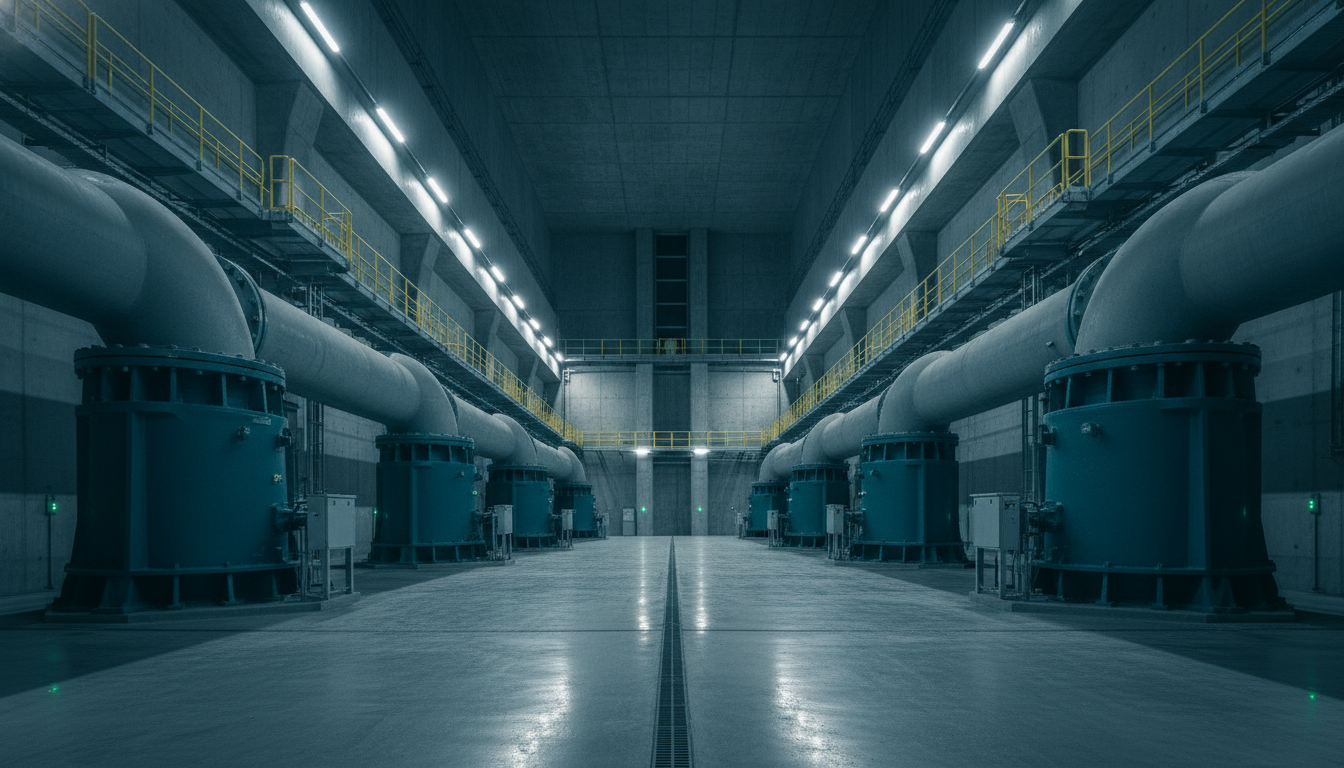
The result deserves recognition before anything is taken away from it. The Levvel consortium (Van Oord, BAM and Rebel) has reinforced the dam along its full length. At Den Oever there is now a pumping station with six pumps that together can move 275 cubic metres of water per second to the Wadden Sea, even when the sea level is too high to discharge by gravity. Together with the new sluices, this has raised the discharge capacity of the IJsselmeer by 45 per cent. New flood gates protect the lock complexes at Den Oever and Kornwerderzand, and at Kornwerderzand the dam has been opened up for the Fish Migration River.
All of this was built on a dam where traffic on the A7 motorway kept flowing and vessels kept locking through. The minister summed up why it matters: sea level rise and peak rainfall are changing the struggle the Netherlands has waged with water for centuries. There is little to argue with there.
What users actually notice
Now set that against the dam as a user finds it this month.
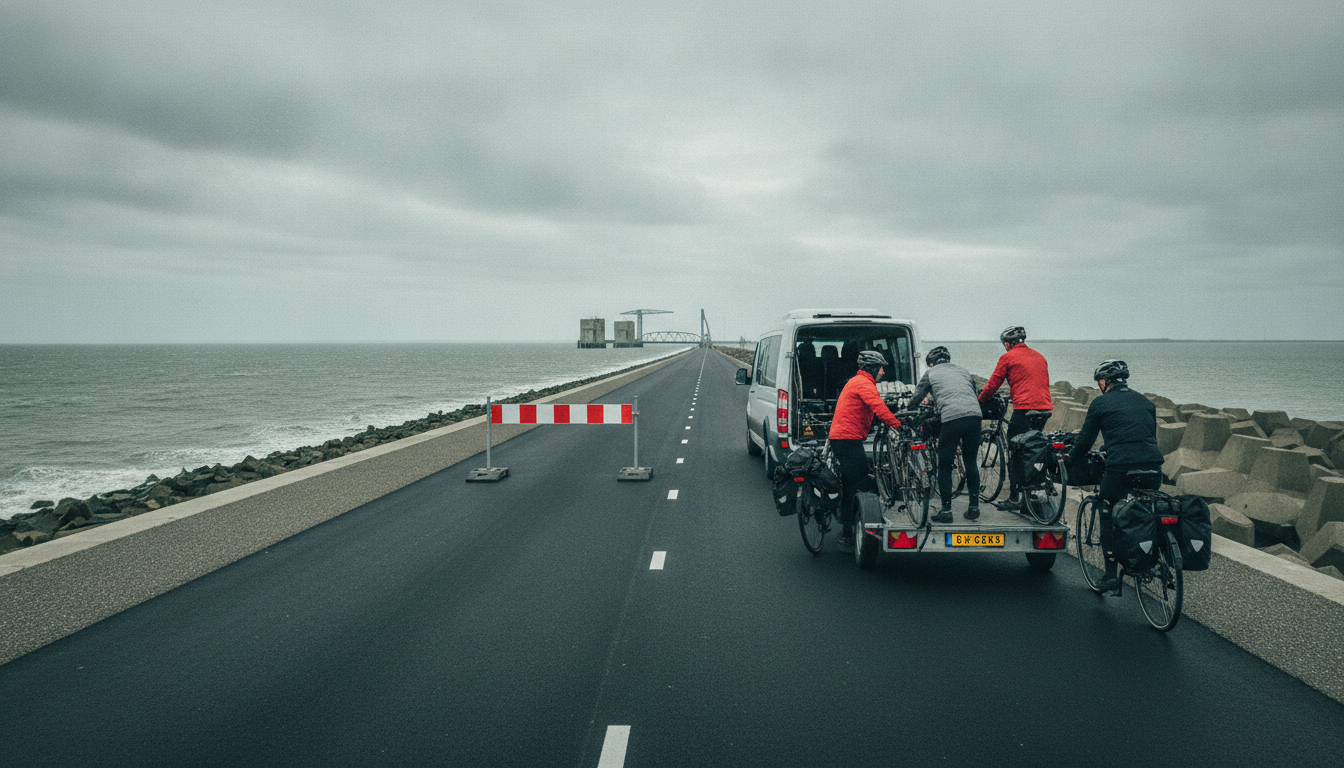
- Cyclists and walkers have not been able to cross the Afsluitdijk in one go since August 2019. A new path of around 24 kilometres opened in the summer of 2024, but the cycle bridges at the Den Oever and Kornwerderzand locks are missing. A free shuttle bus for bikes covers the gaps. The bridges have to rest on the piers of the historic sluices, which need repair first. Temporary cycle bridges will follow in 2027, at a cost of about 5 million euros. Keeping the bus running until 2035 would have cost 14 million euros.
- Drivers are down to one lane in each direction at both lock complexes until the end of this month. Near the Vlieter monument, one lane towards Friesland stays closed until the end of 2027, as does the car park on the south side. Vehicles wider than 3 metres cannot use the dam.
- The swing bridges at Den Oever and Kornwerderzand are old and prone to failure. At Den Oever the moving parts are being replaced like for like, which should keep the bridges in service until at least 2050. For Kornwerderzand, central government and the province of Fryslân signed an agreement in 2020 that assumed new bridges by 2025 and a wider lock by 2028. Rijkswaterstaat now reports that government and region are still in talks and that no start date is known.
- The historic discharge sluices from 1932 are getting life extending maintenance. That renovation was originally part of the Levvel contract, but was taken out in 2022 to be tendered again.
None of these points detracts from flood safety. Together, though, they shape perception. The dam was meant to be finished in 2022. In 2020 that became 2025, after it emerged that the hydraulic boundary conditions used for the sluice design were incomplete. In 2022 a settlement of 238 million euros with the contractor followed and the project budget passed 2 billion euros. Someone who has been told for seven years that the work is nearly done reads the word “complete” differently from the person writing the press release.
Why this is more than semantics
We see three reasons to press the point.
The definition of done belongs to the client; the experience of done belongs to the user. A project is closed out against its scope: the flood defence meets the standard, the installations have been tested, the contract moves into its maintenance phase. The public does not know that scope. They know the dam. When communication celebrates the former without acknowledging the latter, a gap opens between what is said and what people see. The next project pays for that gap.
Residual work loses its stakeholder organisation. During construction there is a project team with a stakeholder manager, a help desk, a disruption calendar and a governance forum. After handover that team shrinks, while the remaining work is spread across new contracts, other contractors and sometimes a different client. The cycle bridges, the swing bridges, the monument and the old sluices are four separate files for the organisation. For a resident of Den Oever or Kornwerderzand, they are one construction site that never leaves.
Disruption from residual work is harder to explain. Everyone understands disruption for a higher dam. Disruption for a bridge that was supposed to be replaced in 2025, or for piers that are only being repaired after the cycle path was laid, requires a more candid story. That story exists: heritage structures, separate budgets, a design error that rippled through the programme. It just needs to be told by someone who owns it.
The objections
“The objective was flood safety, and that objective has been met.” True, and choosing the storm season as the yardstick is right. But a motorway, a cycle route and two lock complexes on the same dam turn any flood safety scheme into an accessibility scheme as well. Accounting only for the first objective leaves half the users out of the final reckoning.
“The bridges and the cycle path are different projects, partly owned by other parties.” Also true. The cycle path was an initiative of the provinces of Fryslân and North Holland and the municipalities of Hollands Kroon and Súdwest-Fryslân. But a division of administrative responsibilities is not an explanation for the user. Precisely because responsibility is divided, somebody needs the job of keeping the whole picture in view.
“You cannot postpone celebrating a milestone forever.” Nor should you. Our criticism is not about the moment but about the word. “The pumping station and sluices are in service, the dam is ready for the storm season, and here is what still has to happen” is just as festive and considerably more durable than “complete”.
What we recommend
- Hand over twice. Once technically, once to the public. Agree at the start of the project which user experiences belong to “finished” (the dam can be cycled in one go, the road has two lanes again, the bridge failures have stopped) and report on those separately.
- Publish a snagging list for the public at handover. Contractors know the snagging list as a fixed part of every handover. A public version, with an owner, a schedule and the expected disruption for each item, costs little and prevents a great deal.
- Keep a help desk and a face in place for as long as work continues. The De Afsluitdijk website and help desk exist and operate across project boundaries. That is exactly the right choice. Commit to keeping such a facility until the last snag has been resolved, not until the main contract moves into maintenance.
- Call open decisions open. That the start date at Kornwerderzand is unknown is not a pleasant message. It is still a better message than silence, as we set out earlier in our practical guide to postponed and cancelled projects.
In closing
The Afsluitdijk is safer than it has been in almost a century, and that is the achievement that counts. Rijkswaterstaat is already looking ahead: around 2045 additional discharge capacity will be needed again, first through more sluice capacity and in the longer term through extra pumps. That next scheme starts with the trust this one leaves behind. That trust is not earned on the day of commissioning, but in the two years that follow, when a cyclist at Kornwerderzand can, for the first time, ride on without getting on the bus.
Sources
- Rijkswaterstaat - Afsluitdijk reinforcement completed: pumping station and new discharge sluices officially in service (1 October 2026, in Dutch)
- De Afsluitdijk - Disruption on and around the Afsluitdijk (in Dutch)
- De Afsluitdijk - Cycling and walking across the whole Afsluitdijk again soon (in Dutch)
- Omrop Fryslân - Cyclists can cross the full Afsluitdijk again from 2027 (in Dutch)
- De Afsluitdijk - Partial replacement of the Den Oever bridges (in Dutch)
- De Afsluitdijk - Renewal of the Kornwerderzand bridges can begin (2020, in Dutch)
- H2O Waternetwerk - Afsluitdijk reinforcement to take three years longer (2020, in Dutch)
- Infrasite - Rijkswaterstaat settles Afsluitdijk dispute for 238 million euros (2022, in Dutch)