A softer climate scenario is not a discount on flood safety. Yet that is exactly the conclusion the public draws the moment the news lands that scientists have “let go of the most extreme scenario”. And that makes dropping the scenario a stakeholder question, not a technical footnote.
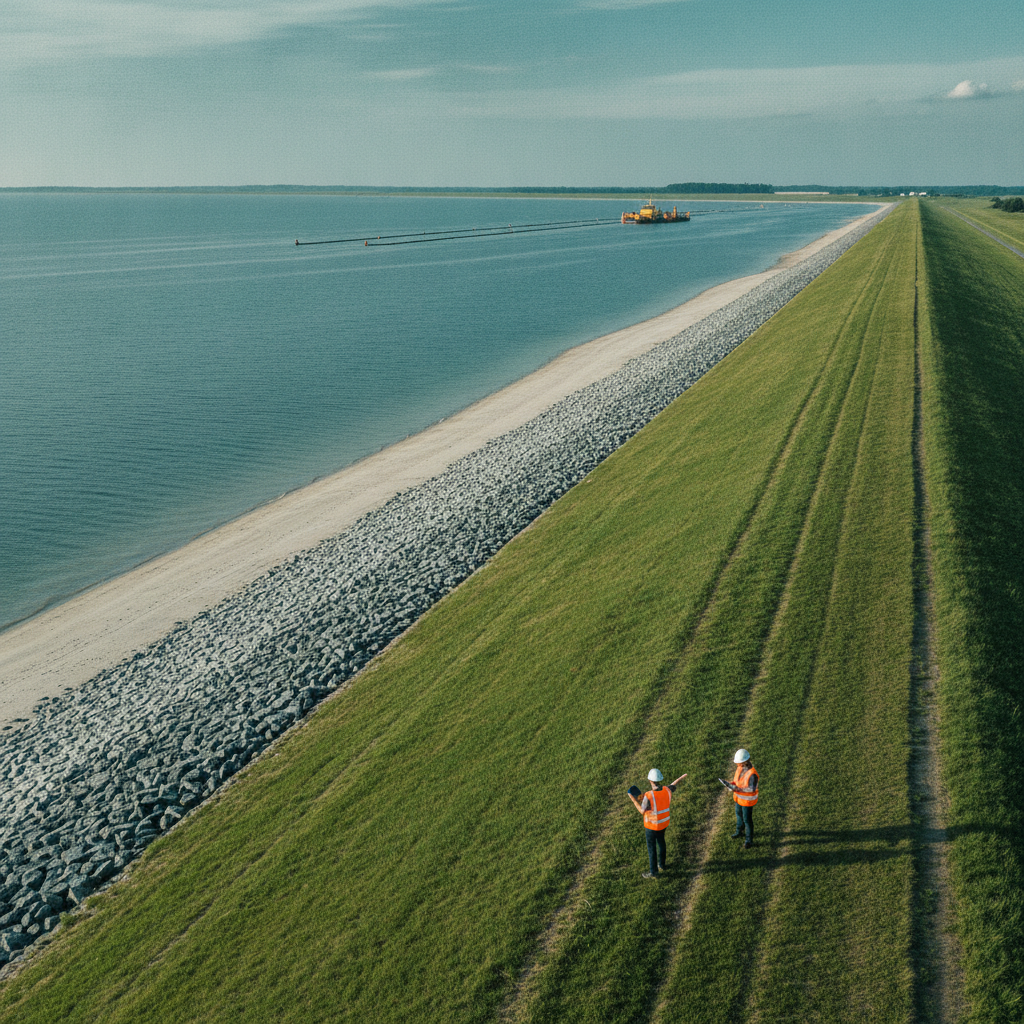
The occasion is concrete. Over the coming years, Waterschap Zuiderzeeland (the Zuiderzeeland water authority) is reinforcing the IJsselmeerdijk between Lelystad and the Ketelbrug: more than 17 kilometres, of which roughly 12 kilometres will receive a wave-damping foreshore while the remaining 5 kilometres are raised and re-clad in the classic way. The preparatory investigations (into the toe protection near the Maxima power plant and the boulder-clay layer beneath the dike) ran until 17 July; the real work on dike and foreshore starts in September 2026. The project is part of the Flood Protection Programme (HWBP), the joint task of the water authorities and central government to make the Netherlands flood-safe by 2050. The IJsselmeerdijk consortium (Boskalis and Van Oord) is delivering it.
In the middle of that preparation came the question dike-reeve Hetty Klavers had to answer: now that climate scientists are setting aside the heaviest scenario as unrealistic, is all that concrete and sand still necessary? The authority held its course. That is the right call. And it is worth spelling out exactly why, because the real challenge for the stakeholder manager lives in that why.
The scenario grew milder, the threat did not
The first fallacy is that a discarded scenario equals a smaller threat. What actually happened at its core: international climate science now regards the very highest emission pathways (the path on which humanity keeps burning fossil fuels unchecked through 2100) as unlikely. The KNMI scenario that leaned on that extreme pathway loses its footing as a result.
But the sea does not listen to emissions accounting alone. Even under a moderate scenario, sea levels along the Dutch coast rise by more than a metre this century, and with accelerated ice-sheet melt, 2.5 metres by 2100 still cannot be ruled out. Recent projections have in parts even been revised upward. The “extreme” that vanished sat in the assumptions about emissions; the uncertainty about how fast the land ice moves (the fat tail of the risk) remained. You do not design a dike for the most likely case, but for the case you cannot afford to get wrong. That is not doom-mongering; it is the definition of flood safety in a country where a third of the land lies below sea level.
Irreversible and slow: why you do not chase every signal
The second argument is one of timescale. A dike reinforcement is an investment with a lifespan of many decades and a preparation-and-delivery track that spans years. As Klavers puts it: for large, irreversible investments you look far ahead. You cannot build a foreshore halfway, evaluate it, and add another layer three years later when a new report appears. The choice to reinforce is one you have to get right once.
That argues for what the field calls robust or no-regret investment: build what holds up across a broad range of futures, rather than optimising for today’s single scenario. The world of climate scenarios is precisely one of continuous revision: the KNMI is developing a new generation of scenarios, and the emission pathways behind the IPCC toolkit are internationally under debate. Anyone who lets a dike design bob along with every scientific update never finishes building anything. You fold new insights into the next round of the programme, not by tearing open a running, funded and contracted project halfway.
The trap: a milder story, a higher bill
And here the stakeholder side enters, because up to this point it is a technical story with a technical answer. The problem is that the story lands differently on the ground. At the very moment the newspaper headlines that the extreme scenario “isn’t so bad after all,” the resident of Flevoland sees their water-authority levies rise by an expected 7 to 8 percent per year, driven at once by dike reinforcements, pumping-station overhauls, tighter treatment standards and higher energy costs.
Those two signals, “less serious than we thought” and “you are going to pay considerably more”, collide head-on. For anyone who does not follow the nuance of emission pathways versus ice-sheet uncertainty, and that is the vast majority, a logical but incorrect sum forms: if it is becoming less extreme, why the expensive dike? That is not a knowledge problem you solve with a single infographic. It is a question of trust, and trust is the currency in which a water authority pays for its democratic legitimacy and its tax base. Leave that question unanswered, and the next credit decision, the next levy increase or the next project with local disruption becomes considerably harder to defend.
”So isn’t reconsidering the sensible thing?” No, and here is why
The honest counter-argument deserves an honest answer. If a scenario grows milder, reconsidering large expenditures sounds sensible and thrifty. Why not trim the scope and hand the saving back to the levy payer?
Because the cost of doing too little and the cost of doing too much are not symmetrical. A dike that turns out to have been dimensioned a fraction too generously costs extra sand and concrete: annoying, but bounded and known. A dike that turns out too tight costs, in the event of a breach in the low-lying Netherlands, human lives, tens of thousands displaced, and damage running into the tens of billions, plus a reinforcement you then have to carry out under time pressure and at higher prices. Given that asymmetry, a margin is not waste but an insurance premium. And unlike insurance, this one pays out in the form of something that does not happen, precisely why its value is so easily underestimated the moment the threat recedes for a while.
What this demands of stakeholder management
The lesson is not that water authorities should go deaf to new science. The lesson is that a scenario change is a communication moment you must actively direct, not passively absorb. Three things belong to that.
Explain the asymmetry before anyone asks. Do not wait for the critical formal objection or the council question to come in. Proactively tell people why a margin under uncertainty is rational, and why “lower emissions” does not equal “lower seas.” Whoever only tells the story once pushed onto the defensive has already half lost it.
Tie the levy to what it buys. A 7-to-8-percent levy increase is defensible, but not as an abstract number on a tax assessment. Make visible that the money goes to concrete, local, tangible protection (this dike, this pumping station, this stretch of coast) and that the bill for delay is always higher than that of acting in time.
Be honest about uncertainty without hiding behind it. Say that scenarios will keep moving and that new insights land in the next round of the programme. That is more credible than false certainty, and it inoculates you against the charge of using “outdated figures”: you acknowledge the movement and explain why it does not leave you rudderless.
Waterschap Zuiderzeeland is doing the right thing by keeping the IJsselmeerdijk on course. But the dike itself is the easy part: a matter of toe protection, boulder clay and foreshore. The hard part is bringing the community along in the insight that a milder scenario and a necessary investment can perfectly well coexist. That is not a sideshow next to the engineering. For an investment the community co-funds and lives alongside for decades, explaining it is part of the work itself.