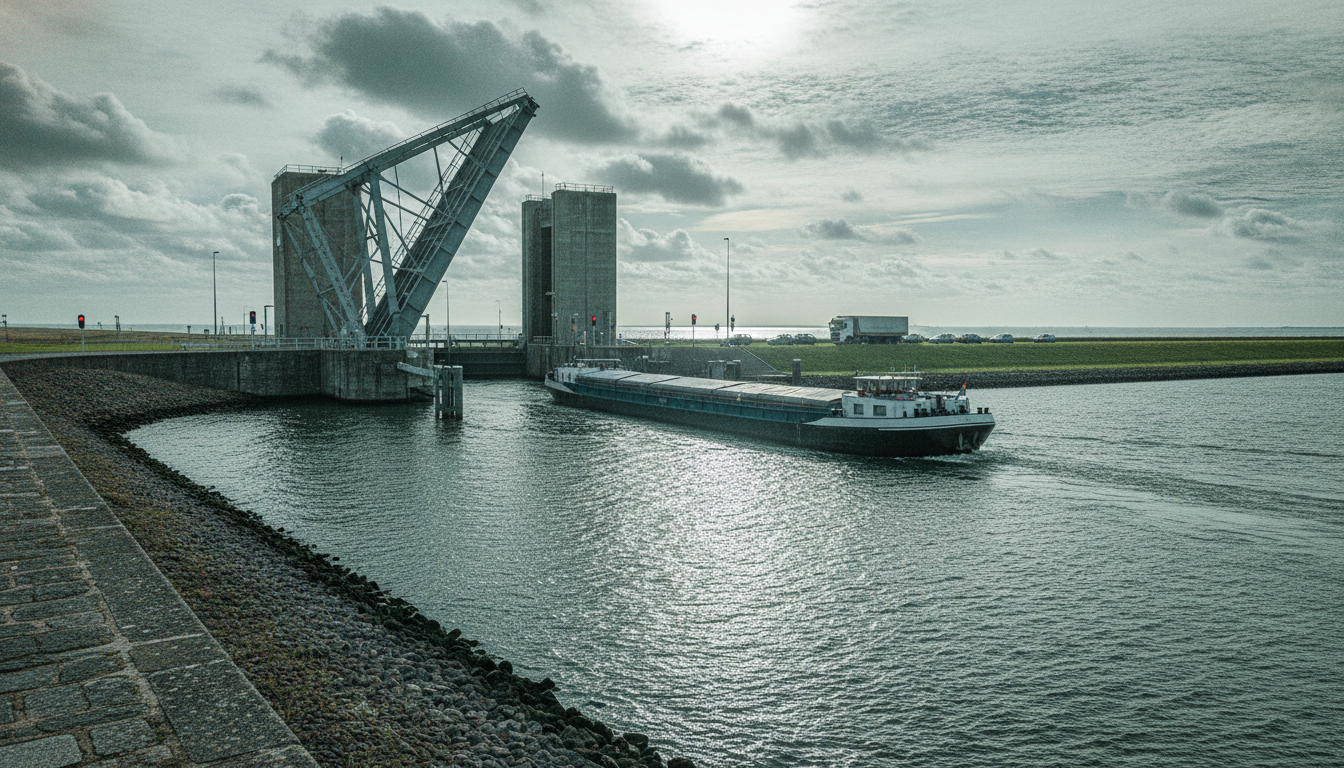
Drive along the A7 across the Afsluitdijk at Kornwerderzand and you experience the lock complex mainly as a moment of standstill: the swing bridge opens, an inland vessel slides through the large lock, and a few minutes later the traffic moves again. That large lock is 14 metres wide. The clearance under the bridges is 16 metres. For the shipyards and ports around the IJsselmeer and on the waterways of Overijssel and Friesland, those figures have long decided which ships can and cannot reach the Wadden Sea.
On 16 October, Minister Karremans and State Secretary Bertram presented the reprioritisation of all national infrastructure projects at the Calandbrug in Rotterdam. Around 18 billion euros will go to maintenance and renewal up to and including 2041, while a series of new construction projects is put on hold. Kornwerderzand sits on both sides of that line. The lock widening is being pushed back, the bridges will be renewed, and according to the inland shipping weekly Schuttevaer this will be done in a way that keeps a wider lock possible later.
That sounds like a sensible compromise. For the people and businesses around the project, it is above all a new phase in a scheme that has hung between two outcomes for six years.
One agreement, two readings
In 2020 central government and the region agreed to widen the Lorentz lock complex and deepen the shipping channels in the IJsselmeer. The arrangements were laid down in an administrative agreement. The province of Fryslân took the lead, and Fryslân, Overijssel and Flevoland jointly pledged a regional contribution of 73.5 million euros. The aim was to widen the large lock to 25 metres so that larger vessels (including new builds from the shipyards and ships serving Port of Zwolle) could reach the Wadden Sea under their own power.
The project stalled. The scenario report of May 2024, drawn up by specialists from the province and Rijkswaterstaat under independent process management, is unusually candid about why. The agreement did not refer to the sketch design and cost estimate on which it was based. At the same time the design had to meet Rijkswaterstaat’s requirements as asset owner, without any provision for what would happen if those requirements conflicted with the sketch design. The report therefore sets out the province’s reading and Rijkswaterstaat’s reading side by side: on the design vessel, on the hydraulic boundary conditions, on the design guidelines.
The consequences were substantial. The original estimate of around 208 million euros grew across the four scenarios to:
- Scenario A, full widening with adaptation of the entire complex: 461 million euros;
- Scenario B, widening with larger vessels passing under an exemption: 381 million euros;
- Scenario C, renovation of the lock and new bascule bridges already suited to later widening: 237 million euros;
- Scenario D, renovation and replacement of the superstructure of the existing swing bridges: 121 million euros.
All figures include VAT and carry a margin of 30 percent. On top of that come measures against salinisation: 114 million euros with a widened lock, 83 million in the current situation. In October 2024 the then minister, Madlener, told parliament it was not realistic for the province to place the cost increase solely with central government.
Salt as the silent decision-maker
The debate on Kornwerderzand is usually framed as a debate about shipping and jobs. In the scenario report, the first question in the decision tree is a different one: from a salinisation perspective, may the IJsselmeer channels be deepened at all?
The answer is uncomfortable. A larger lock chamber lets in roughly twice as much salt water. Deeper channels act as salt highways that carry that salt further into the IJsselmeer, which is a drinking water source. Research by Deltares shows that deepening without mitigation increases the risk of exceeding the drinking water standard, and that this is already an issue at the current salt load. A salt trap with pumps in the inner harbour is technically promising, but widening is only possible if the salt load does not merely stay level but actually falls. That differs from the agreement’s starting point, which assumed a standstill.
Anyone mapping the stakeholders of this project should therefore look beyond shipyards, ports and the province to drinking water companies, water managers and KornwerderZout, the national project that already has to reduce the salt load in the current situation. Those parties are not currently at the table where the lock is discussed.
What has actually been decided
The cabinet did not choose the cheapest option. Renewing the bridges so that widening remains possible most closely resembles scenario C: new bascule bridges suited to larger vessels, combined with a renovated lock that is not. In effect, the cabinet is investing in preparation for an outcome it is simultaneously placing low on its list.
For the region the message is mixed. Provincial executive Matthijs de Vries calls the decision painful and the distribution of funds extremely lopsided, not least because the same round also removes 250 million euros for a better shipping route to Ameland. He points out that the lock matters not only to Friesland but also to Overijssel, Drenthe and Flevoland, and the province will keep lobbying. According to regional broadcaster Omrop Fryslân, the postponement saves several hundred million euros. Karremans stresses that projects have not disappeared from view, but that anyone who wants a different allocation must also say where the money comes from.
The disruption of half a solution
This is where the project matters most for stakeholder and environmental managers. The scenario report worked out the construction phasing for each scenario, and the differences are large:
- Scenario C requires an estimated 4.5 years of construction. One of the two navigation openings is closed for about 35 months, spread over two sailing seasons, with a further 22 months of width restrictions. The small lock closes for half a year outside the sailing season. The cause is the concrete central pier that Rijkswaterstaat requires; according to the report, this cannot be optimised without concessions on maintenance.
- Scenario D requires about 2 years, with a total of four months of full closure outside the sailing season.
- On the A7, all scenarios keep one lane open in each direction during the sailing season.
The report identifies a second effect. With full widening, the closure of the large lock and the construction of the bridges coincide, keeping the total period of disruption as short as possible. That advantage is lost if the bridges are built now and the lock later. The waterway then faces two long construction periods.
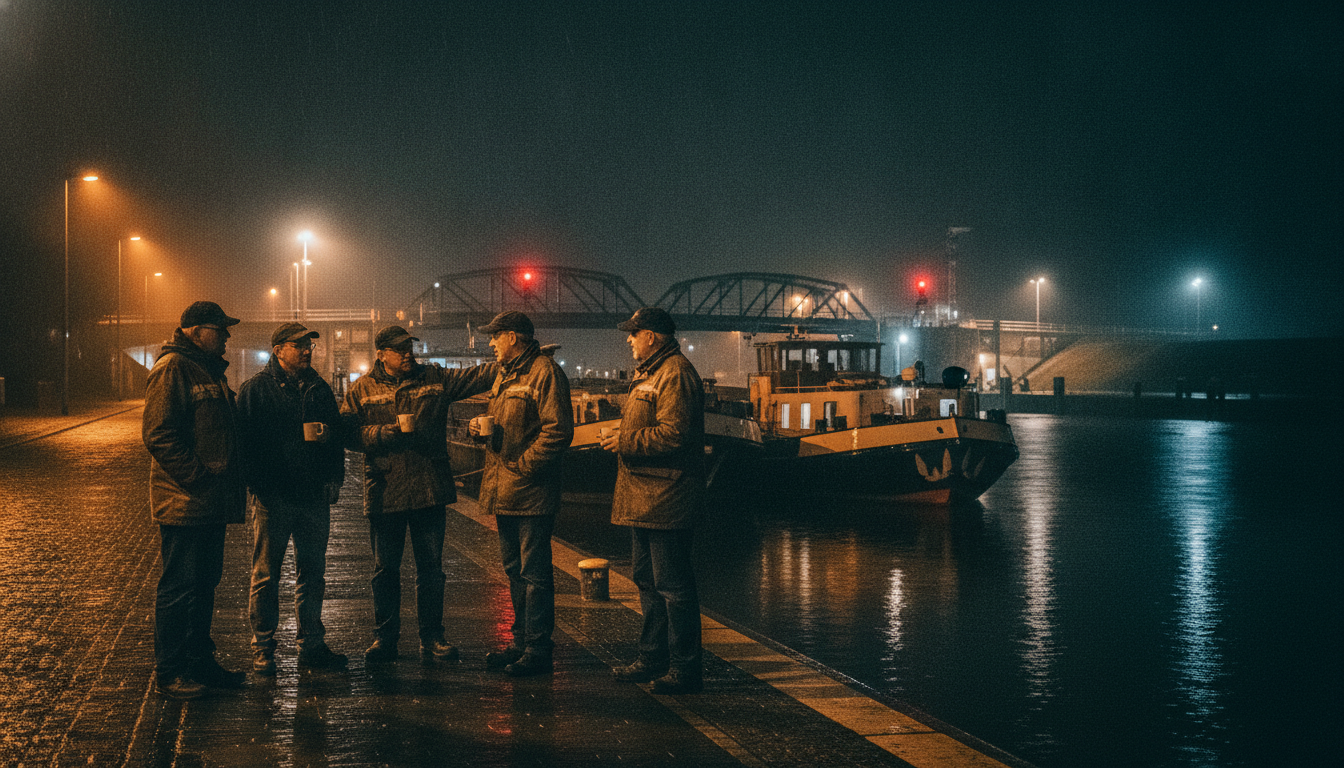
Put plainly: the skipper waiting at the bridge in the coming years bears much of the disruption of a widening that nobody knows will ever happen. That is explainable, but only if someone explains it. The works also interface with Levvel’s DBFM contract for the Afsluitdijk, which the report flags as an explicit risk of delay and extra cost. We argued earlier on this site that the Afsluitdijk is not yet finished for the people around it; Kornwerderzand is the clearest example.
What this demands of the approach
In our view, Rijkswaterstaat and the province face four stakeholder tasks that stand regardless of whether the widening ever goes ahead.
- State the status precisely. Low on the list is neither a decision nor a cancellation. Shipyards, ports and shippers make investment decisions based on what they think is coming. A clear review moment, with the criteria the project will then be tested against, is worth more than the reassurance that it remains in view. Our guide to postponement and cancellation goes into this in more detail.
- Explain why the bridges will be larger than currently needed. Choosing future-proof bridges costs extra money and above all extra closure time. It is a rational choice, but only if the people affected know it is being made and why.
- Bring salinisation to the front. As long as salinisation is an annex to a shipping project, drinking water and shipping remain in separate conversations. The precondition for widening is a falling salt load, which makes KornwerderZout not a side project but part of the critical path.
- Plan closures with the shipping sector, not for it. Commercial vessels will have to detour via Den Oever or the Prinses Margrietkanaal. The scenario report itself warns of compensation claims during long closures and names good, timely communication as the main mitigation.
Outlook
The House of Representatives will debate the reprioritisation after the autumn recess. The regional MIRT consultations follow, and the budgetary processing comes with the 2027 Spring Memorandum. Only then can Rijkswaterstaat firm up the programming and procurement for the bridges.
Kornwerderzand shows that a prioritisation decision is not the end of a project but the start of a harder stakeholder phase. Building the bridges will cause visible disruption in the years ahead. Whether that disruption is experienced as an investment in the future or as a detour to nowhere depends largely on how honestly central government and the province explain, in the coming months, what has and has not been decided.
Sources
- Rijkswaterstaat - Letter to parliament on the reprioritisation of infrastructure maintenance and renewal (16 October 2026)
- NOS - Billions for ageing bridges and locks, at the expense of several major projects
- Weekblad Schuttevaer - Cabinet puts Kornwerderzand lock widening on the back burner
- Omrop Fryslân - Bad news for Ameland and the Afsluitdijk
- Reformatorisch Dagblad - Friesland calls cuts to infrastructure plans painful
- Province of Fryslân and Rijkswaterstaat - Final report on scenarios for widening the Kornwerderzand lock complex (May 2024)
- Schuttevaer - Kornwerderzand lock to cost more than a hundred million extra (October 2024)