
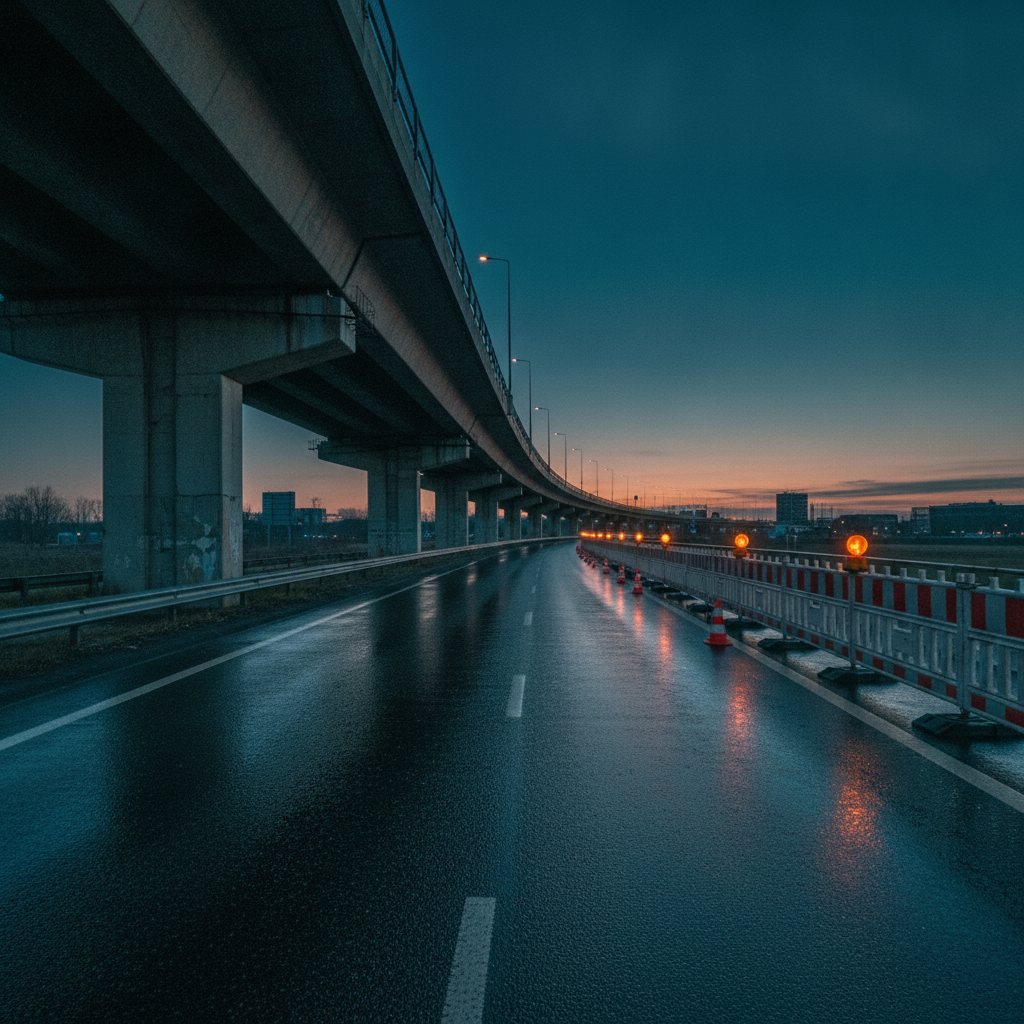
Ninety-two kilometres of asphalt that will not be replaced for now. One hundred and thirty kilometres that will not be repaired. One hundred and four kilometres of crash barrier and ninety-four viaducts, tunnels and bridges whose maintenance has to wait. In June 2026, Rijkswaterstaat announced that it was suspending a whole series of planned maintenance projects across the north and centre of the country, on the A7, A28, A37, N31 and A12 among others. The reason was sobering in its simplicity: the money has run out. Work scheduled for 2027 and 2028 has now been postponed indefinitely, pending a nationwide decision on which projects still go ahead.
It is tempting to read this as an incident, a temporary cash-flow pinch in one region. It is not. It is the visible tip of a structural shortfall that will shape the entire replacement-and-renewal (R&R) programme of the Netherlands for years to come. And that shortfall changes the nature of the work: it shifts the question from how we renew to whether and where we still renew at all. That shift is not merely a financial problem. It is, we would argue, at its core a stakeholder and environmental management issue.
The numbers behind the gap
The maintenance backlog on the Dutch national infrastructure has reached a scale that cannot easily be brushed aside. The Netherlands Court of Audit calculated a shortfall of tens of billions between available budgets and what is actually required: in the order of €34.5 billion for the Rijkswaterstaat estate, plus roughly €20 billion for ProRail’s rail network. TNO modelled the renewal challenge through to the end of the century and arrived at a steadily rising cost curve: from around €1.1 billion a year in 2021 to well over €3 billion a year from 2040 onwards, peaking at almost €3.7 billion around 2080. Together, some €260 billion by 2100.
Against that backdrop, ProRail’s warning sounds sharper than a routine budget lobby. Without structural investment, the rail manager states, only minimal maintenance will be possible from 2026 (the minimum needed to keep trains running safely) and genuine renewals will grind to a halt. ProRail is calling for infrastructure spending to rise from roughly 1.2 to 2 percent of GDP, together with Rijkswaterstaat and the Logistics Alliance. As early as March 2026, the government indicated that “hard choices” were unavoidable and that priorities had to be set before the summer of 2026, so they could be reflected in the 2027 budget.
From renewing to merely maintaining
Minimal maintenance sounds like a sensible, austere choice. It is only very partly that. Maintenance keeps an asset running or navigable; it does not make it future-proof. Postpone renewal and you move the bill to later, and the later bill is usually higher, not lower. ProRail captures it in a single image: the country risks “getting stuck in maintenance mode”, with ever more capacity going into propping up an ageing network rather than preparing it for the future.
The experience elsewhere is not reassuring. Germany’s rail sector has become the textbook example of what long-deferred maintenance does: a network that technically functions but is so worn that disruptions, speed restrictions and prolonged closures become structural. Postponement, in other words, is not a neutral pause button. It is a choice with a rising price tag, and one that rarely allows itself to be scheduled neatly.
Prioritisation is a distributional question
This is where the challenge becomes genuinely interesting for environmental and stakeholder management. Because if the money is not enough to do everything, then someone has to choose what gets done and what does not. “The minister will look at which projects get priority nationally,” reads the plain sentence in the announcement about the north. Behind that sentence lies a distributional question with winners and losers: which regions, which corridors, which assets slide to the back of the queue?
In its programmatic approach, TNO offers a prioritisation logic in which safety is leading “but not the only factor”. That is precisely the point. The moment safety ceases to be the sole yardstick, accessibility, economic significance, regional balance and public support all enter the picture. And these are not quantities you can add up on a purely technical or financial basis. A prioritisation decision that simply falls out of a spreadsheet lacks something essential: legitimacy. Why does the postponement hit the north rather than the Randstad? Why this bridge and not that one? Anyone without a traceable, explainable answer to those questions is organising the very resistance that later makes delivery slower and dearer than the euros saved were ever worth.
Deferred disruption is more expensive disruption
Postponing renewal has a second, subtler stakeholder effect that is at least as important. An asset you fail to renew in time will sooner or later force you into emergency measures: a sudden lorry ban, a weight restriction, a speed reduction and, in the worst case, an abrupt closure. Rijkswaterstaat itself already names such measures as possible consequences of the suspended maintenance in the north.
The difference between planned and reactive disruption is enormous for the surrounding community. Planned renovation can be announced, explained and cushioned with alternatives, as with the major closures around the Drechtsteden region. A sudden restriction simply happens to people. The classic example is the Zwijndrechtse bridge, where in 2025 a lorry ban had to be introduced fairly abruptly because the renovation was still years away. Such interventions erode exactly what stakeholder management runs on: predictability and trust. The surrounding community pays the price of postponement not in euros but in uncertainty, and that is a currency far harder to earn back.
What this asks of environmental management
If the funding gap means that the coming years will bring systematic choosing and postponing, then the role of the environmental manager changes with it. Four things become more important.
Make the prioritisation traceable. A decision not to do something deserves the same careful substantiation as a decision to proceed. Make the criteria explicit (including the non-technical ones, such as accessibility and regional spread) and explain how they were weighed. Legitimacy is created not by the decision, but by the explainable story beneath it.
Be honest about postponement and reliability. Do not call something “temporary” when it is structural. A community that knows a connection will run on minimal maintenance for years can adjust to it; a community lulled with false certainty feels betrayed at the first breakdown.
Think in corridors, not in isolated assets. A postponed asset never stands alone. Push one bridge or lock back and you divert traffic, pressure and risk onto the rest of the chain. Those consequences belong with the decision, not with the next incident.
Involve the community in the allocation, not just in the breakdown. The moment to invest in public support is now, in the phase where the hard choices are being made, and not later, when an emergency closure has already hardened the conversation.
Conclusion
Whether the structural money materialises will be decided in The Hague. But the gap is too large to close with money alone; prioritisation will happen regardless. And it is there that the underestimated task lies. How the scarce money is allocated, and above all how that allocation is explained and legitimised in the region, will determine whether the Netherlands moves through its renewal challenge with trust or with mistrust. Treat prioritisation as a spreadsheet and you will get it back as a trust problem. The funding gap has become a budget question, but it is just as much, and perhaps above all, a stakeholder question.
Sources
- ProRail - Investment lags, focus shifts to maintenance (Dutch)
- NOS - ProRail wants far more money, otherwise ‘only minimal maintenance possible’ (Dutch)
- Mobiliteit.nl - Rijkswaterstaat halts road maintenance in the northern Netherlands: money has run out (Dutch)
- Verkeerskunde - Hard choices needed because of billions in infrastructure shortfalls (Dutch)
- Binnenlands Bestuur / TNO - Five steps towards a manageable infrastructure renewal challenge (Dutch)