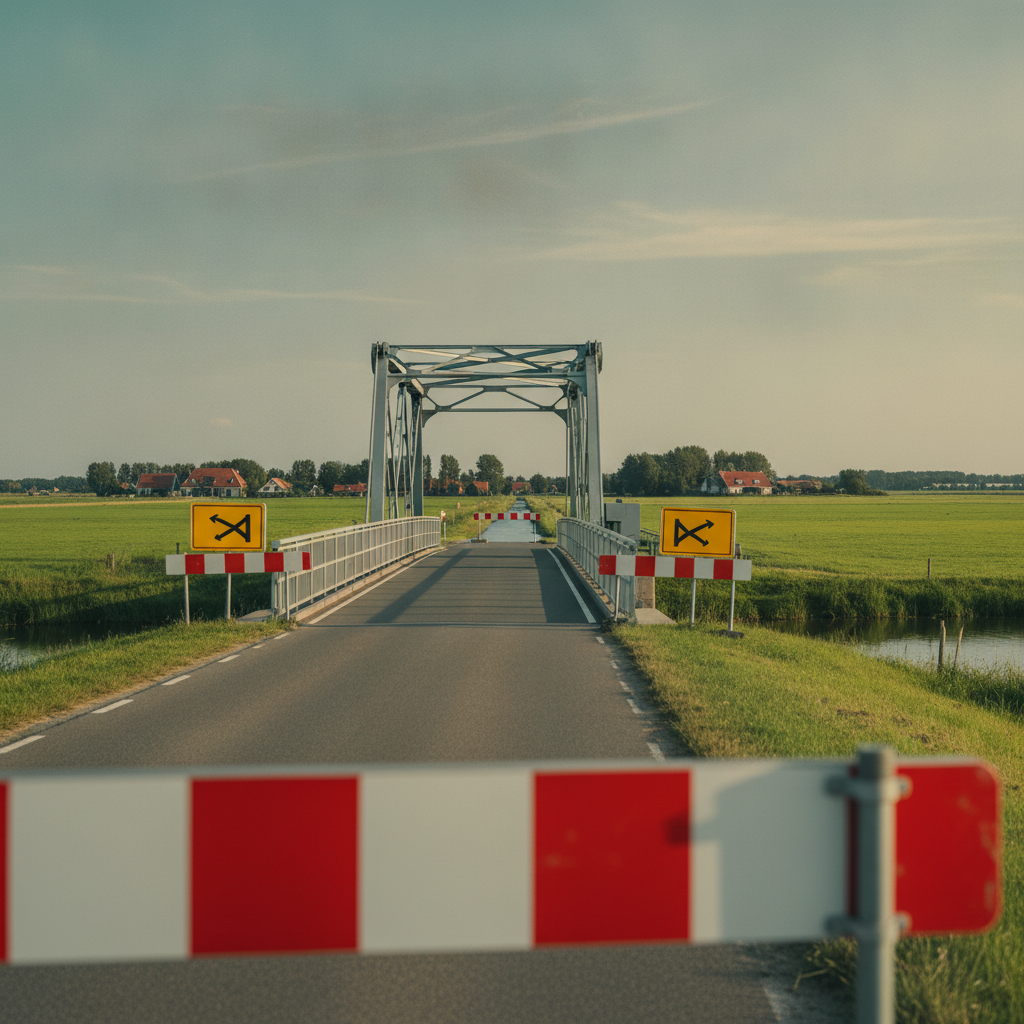

When is a detour acceptable? For a driver taking a few extra minutes, the answer is simple. For a dairy farmer whose land sits on the far bank of the canal, for the home-care worker on a tight daily schedule, or for the shopkeeper whose customers suddenly have to drive five kilometres further, it looks very different. The same detour is a minor nuisance for one person and an eight-week problem for another.
That tension took centre stage this month at the Twee Zwanenbrug near Schagerbrug, in the North Holland municipality of Schagen. The movable bridge over the Stolpen-Schagen canal, at the junction of the N248 and N249 provincial roads, closed completely on 15 July 2026: to cars, buses, cyclists and pedestrians alike. The province of North Holland allowed eight weeks for the work, with a detour via the Zijperbrug. One striking detail: the bridge is only eleven years old. Some rotating components had worn faster than anticipated at construction, and the alignment needed correcting. The contractor is replacing mechanical parts, sandblasting the bridge and repainting it.
A full closure is a technically straightforward job. But experience shows that its success or failure rarely turns on the engineering, and almost always on the surrounding community. In a rural area a bridge is no ordinary stretch of road: it is often the only logical link between two banks, and therefore a lifeline. Below are eight principles for stakeholder managers dealing with a closure of this kind.
1. Start the community dialogue before the plan is fixed
The biggest mistake you can make is to work out the detour, secure the permits, and only then inform the community. That is not participation but an announcement. Whoever waits until the decision is already made squanders goodwill they will badly need later.
For the N248 programme that the Twee Zwanenbrug is part of, the province held drop-in sessions, including on the nearby new Stolperbrug. That is the right order: first gather which dependencies exist in the area, then finalise the phasing and detour. Input from an evening like that is not a formality; it yields the information you need to genuinely reduce the disruption.
2. Map the real dependencies, not just the traffic counts
A traffic count tells you how many vehicles cross the bridge per day. It does not tell you who is among them or what is at stake for those people. In a rural area like the Zijpe, that often means farms with plots on both sides of the water, care routes, school transport, and tourist and recreational traffic in the summer months: precisely the period when the work takes place.
A good stakeholder analysis seeks out those specific interests before the first spade goes into the ground. Who are the hardest-hit parties, and what tailored arrangements are possible? For a farmer, a temporary works bridge or an adjusted exemption can be the difference between inconvenience and business damage.
3. Design the detour together with those who use it
A detour route that looks logical on a desk map can, in practice, run into a narrow dike, a weight limit or a school zone. The people who use the area daily know this better than anyone. So put the proposed route to local users and adjust it where you can.
At the Twee Zwanenbrug the detour runs via the Zijperbrug. For through traffic that works, but for local and slow traffic every extra kilometre weighs relatively heavily. It pays to test explicitly whether cyclists and agricultural vehicles can manage the chosen route, and to add extra provisions where needed.
4. Phase the disruption and promise only what you can deliver
Not every week of a closure has to be equally severe. At the Twee Zwanenbrug the disruption was deliberately split into two phases: for the first four weeks (20 July to 14 August) the bridge stands completely still; in the four weeks after that (17 August to 11 September) it operates again on fixed time slots. That gives shipping some perspective again after the toughest phase.
A phased approach like this is worth its weight in gold for communication, provided you actually hit the promised slots. One missed opening undermines trust in every one that follows. So communicate a generous, achievable margin rather than a tight schedule you fail to keep at the first setback.
5. Set up a single recognisable point of contact
During a closure, questions come in via the municipality, the province, the contractor and sometimes the grid operator all at once. For a resident that is a maze. One clear phone number or email address, staffed by a stakeholder manager who knows the area and has the mandate to arrange something, stops people being passed from pillar to post.
That point of contact is not a luxury but a risk-control measure: complaints picked up quickly and personally rarely escalate to politics or the press.
6. Keep emergency services separately in view
For a lifeline connection, access for ambulance, fire and police is not a communications theme but a safety question. Those services need to know that the bridge is closed, which route they take, and whether response times stay within the norm. This should be coordinated early and formally, not through the general residents’ letter.
The same applies to public transport: bus lines crossing the bridge must be rerouted and the travel information must be correct from day one of the closure.
7. Be honest about the why, especially for a young bridge
A bridge that has to close for eight weeks after only eleven years raises questions. “Was it built wrong, then?” is an understandable reaction. Do not dodge that question. Explain that the rotating parts of a movable bridge are wear-sensitive, that intervening early actually heads off a large, expensive replacement, and that renovating now is cheaper and less disruptive than waiting until failures occur.
Transparency about the cause is not a weakness. It stops the information vacuum from being filled with speculation, and that is exactly what turns a closure into a sensitive project.
8. Use this closure as a benchmark for the next
The Twee Zwanenbrug does not stand alone. It is part of a broader programme in which the same contractor also works on the Stolperbasculebrug, the Waardbrug and the Schagerbrug, and in which a new Stolperbrug is being prepared. That is an opportunity: every completed closure yields lessons about detour behaviour, communication timing and complaint patterns that you can apply directly at the next bridge.
Record those lessons explicitly and share them within the programme team. That way stakeholder management does not become a trick reinvented for each bridge, but a learning system.
The pitfalls
Three mistakes recur again and again with closures like this. The first is underestimating the rural setting: because traffic intensity looks low, the community effort is scoped too lightly, when in fact it is precisely there that every detour kilometre counts relatively heavily. The second is communicating in jargon: “renovation in connection with alignment problems of the rotating components” means nothing to a resident; “the bridge is running out of true and needs adjusting” does. The third is switching gear too late when things go wrong: work on old or heavily used structures holds surprises, and the community forgives an honestly reported overrun sooner than silence.
A full closure of a movable bridge is, in short, not an engineering project but a social one with an engineering core. The technology determines how long the bridge has to stay shut; the community determines whether those weeks go down as a well-managed inconvenience or a drawn-out conflict. The difference lies not in the asphalt or the steel, but in how far the people on both sides of the water feel heard and taken along.
Sources
- Province of North Holland - Renovation of the Twee Zwanenbrug
- Infrasite - Twee Zwanenbrug closed for two months: renovation due to alignment problems and wear
- Mobiliteit.nl - Months-long renovation of the Twee Zwanenbrug starts in July
- Ondernemend Schagen - Drop-in session on the new Stolperbrug and Twee Zwanenbrug renovation