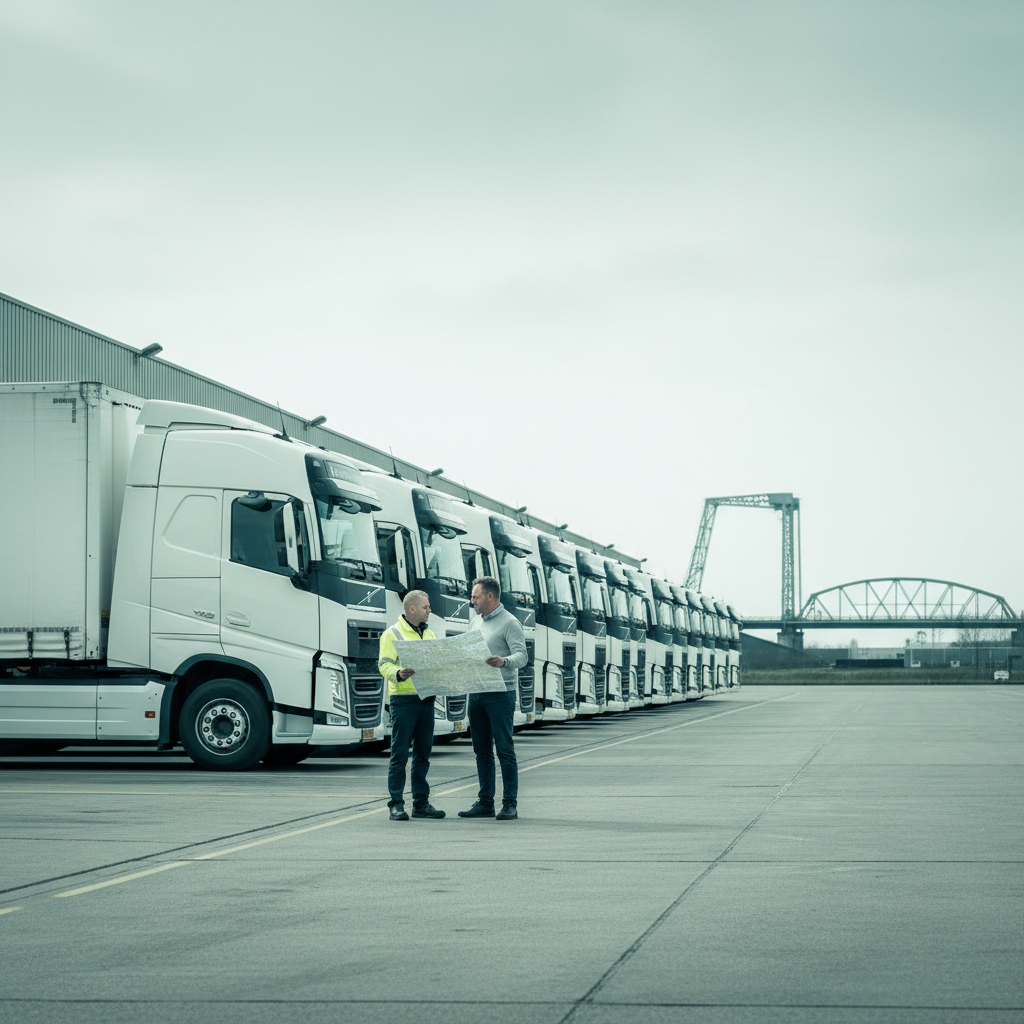
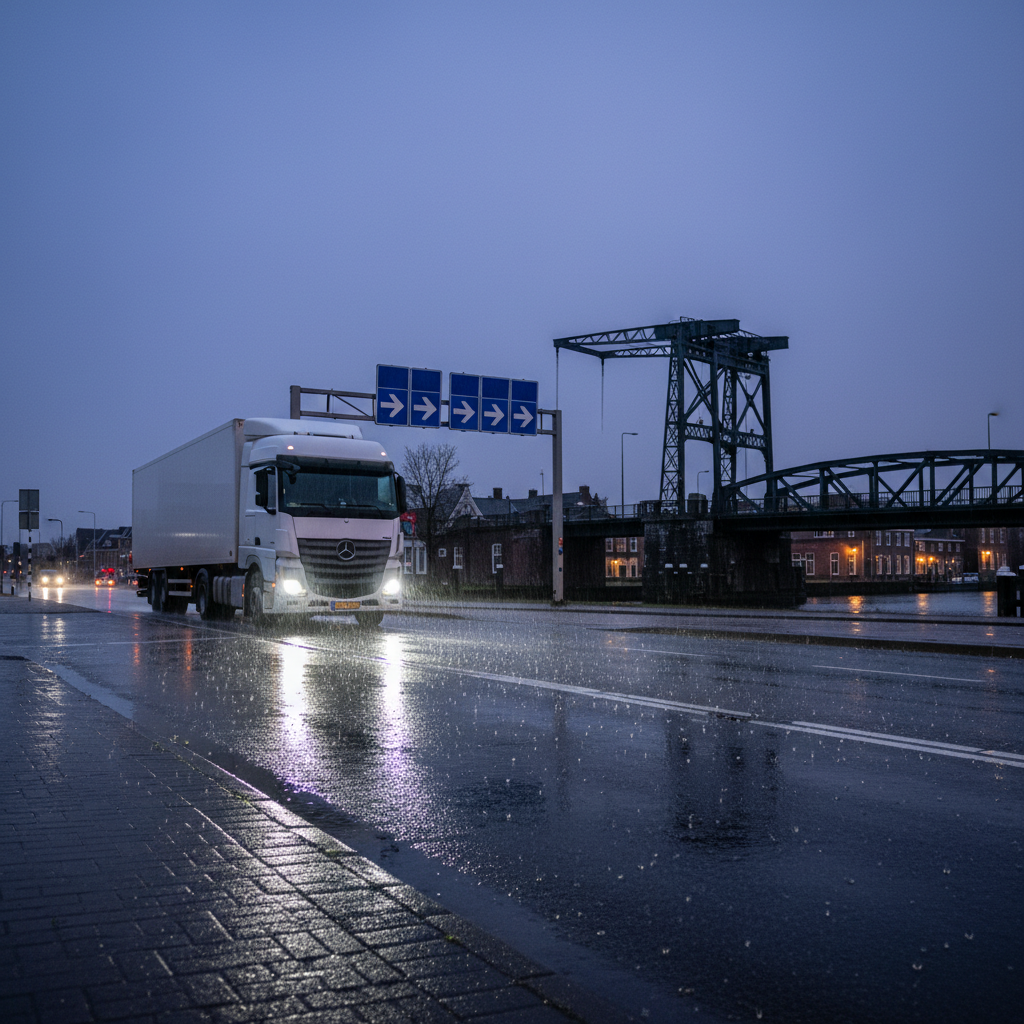
Where the Oude Maas cuts between Dordrecht and Zwijndrecht through the Drechtsteden region, the Verkeersbrug Dordrecht has stood since 1939. Locally almost nobody calls it that — here it is simply the Zwijndrechtsebrug. On 21 May 2026, Rijkswaterstaat announced that heavy traffic would no longer be allowed across it from 3 June. Trucks, tour buses and agricultural and forestry vehicles are being kept off. Emergency services and scheduled buses may continue. The measure stays in place until the planned renovation, currently scheduled to begin no earlier than 2030.
This is no acute incident, no breakdown, no collapsed bearing as occurred at the Merwedebrug in 2016. It is something far more ordinary: a planned interim measure to keep an ageing bridge upright until a renovation that is still years away. For stakeholder and environmental management that is an awkward variant. Nothing will be built, no ribbon will be cut, and the headline message is that the underlying problem will not be solved for the time being.
The bridge and the inspection
The Zwijndrechtsebrug is a 1930s lift bridge — a local artery between central Dordrecht and Zwijndrecht, and a rat run for drivers wanting to avoid congestion on the A16. That makes it exactly the kind of asset on which the Dutch renewal and replacement programme leans most heavily: late pre-war design, decades of intensive loading, and never originally engineered for today’s freight and coach traffic.
During preparation for renovation, Rijkswaterstaat commissioned a detailed structural investigation. The conclusion: the load-bearing structure shows wear at multiple points. The concrete deck slabs are damaged by corrosion of the reinforcement and years of loading. The steel structure has been weakened by material fatigue. No acute collapse risk, but a remaining service life that will only be reached if the heaviest axle loads are removed.
Between that inspection report and the announcement of the ban sits a familiar Rijkswaterstaat process: peer review, second opinion, legal check, alignment with road authorities and emergency services, and only then external communication. For stakeholder management that sequence is recognisable — and also a problem. By the time industry bodies, municipalities and hauliers learn about it, the measure has effectively already been taken.
The stakeholders
A truck ban on a single bridge looks small on a map. In the Drechtsteden it touches four groups directly.
Freight hauliers. For heavy goods traffic, the diversion via the Drechttunnel on the A16 looks simple on paper: two to three extra kilometres, a few minutes of detour. In practice, the Drechttunnel is one of the Netherlands’ busiest tunnels, with regular maintenance closures that industry bodies such as evofenedex publish each year in disruption schedules. A permanent shift of local freight traffic onto that same A16 increases the fragility of the entire corridor.
Coach operators. Tour buses fall under the same ban. For group transport with fixed pick-up and drop-off points in central Dordrecht, that means rerouting, longer trips and, in some cases, transfers at exchange points outside the restricted area. For KNV (the industry body) and regional coach operators, this becomes an operational problem faster than for general freight.
Agriculture and forestry. For agricultural vehicles, the diversion runs via the Papendrechtsebrug on the N3. For farmers on the southern side of the Oude Maas with land on the northern side, that means substantial detours. They are the group least visible in the communication, and often the most deeply affected in practice.
Residents and municipalities. The municipalities of Dordrecht and Zwijndrecht see their local road networks change. On the Dordrecht side, access and exit ramps interact with other flows under increased pressure. On the Zwijndrecht side, traffic shifts towards residential neighbourhoods already loaded with A16 noise. Emergency services and buses still cross the bridge, but the wider accessibility question — can someone with a sick child or a broken boiler still be reached within thirty minutes — shifts with it.
The approach
In its press release, Rijkswaterstaat explicitly noted that it is in discussion with industry bodies, stakeholders and affected municipalities about the measure. That sounds like an open invitation to participate, but in substance the decision is fixed: heavy traffic has to come off, or the bridge cannot be kept safe until 2030. The conversations are not about whether, but about how — about exceptions, enforcement, signage, advance notice, communication to hauliers and alignment with other works in the region.
That is exactly where stakeholder and environmental management can make the difference. Three elements stand out.
First: linkage to the portfolio approach. The Zwijndrechtsebrug is not a stand-alone object. It is part of a wider programme in which Rijkswaterstaat will tackle thirteen bridges, eight tunnels and thirteen roads in the Drechtsteden and Alblasserwaard between 2025 and 2031. The Noordtunnel will be renovated from summer 2027, the Drechttunnel from summer 2029, and the Papendrechtsebrug is also in the programme. A truck ban on one bridge touches directly on the diversion routes needed for those other renovations. The stakeholder question is not “how do we divert the traffic”, but “how do we keep the corridor network intact while we work through every bridge and tunnel in turn over the next five years”.
Second: time as a variable. Four years between announcement and renovation is long enough for hauliers to invest in new routes, businesses to adjust their logistics and residents to come to see the new traffic patterns as normal. But it is also short enough to invite scope creep: municipalities starting to treat the interim measure as the definitive solution, farmers planning their operations around the N3 route, hauliers relocating their depots. By the time the actual renovation arrives in 2030, the stakeholder landscape will look different from today. Environmental managers need to factor in that shifted field now.
Third: communicating a non-solution. “We are doing nothing, we are waiting” is a difficult message. The ban is technically necessary, but for the user it feels like a loss of capacity with no recovery in sight. The experience from the Vlaketunnel closure and the Buitenhuizerbrug petition earlier this year is that such interim measures are only accepted when the user understands why the choice was made, when the real solution arrives and how firm that date is. The phrase “renovation from 2030 onwards” without a concrete schedule risks being moralised over four years as deliberate procrastination.
Current status
At the time of writing (25 May 2026), decision-making is in its closing phase. The measure takes effect on 3 June. Signage, advance information and enforcement arrangements with police and municipalities are under way. Industry bodies have been informed. Enforcement will include camera detection and on-the-ground checks by police and municipal officers; the exact treatment of exemptions for specific businesses will be worked out over the coming weeks.
For the broader Drechtsteden and Alblasserwaard bridge and tunnel renovation programme, the procurement of the Drechttunnel renovation is running in parallel. The contract is expected to be awarded in spring 2026, with execution in 2029–2030 — exactly the window in which the Zwijndrechtsebrug must operate without heavy traffic. These overlap: if the Drechttunnel closes for renovation, the diversion route for freight from the Zwijndrechtsebrug ceases to be available. The programme will need to formulate an answer to that, and the answer will inevitably come from stakeholder management: which combinations are workable, which are not, and what phasing keeps the corridor network functional.
Outlook
What can stakeholder and environmental management mean in this phase, concretely?
Four things stand out.
The Zwijndrechtsebrug case shows that an interim measure before a renovation can demand as much stakeholder management as the renovation itself — sometimes more. A renovation has a contractor, an environmental team, a worksite, a communication plan and a defined window. An interim measure hides inside the operations organisation, with one-off arrangements per stakeholder and without the natural deadlines of a construction project. That structural attention has to be designed in.
The Drechtsteden portfolio approach calls for corridor-wide stakeholder management, not object-bound teams. A truck ban on the Zwijndrechtsebrug, a maintenance closure of the Drechttunnel and a phased renovation of the Papendrechtsebrug are three projects on a planning chart, but for the haulier, the farmer and the municipality they form a single accessibility question.
The four years between the ban and the renovation are a slow-burning risk period for scope creep. Stakeholders will plan as if the interim measure is permanent. Sound stakeholder management keeps the time horizon explicit, with annual reviews, fixed information moments and visible decision dates on the calendar — otherwise the difference between temporary and permanent erodes.
And communicating a non-solution requires sharpness. Four years of waiting for a renovation is harder to explain than four months of disruption during execution. The message has to be honest about what the interim measure costs — in detour minutes, operational burden and reciprocal goodwill — and concrete about what changes after 2030. Vagueness on those points undermines support for the entire portfolio.
The Zwijndrechtsebrug is, in itself, a minor intervention. But as a blueprint for what the renewal programme will produce dozens of times across the Netherlands in the coming years — waiting measures for ageing structures that still have to last several more years — it deserves more attention than a local traffic order. The upcoming renovations are scheduled. The interim period is not.
Sources
- Rijkswaterstaat — No trucks, coaches or agricultural vehicles on Verkeersbrug Dordrecht; 3 June 2026 (Dutch)
- Rijkswaterstaat — Renovation of bridges and tunnels in Drechtsteden and Alblasserwaard (Dutch)
- Infrasite — Heavy traffic banned on Zwijndrechtsebrug until 2030 due to wear (Dutch)
- Transport Online — Ban on freight traffic on Verkeersbrug Dordrecht from 3 June (Dutch)
- Municipality of Dordrecht — Traffic measure Verkeersbrug Dordrecht (Dutch)