Working in public spaces always affects people. Whether it involves a dyke reinforcement, the construction of a heat network, a quay wall renewal or the building of a medium-voltage substation, there are residents, businesses, road users, authorities and interest groups who notice the project. Operational management (omgevingsmanagement) is the discipline that keeps the relationship between the project and its surroundings in balance.
More than “just informing the neighbourhood”
A persistent misconception is that operational management amounts to a residents’ letter and an open evening. In reality, it is a broad and strategic discipline that runs from the initial exploration right through to well after delivery. The operational manager operates at the intersection of engineering, communication, legal affairs and governance, and constantly switches between these worlds.
The discipline is widely applied: at national infrastructure agencies, rail operators, provinces and municipalities, water boards, utility companies and contractors. Wherever projects take place in the physical living environment, operational management plays a role.
The six domains
Operational management comprises six interrelated domains. In practice they overlap, but together they cover the entire playing field.
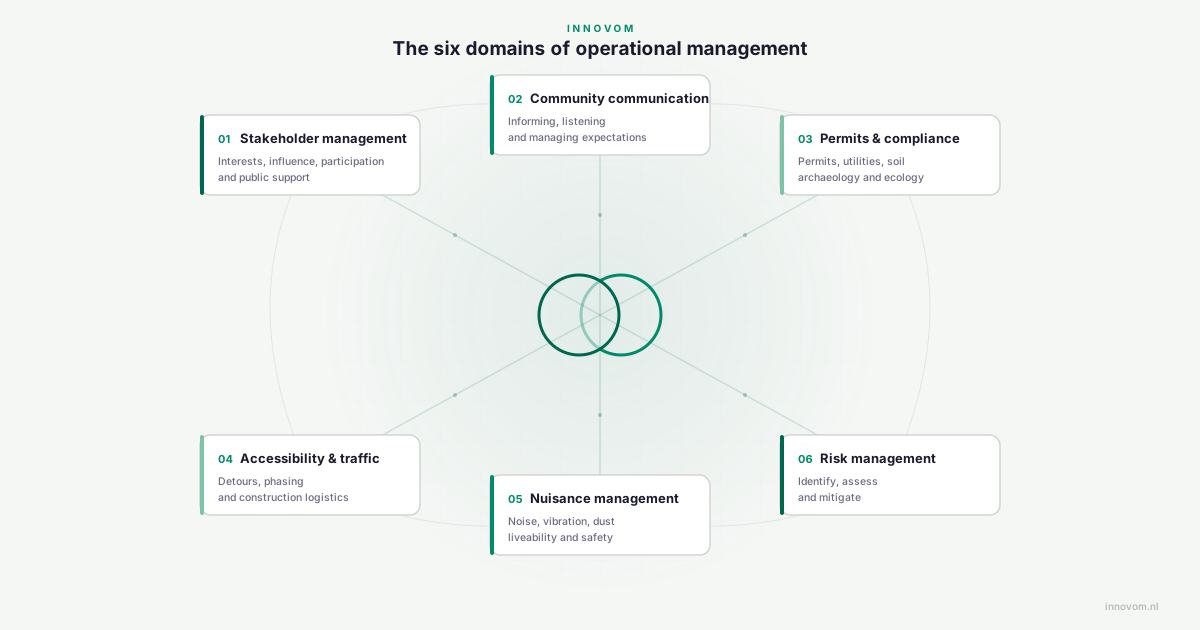
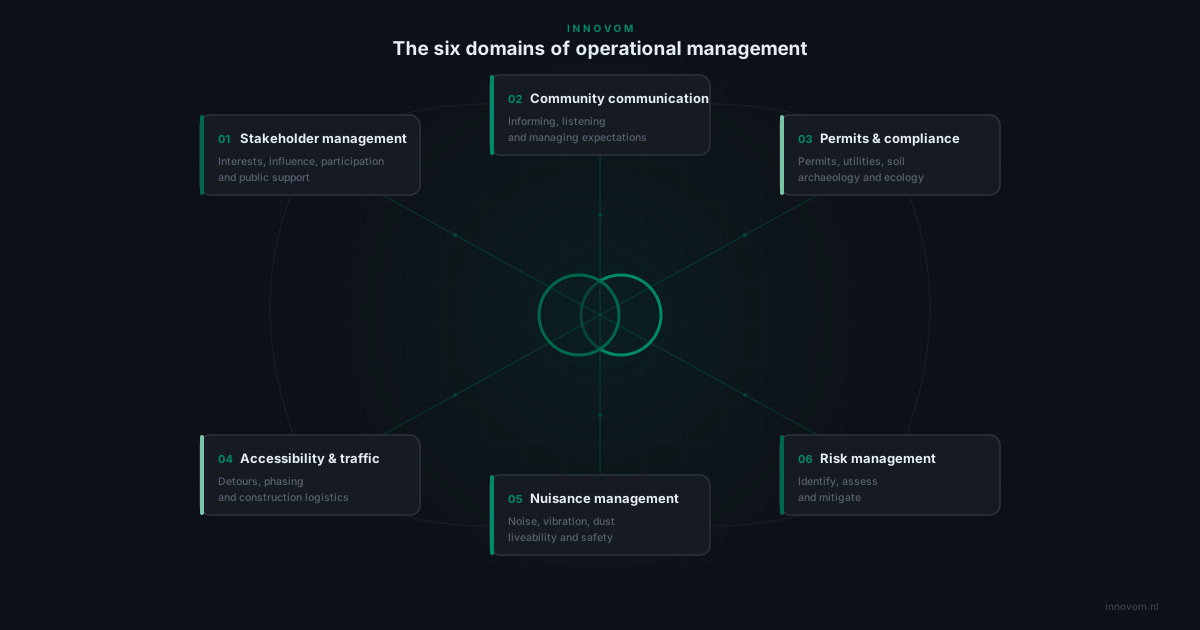
1. Stakeholder management
Who is involved, and what does the project mean for them?
Every project has a web of stakeholders: residents, businesses, municipalities, provinces, water boards, emergency services, nature organisations, utility companies and interest groups. Stakeholder management starts with systematically mapping all these parties: their interests, their influence and their attitude towards the project.
For each stakeholder or group, you develop an approach. Who do you involve early in the design? Who primarily wants to be well informed? Where do potential conflicts lie? This is not a one-off exercise but a continuous process: interests and relationships shift throughout a project.
Stakeholder management is also where client requirements are gathered: wishes and conditions from the surroundings that need to be incorporated into the design.
2. Community communication
How do you inform the surroundings, honestly, understandably and at the right time?
Communication is not a by-product of the project; it is a domain in its own right. Good community communication ensures that people understand what is happening, why it is happening and what it means for them.
In practice, this includes:
- Residents’ letters and newsletters: clear, in plain language
- Open days and drop-in sessions: accessible, in the neighbourhood
- Digital channels: project website, community app, social media
- Personal contact: face-to-face conversations with those directly affected
- Complaints management: a clear and swift process for reports
The communication strategy is derived from the stakeholder analysis and the participation approach. The message differs per project phase: during exploration it is about possibilities, during execution it is about planning and disruption.
3. Permits and compliance
What conditions must be met before construction can begin?
Permits and compliance is the domain where non-technical preconditions are arranged. This is often the most underestimated component, while a missing permit or an unexpected soil contamination can bring the entire project to a halt.
This includes, among other things:
- Permits and exemptions: environmental permits, water permits, nature conservation exemptions, tree felling permits and more
- Utilities (cables and pipelines): inventory, trial trenches, relocations
- Soil investigation: contamination, bearing capacity, remediation plans
- Archaeology: desk studies, trial trenches, monitoring
- Ecology: quick scans of flora and fauna, exemption applications, mitigation measures
- Unexploded ordnance (UXO): detection and clearance
The operational manager coordinates these investigations and ensures that the outcomes are incorporated into the design and planning in a timely manner. An early-stage permit scan prevents surprises later on.
4. Accessibility and traffic
How does the surroundings remain accessible during the works?
Working in public spaces almost always impacts traffic. Roads are closed, detours put in place, bus stops relocated, parking spaces occupied. Accessibility management ensures that this impact remains controlled and acceptable.
This concerns:
- Traffic measures and detour routes: for cars, cyclists, pedestrians and public transport
- Phasing: organising the work so that not everything closes at once
- Coordination: with other projects in the area, with emergency services, with public transport operators
- Construction logistics: supply routes, turning areas, loading and unloading times
In municipal projects, this is often documented in a BLVC plan: Accessibility, Liveability, Safety and Communication. This plan describes which measures apply per phase.
5. Nuisance management
How do you limit disruption to the surroundings, and how do you make remaining nuisance acceptable?
Construction causes nuisance: noise, vibrations, dust, light, odour, reduced accessibility, visual impact. Nuisance management is about minimising that disruption and dealing carefully with the nuisance that is unavoidable.
Specifically:
- Noise and vibrations: monitoring, quiet working methods, working hours regulation
- Dust and air quality: spraying, covering, clean machinery
- Safety: construction fencing, signage, social safety
- Liveability: clean and tidy working, temporary facilities
- Monitoring: measuring and adjusting based on complaints and measurements
Nuisance management is also communication: residents accept more disruption when they know in advance what to expect, and when they notice that their complaints are taken seriously.
6. Risk management
What could go wrong, and how do you prepare for it?
Every project in the living environment carries risks: political changes, legal objections, unexpected soil contamination, public resistance, delays in permit granting or conflicts with stakeholders. The operational manager identifies these risks, assesses them on probability and impact, and ensures that mitigation measures are in place.
In practice, this means:
- Operational risk analysis: systematically mapping risks
- Mitigation measures: concrete actions to reduce or prevent risks
- Periodic review: risks change throughout the project
- Escalation protocol: who decides when a risk actually materialises?
Good risk management is not a paper exercise. It is the discipline of continuously asking: “What are we overlooking?”
How these domains interconnect
The six domains do not stand alone. An outcome from ecological research (permits and compliance) influences the planning and thereby the accessibility measures. A signal from the stakeholder analysis leads to adjustments in communication. A complaint about vibrations (nuisance management) can become a risk if not properly addressed.
The operational manager is the connecting link. Not by doing everything themselves (there are specialists for that) but by maintaining overview, safeguarding coherence and ensuring that the right information reaches the right people at the right time. In the IPM model (Integral Project Management), widely used across government and the infrastructure sector, the operational manager is one of five permanent roles alongside the project manager, technical manager, contract manager and project control manager.
From preparation to delivery
Operational management is not only there “when things get tense”. It runs through every phase:
- Exploration: environmental scan, initial stakeholder analysis, compliance overview
- Plan development: participation, permit processes, gathering client requirements
- Procurement: BLVC plan, environmental requirements in the contract
- Execution: daily operational management, nuisance management, complaints handling
- Aftercare: evaluation, closing relationships, handover to asset manager
The earlier operational management is given a place in the project, the more effective it is. The Dutch Environment and Planning Act (Omgevingswet), which came into effect on 1 January 2024, underscores this: participation has become a legal principle. Initiators must indicate in their application how they have involved the surroundings. Early and careful operational management is therefore not just smart: it is the standard.
In conclusion
Operational management is ultimately a practical discipline. It is about having a conversation with a concerned resident. About finding the right tone in a council briefing. About devising a creative solution when two interests seem irreconcilable. And about the discipline of keeping all the balls in the air while the project charges ahead.
The six domains in this article provide a framework. In upcoming articles, we will delve deeper into each component individually.
Want to know how operational management can strengthen your project? Get in touch. We are happy to think along.