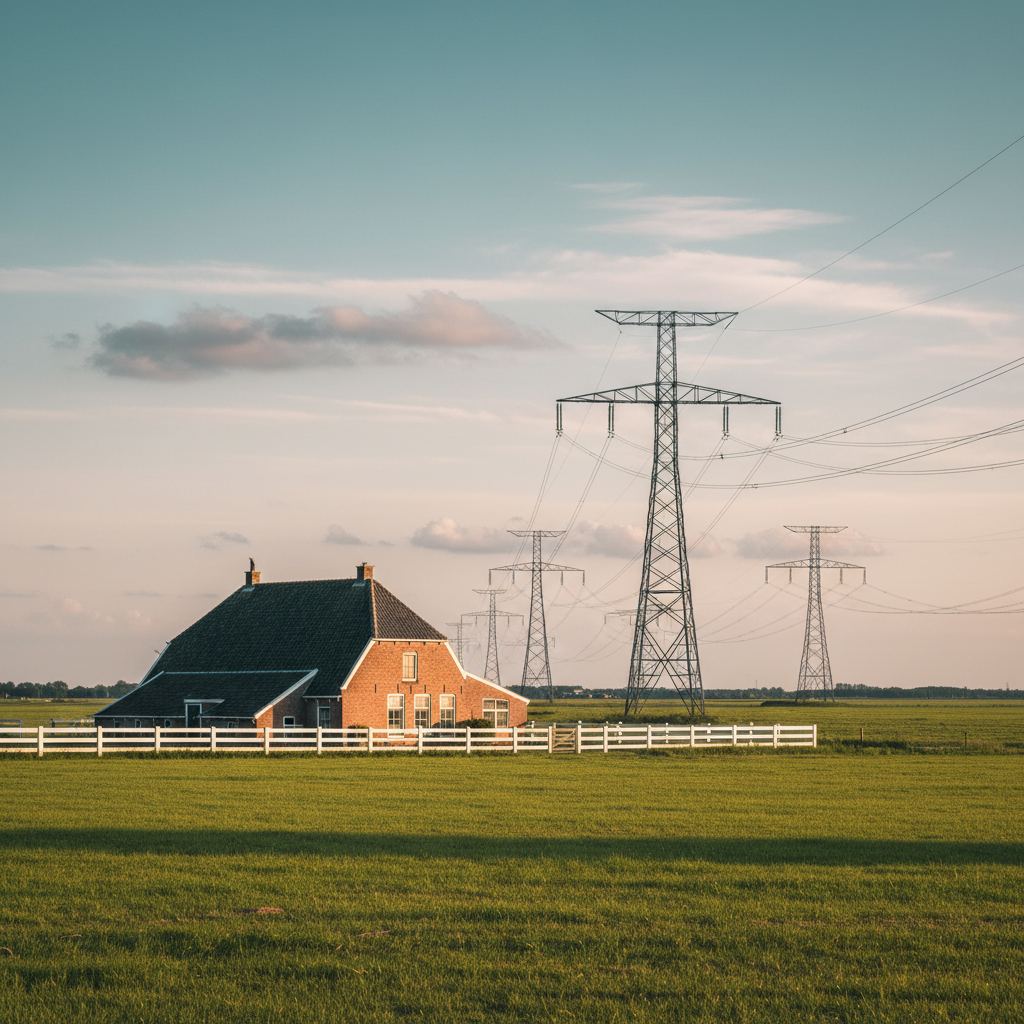
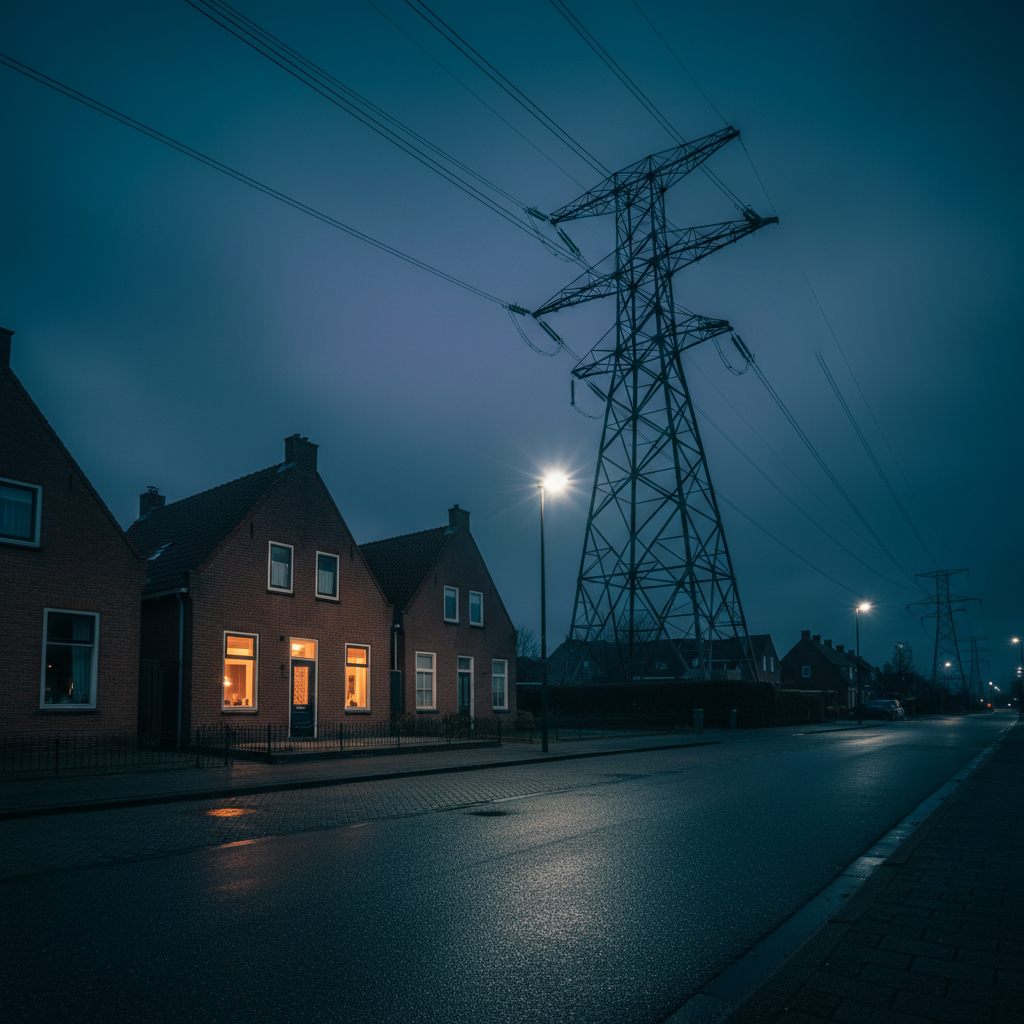
Since 1 January 2026, a new purchase policy from TenneT has applied to homes located within one hundred metres of a new overhead high-voltage connection. Owners can sell their property to the transmission system operator at market value. Tenants in the same zone are entitled to a relocation cost allowance. It is a significant extension of the old practice, in which such purchases typically only became negotiable once planning damage or formal expropriation proceedings were on the table.
Five months after entering into force, the first major applications are underway. From 22 May to 2 July 2026, the preliminary preferred decision for the Vierverlaten–Ens 380 kV connection is open for public review — a route running through parts of Friesland, Groningen, Drenthe and the Noordoostpolder. For the Diemen–Ens connection, the draft preferred decision is expected in the autumn of 2026. The first serious critiques are coming into focus along with these milestones: not so much about the level of compensation, but about the deadlines, the geographic spread, and what the scheme implicitly says about the relationship between transmission system operator and surrounding community.
Why a more generous scheme
The scale of the upcoming grid expansion is out of proportion to anything the Netherlands has previously been used to. The 220 kV network in the north of the country will hit its capacity limit around 2030. Additional electricity from offshore wind farms must be conveyed inland from Eemshaven and the northern coast, en route to consumption centres in the west and centre of the country. The 380 kV grid expansion is the spine for that flow. At the same time, growth in Flevoland and Almere requires a new Diemen–Ens connection, and preparations are underway for reinforcements between Zeeland-Flanders and West-Brabant and in the Randstad.
For TenneT, this is a delivery programme on a scale never seen before. For surrounding communities, it means that tens of thousands of homes will, for the first time or anew, find themselves in the spatial influence area of a high-voltage route. The more generous buyout scheme is a sensible step in that light. Residents who genuinely do not want to live next to a pylon now have a choice — and no longer need to litigate or pursue formal expropriation to enable a sale at market value. It also relieves the transmission system operator of a difficult defensive position in public meetings: “You can sell, and we will help guide that process.”
The hundred-metre boundary
The hundred-metre zone is not a new norm, but borders on the older debate about magnetic field contours. Scientifically, after decades of research, there is no convincing evidence of health damage at the levels found in Dutch housing around high-voltage routes, with the exception of a statistical signal around childhood leukaemia that has never been fully explained away. Precautionary policy uses a guideline value of 0.4 microtesla, and in many practical situations the hundred-metre zone is a reasonable approximation of that line.
Yet this sharp boundary creates new stakeholder and environmental management challenges. A house at 98 metres receives an offer, a house at 102 metres does not. At TenneT’s drop-in sessions — among others around the Geervliet–Krimpen connection in Krimpen aan den IJssel — that issue quickly resurfaced in resident questions. Two identical farmhouses on the same polder road, effectively the same landscape, with different outcomes. The rationale of the policy (an applicable, verifiable threshold) sits in tension with the lived experience (comparable disturbance, unequal compensation). In practice this requires environmental managers to provide explicit explanations at the level of the individual case, with a repeatable narrative: not that it is fair, but that it is workable, and why a straight boundary is necessary in a scheme of this scale.
The six-month deadline
The sharpest critique is procedural. Residents within the hundred-metre zone receive an offer following appraisal, but must decide within six months. For urban housing markets that is a workable timeline. In the sparsely populated parts of Friesland and Groningen, the dynamics differ. Friesian administrators reacted via Omrop Fryslân with frank astonishment: in parts of their territory, homes in comparable price segments rarely come onto the market, let alone within half a year does a suitable replacement become available.
The combination is unfortunate. A resident has six months for a decision that affects the rest of family life — and which in practice only becomes truly concrete when the definitive preferred decision is taken (for Vierverlaten–Ens expected early 2027), while the actual visual and physical impact is still years away. Meanwhile, the deadline does run as a legal matter: those who wait too long can forfeit their rights.
For stakeholder and environmental management, this means that communication about these deadlines must happen up front and consistently. Not as a legal footnote at the back of a letter, but as a core message in the very first personal conversation. People considering selling need time to orient themselves — on relocation destinations, on tax consequences, on the conditions of sale. The transmission operator that provides practical guidance here (an independent financial advisor, a relocation advisor, help in the search for a replacement property) will, in the evaluation round a few years from now, hold a far better reputation than the party that simply sent an offer letter.
What this means for other network operators and projects
The buyout scheme currently applies only to new overhead 380 kV connections by TenneT. But regional distribution network operators — Liander, Stedin, Enexis — will, in the wake of this scheme, inevitably be confronted with the question of what they offer around new 150 kV and 110 kV expansions. The same applies to reinforcements on existing routes and to new distribution stations close to residential development. A difference in compensation approach between network operators will quickly be framed in formal participation processes as unequal treatment.
For environmental managers there are three practical assignments. First: make the scheme known in the very first contact moments, not only in the closing phase of the preferred decision. Residents who only hear about a buyout option at the formal response stage feel ambushed. Second: organise independent guidance. The network operator is appraiser, buyer and project developer in one — a separation of interests in the advice given to residents is essential to maintain trust. Third: link individual case handling explicitly to the broader area task. If one resident accepts the buyout while a neighbour stays, a fragmented ribbon along the route emerges over the years — once again requiring joint stewardship by municipality, province and network operator.
In closing
The buyout scheme is a substantial improvement over previous practice. But a scheme is not stakeholder and environmental management; it is a tool. The quality of execution will be determined by the combination of procedural clarity, personal guidance, and the ability to keep the tension between straight boundaries and individual situations manageable. For TenneT, this means that the ongoing public review of Vierverlaten–Ens is not just a formal procedural step, but the first practical test of a policy on which the entire Dutch grid expansion will ultimately lean. The experiences accumulated there in the coming months will be read sector-wide.
Sources
- TenneT — Purchase policy for new overhead high-voltage connections
- TenneT — Vierverlaten–Ens 380 kV
- TenneT — Diemen–Ens 380 kV
- RVO — 380 kV high-voltage connection Diemen, Lelystad and Ens
- Omrop Fryslân — Friesian administrators astonished by buyout scheme
- TenneT — Expansion of the 380,000 volt high-voltage grid