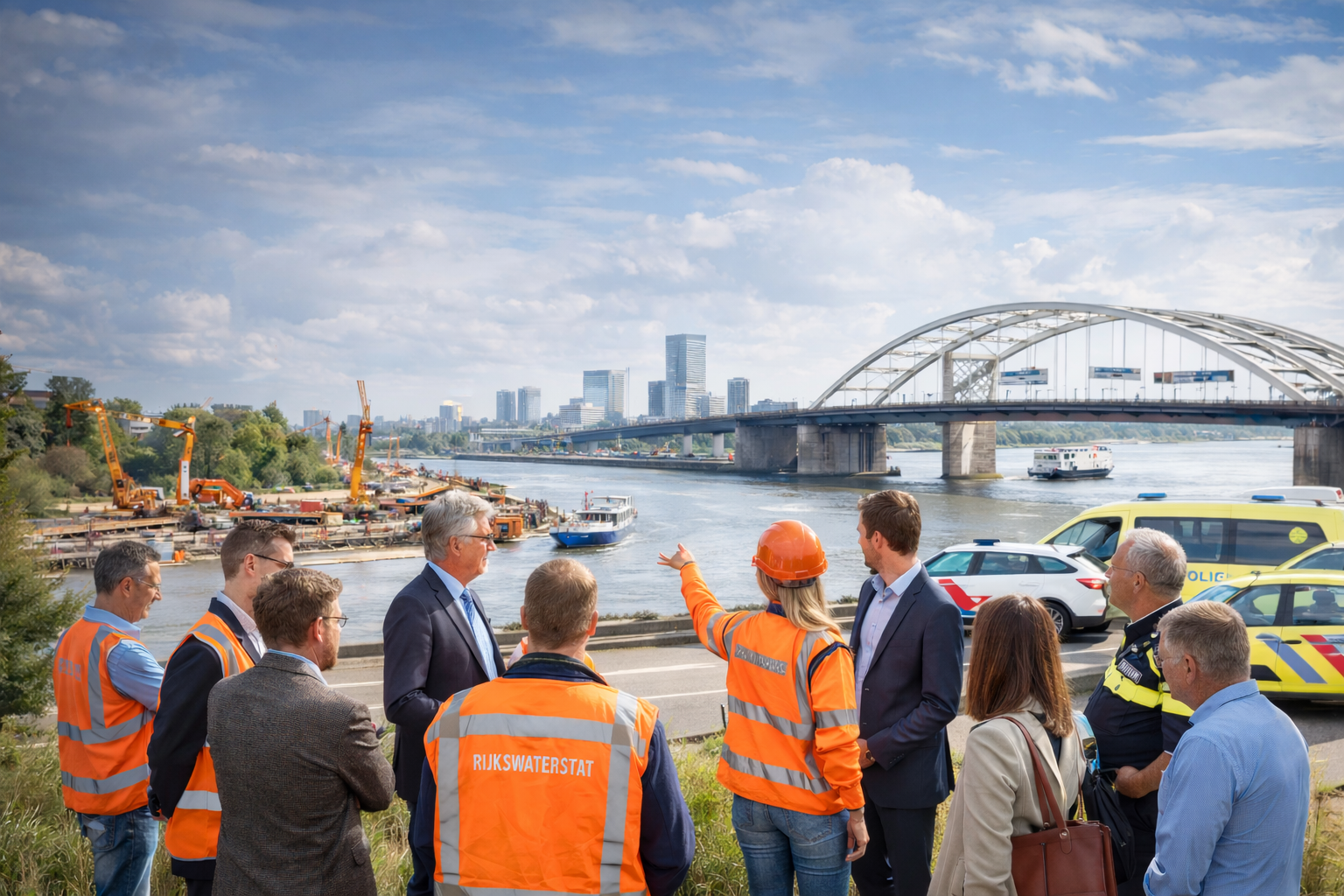
The renovation of the Van Brienenoord Bridge in Rotterdam is one of the largest bridge projects in the Netherlands. The bridge over the Nieuwe Maas connects Rotterdam-South with the north and is used daily by over 120,000 vehicles. When Rijkswaterstaat (the national infrastructure agency) announced the renovation, it quickly became clear that the technical challenge — how do you renovate a bridge over fifty years old under continuous traffic? — is at least as complex as the societal challenge: how do you keep a city accessible, businesses running and residents satisfied while a crucial connection is under construction for years?
This article addresses that second challenge: stakeholder management. The systematic identification, analysis and engagement of all parties with an interest in a project. Not as an administrative exercise, but as a strategic discipline that makes the difference between a project that succeeds and one that stalls.
What is a stakeholder?
A stakeholder is anyone who has influence on the project, or who is affected by the project. That sounds simple, but in practice the field of forces surrounding a large infrastructure project is surprisingly broad.
For a project like the Van Brienenoord Bridge, consider:
- Client and asset manager — Rijkswaterstaat as road manager and initiator
- Competent authority — the Municipality of Rotterdam as permit issuer
- Executing parties — the contractor consortium, subcontractors, engineering firms
- Other authorities — the Province of South Holland, the Rotterdam-Rijnmond Safety Region
- Utility companies — Stedin, KPN, water company Evides — with cables and pipelines in and near the bridge
- Port of Rotterdam Authority — shipping beneath the bridge must continue
- Public transport operators — RET with bus routes across the bridge
- Business community — logistics companies, retailers, employers on the south bank
- Road users — commuters, freight traffic, delivery services
- Local residents — residents of Feijenoord, IJsselmonde and Kralingen who experience nuisance
- Emergency services — fire brigade, ambulance and police who respond via the bridge
- Interest groups — cyclists’ union, environmental organisations, business associations
That already amounts to more than twenty stakeholder groups, and the list is not even complete. Identifying stakeholders is not a one-off action — throughout the project, new parties emerge and interests shift.
Identifying stakeholders: the first step
Identifying stakeholders begins with a broad inventory. In practice, operational managers (omgevingsmanagers) use various methods:
Exploration from the project. Walk through the project geographically and thematically. Who lives in the immediate vicinity? Which businesses are established there? Which cables and pipelines run through the corridor? Which permits are required — and therefore which authorities are involved? Which roads are affected?
Exploration through networks. Ask existing contacts who they consider a relevant party. Stakeholders often know other stakeholders you had not considered.
Exploration from previous projects. In comparable projects in the past — which parties proved important? Which were surprised because they were not involved?
Exploration from legislation. The Dutch Environment and Planning Act (Omgevingswet) requires initiators to indicate how they have involved the surroundings. Which statutory advisers and permit authorities exist?
The result is a stakeholder register: an overview of all identified parties with contact details, an initial assessment of their interest and influence, and the responsible person from the project team.
The stakeholder matrix: interest versus influence
Not every stakeholder requires the same approach. A resident living directly next to the construction site has different needs than a provincial administrator watching from a distance. To determine who deserves what attention, operational managers use the stakeholder matrix — also known as the interest-influence matrix.
The matrix places stakeholders on two axes:
- Interest: how strongly does the project affect this stakeholder?
- Influence: how much power does this stakeholder have to affect the project?
This produces four quadrants, each with its own strategy:
High interest, high influence → Actively engage
These are the stakeholders who can make or break the project. For the Van Brienenoord Bridge, this includes Rijkswaterstaat itself (as client), the Municipality of Rotterdam (as permit authority and competent authority) and the Port of Rotterdam Authority, which must safeguard shipping.
Strategy: close collaboration, regular consultation, joint decision-making. Invest in the relationship before problems arise.
High interest, low influence → Inform
Local residents and road users often fall into this quadrant. They are directly affected by the project but have limited formal power to influence it.
Strategy: communicate transparently and regularly. Take concerns seriously. Provide an accessible channel for questions and complaints. The risk with this group is that dissatisfaction escalates through media or politics — causing their influence to increase after all.
Low interest, high influence → Keep satisfied
Think of a provincial administrator or a Member of Parliament following the project from a distance. The project does not directly affect them, but they can significantly disrupt the project with a political question or motion.
Strategy: keep informed, no surprises. Ensure they are positively briefed when the project appears in the news.
Low interest, low influence → Monitor
Stakeholders whom the project barely affects and who have little influence. Think of a utility company with no cables in the corridor, or an interest group focused on a different theme.
Strategy: keep an eye on with minimal effort. Positions can shift — a party currently in this quadrant can suddenly become relevant due to a change in the project.
From analysis to strategy: the engagement approach
The stakeholder matrix is not an end in itself. It is the starting point for a considered engagement approach — a plan that describes per stakeholder or group:
- Objective: what do we want to achieve in the relationship with this stakeholder?
- Message: what is the core message we want to convey?
- Channel: how do we communicate — in person, in writing, digitally, through events?
- Frequency: how often is contact needed?
- Responsible person: who on the project team is the point of contact?
For the Van Brienenoord Bridge, this might look like:
Port of Rotterdam Authority — monthly strategic meetings, weekly operational consultation on waterway availability, direct line between harbour master and project director.
Residents of Feijenoord — quarterly newsletter, drop-in sessions at phase transitions, dedicated helpdesk for nuisance reports, neighbourhood contact person on behalf of the project.
RET — technical consultation on detour routes and bus stops, joint communication towards passengers, coordination on night works.
Public support is not a tick-box exercise
One of the most common mistakes in stakeholder management is treating it as a checklist. “We organised a drop-in evening, so public support is sorted.” It is not.
Public support arises when stakeholders feel that:
-
They are heard — not that they are listened to for the sake of listening, but that their input is genuinely weighed in decisions.
-
They are honestly informed — including about the uncomfortable things. That the bridge will be closed for three years. That piling will take place at night. That the detour adds twenty minutes of travel time.
-
The project serves a reasonable purpose — people accept nuisance when they understand why the project is necessary and when they see that efforts are being made to limit disruption.
-
There is a listening ear when problems arise — a complaint that is handled quickly and seriously builds more trust than ten newsletters.
During the renovation of the Heinenoord Tunnel in the 1990s, it was found that early involvement of the surroundings significantly increased public support for far-reaching traffic measures. The lesson: invest in the relationship before you need something from the community.
Risks of poor stakeholder management
When stakeholder management falls short, the consequences are concrete:
-
Legal proceedings — objections and appeals against permits can delay a project by months to years. The Environment and Planning Act explicitly requires participation; a deficient approach weakens the legal position.
-
Political escalation — an angry residents’ group that seeks media attention or prompts council questions forces administrators to intervene. The project loses control.
-
Scope changes under pressure — concessions made under time pressure to dissatisfied stakeholders lead to cost overruns and delays.
-
Reputational damage — a client or contractor known as “not listening” faces immediate resistance in the next project.
The costs of poor stakeholder management are rarely visible in the project budget, but are certainly felt in the timeline. Research shows that in large infrastructure projects, a significant proportion of delays can be traced back to public resistance that could have been prevented.
Stakeholder management through project phases
Like the project itself, stakeholder management passes through various phases:
Exploration
- Broad inventory of stakeholders
- Initial analysis of interests and influence
- Environmental scan: what is happening politically, socially, legally?
- Building relationships with key figures
Plan development
- Participation process: stakeholders contributing ideas on design and planning
- Gathering client requirements: what wishes and conditions does the surroundings have?
- Permit process: formal consultation and views
- Refining the stakeholder register based on conversations
Procurement and preparation
- Incorporating environmental requirements into the contract
- Involving the contractor in stakeholder relationships
- Preparing a BLVC plan (Accessibility, Liveability, Safety, Communication)
- Preparing communication tools: website, newsletter, helpdesk
Execution
- Daily operational management on the construction site
- Complaints handling and nuisance reporting
- Proactive communication at phase transitions and unexpected disruption
- Monitoring compliance with stakeholder commitments
Delivery and aftercare
- Feedback to stakeholders: what was done with their input?
- Evaluation of the engagement approach
- Transfer of relationships to the asset manager
- Closing outstanding commitments
The Van Brienenoord Bridge: what makes this project special?
The renovation of the Van Brienenoord Bridge illustrates several characteristics that make stakeholder management in large infrastructure projects particularly complex:
Long-term impact. The project spans several years. Stakeholders must be engaged not once but continuously. Relationships and interests shift over that period.
High visibility. The bridge is an icon of Rotterdam. Every change is news. This makes communication extra sensitive — but also offers opportunities for positive attention.
Complex interdependencies. Road, waterway, rail and public transport converge. A decision about waterway scheduling affects traffic planning affects public transport planning affects communication planning. Stakeholder management must oversee these chains.
Multiple clients and managers. Rijkswaterstaat, the Municipality of Rotterdam, the Port Authority and ProRail each have their own role and their own stakeholders. Coordination between these organisations is a stakeholder challenge in itself.
Financial uncertainty. The project costs have risen significantly — from 680 million to a range of 1.5 to 2 billion euros. This creates political and public pressure that influences the stakeholder landscape.
Practical tips
Based on our experience with complex infrastructure projects, a number of practical recommendations:
-
Start earlier than you think. The first stakeholder contacts should be made during the exploration phase, not at the start of execution. The earlier you invest in relationships, the more goodwill you build for the moment things get tense.
-
Make it personal. A project website and newsletter are necessary, but the real work happens in personal conversations. Know your stakeholders by name. Know what drives them.
-
Be honest about what cannot be done. Stakeholders appreciate honesty more than fine promises. “We cannot prevent the nuisance, but this is what we are doing to limit it” is more powerful than evasive language.
-
Document everything. Record commitments, promises and signals. In a project spanning years, team members change. Continuity in the stakeholder relationship is crucial.
-
Monitor and evaluate. Track how stakeholders experience the project. Use complaint registrations, surveys and personal contacts as indicators. Adjust course when needed.
-
Think in coalitions. You do not need to serve every stakeholder individually. Seek natural coalitions — a sounding board group of residents, a consultation of utility companies, an administrative platform of authorities.
In conclusion
Stakeholder management is not a side issue in large infrastructure projects — it is a core competency. The engineering to renovate a bridge is complex, but manageable. The societal playing field often less so. The difference is made by operational managers (omgevingsmanagers) who understand the field of forces, maintain relationships and translate between the project world and the outside world.
The Van Brienenoord Bridge will ultimately be renovated. The question is not whether it will succeed, but what Rotterdam looks like while it is happening — and whether the city experiences the project as a burden or as a shared challenge. That is where stakeholder management makes the difference.
Want to know how stakeholder management can strengthen your project? Get in touch — we are happy to think along.