In December 2025, Rijkswaterstaat published its first multi-year renewal overview for 2026-2030: a candid document that exposes the full scale of the challenge. Of the €12.85 billion in required investments in bridges, tunnels and locks, €6.55 billion has no funding secured. Meanwhile, ageing infrastructure is increasingly reaching its technical limits, and unplanned outages and emergency safety measures can dramatically amplify societal disruption. This demands a fundamentally different approach to stakeholder and environmental management: not as a by-product of a construction project, but as the core of the project strategy.
Infrastructure at the edge of its lifespan
After the Second World War, the Netherlands rapidly expanded its infrastructure network. In the 1950s and 1960s, tens of thousands of structures were built: concrete bridges over rivers, locks in canals, tunnels beneath busy motorways. The technical lifespan of concrete and steel is finite, however, and for many of these assets that limit is now approaching.
Rijkswaterstaat manages 5,458 kilometres of national road with 1,143 bridges and 27 tunnels, and 6,300 kilometres of waterway with 92 lock complexes. More than 4,700 of those bridges are concrete, and virtually all were built during that post-war construction wave. The organisation currently renovates approximately 5 concrete bridges per year. To address the backlog, that rate needs to rise to around 50 bridges per year, a tenfold increase.
The environmental dimension: beyond nuisance management
The renewal challenge is often framed as a construction and financing question: who pays, who builds, how do we distribute the burden over time? But for all parties involved (residents, the inland shipping sector, emergency services, regional authorities), the central question is different: how does my environment remain accessible and liveable while this work takes place?
That question elevates stakeholder and environmental management to a strategic instrument, not merely a communication tool. A few concrete examples illustrate why.
Extended closures and alternative routes
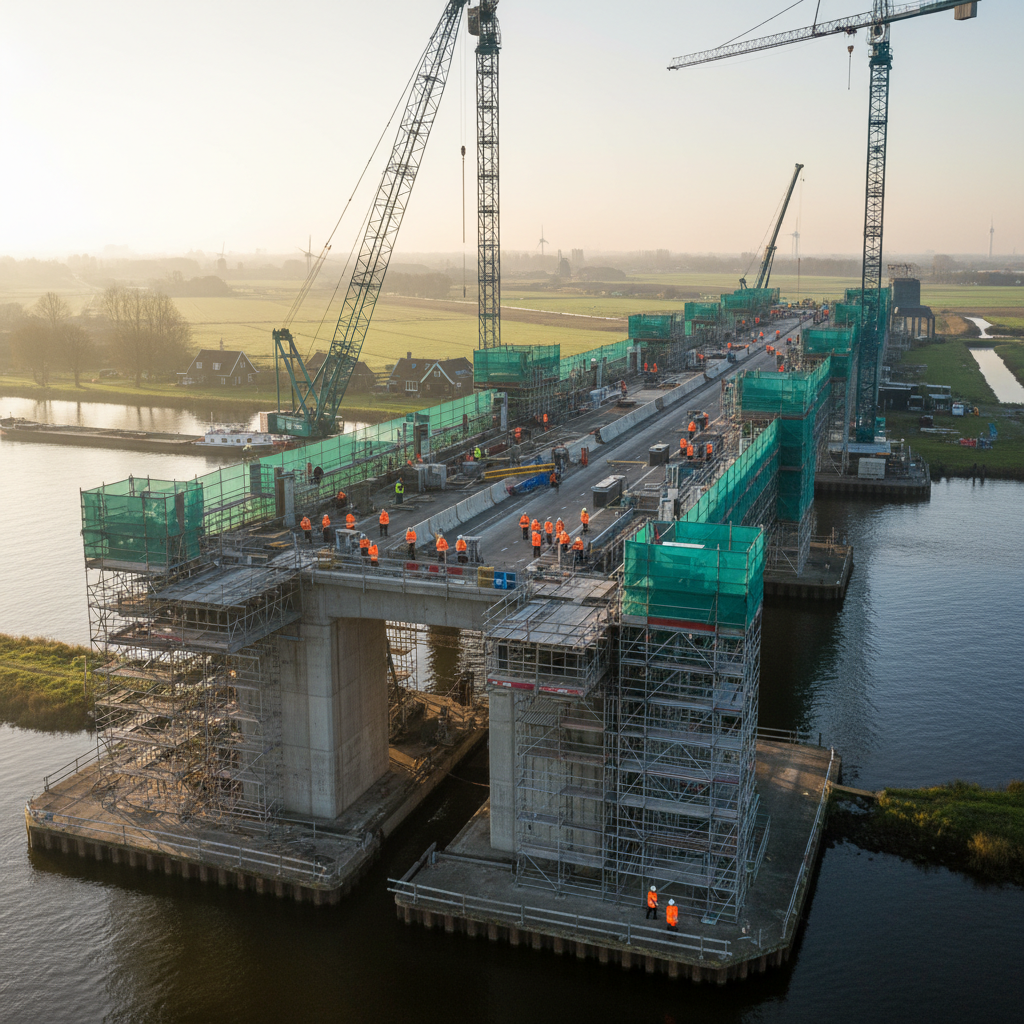
The renovation of the Papendrechtsebrug (N3), planned from July 2026 to April 2027, will shut the road for months. Together with regional authorities and the inland shipping sector, Rijkswaterstaat sought an execution method that keeps waterway navigation accessible, if limited. That consultation did not begin at the start of construction, but already during the options study. Stakeholders thereby gained influence over the method of execution itself, a core principle of early participation.
A comparable process is underway for the Haringvlietbrug (N915): residents, businesses and other parties were able to respond via platformparticipatie.nl to the preferred variant, which implies a complete closure of six to twelve months. For an island community like Goeree-Overflakkee, that is far from trivial. The insights from that participation process (on accessibility, economic vulnerability and social cohesion) must directly feed into the project planning.
Emergency services and continuity of care
A specific concern in prolonged closures is accessibility for emergency services. Rijkswaterstaat routinely consults the safety region and healthcare sector during renovations: can ambulances, fire brigades and police maintain their response times? If not, additional measures are needed: temporary ferries, adjusted routes for emergency vehicles, or extra personnel at critical junctions.
This requires detailed analysis of the surrounding area and the networks it depends on. Stakeholder and environmental management combines risk analysis, logistics and administrative coordination in this context.
Inland shipping as a distinct stakeholder group
For bridges and locks, inland shipping represents a stakeholder group with interests fundamentally different from road users. Shipping time windows, height restrictions, alternative waterway routes via the secondary network: these are technical and logistical issues with direct economic consequences for carriers and shippers. A freight transport that takes three extra days due to an alternative route has knock-on effects throughout the entire supply chain.
Effective environmental management in hydraulic renovation projects therefore means structured dialogue with sector organisations such as Schuttevaer, Binnenvaart Logistiek Nederland and the Central Commission for the Navigation of the Rhine, not merely for support, but for practical problem-solving.
Clustering: economies of scale demand joint planning
Rijkswaterstaat pursues a clustering strategy: multiple similar structures are tendered as a programme to embed knowledge, develop standards and control costs. That is technically and financially sound, but creates a new environmental dynamic.
When several bridges in a region are renovated simultaneously or in close succession, disruption and traffic uncertainty compound each other. Environmental managers must in those cases work across regional boundaries: a closure schedule that is acceptable for a single structure may become untenable for a municipality or province when combined with other projects.
This demands early alignment with co-authorities, ProRail, municipalities and utility companies, precisely the parties that are simultaneously executing their own maintenance and replacement programmes in the same area. Joint programming, where sewers, cables and pipelines are addressed during road openings, substantially reduces the cumulative societal impact.
Financial uncertainty as a complicating factor
The €6.55 billion funding gap is not merely an accounting problem. It translates into uncertainty for all parties involved: contractors unable to plan, municipalities unsure when a critical bridge will be addressed, and residents unexpectedly confronted with emergency interventions when an asset suddenly reaches its safety threshold.
Urgent safety measures (temporary weight restrictions, traffic controllers, additional monitoring equipment) can place a heavy burden on the local environment without any participation process having taken place. This makes reactive environmental management far more challenging than proactive environmental management.
Rijkswaterstaat’s announcement to update the multi-year overview annually is a step in the right direction: it offers the market and surrounding communities greater predictability. But as long as funding is not structurally guaranteed, emergency prioritisation, and the accompanying environmental impact, remains a variable.
Sustainability as an additional dimension
The renewal challenge also presents opportunities. Renovations are moments when infrastructure can be strengthened to meet future demands: heavier traffic, climate extremes, higher water levels. Rijkswaterstaat applies principles of material efficiency and CO₂ reduction: the choice to reuse existing foundations or apply low-carbon concrete mixes directly influences the construction method, and therefore the environmental disruption it causes.
Environmental managers play a role here too: sustainability objectives must be translated into concrete contractual agreements with contractors, and communicating these commitments to the surrounding community can contribute to social acceptance of the inevitable disruption.
Outlook: environmental management as a strategic discipline
In the years ahead, Rijkswaterstaat’s renewal challenge will unavoidably bring disruption, uncertainty and complex administrative trade-offs. The question is not whether this will affect the surrounding environment, but how that impact can best be anticipated, communicated and mitigated.
Stakeholder and environmental management is in this light not a staff function trailing behind the project, but a strategic discipline that from the outset co-determines which variant is feasible, which schedule is realistic and which societal trade-offs are acceptable. Organisations that engage it early, and involve environmental managers in the design and decision-making phase, are better positioned to keep the coming renovation wave manageable.
Sources
- Rijkswaterstaat - Multi-year overview renewal programme for bridges, tunnels and locks 2026-2030
- Infrasite - Rijkswaterstaat multi-year overview: €6.5 billion shortfall for renewal of bridges, tunnels and locks
- Rijkswaterstaat - Replacement and Renovation programme
- Rijkswaterstaat - Papendrechtsebrug N3 renovation in 2026 to cause major disruption
- SGP Goeree-Overflakkee - Renewal of the Haringvlietbrug in 2031-2032