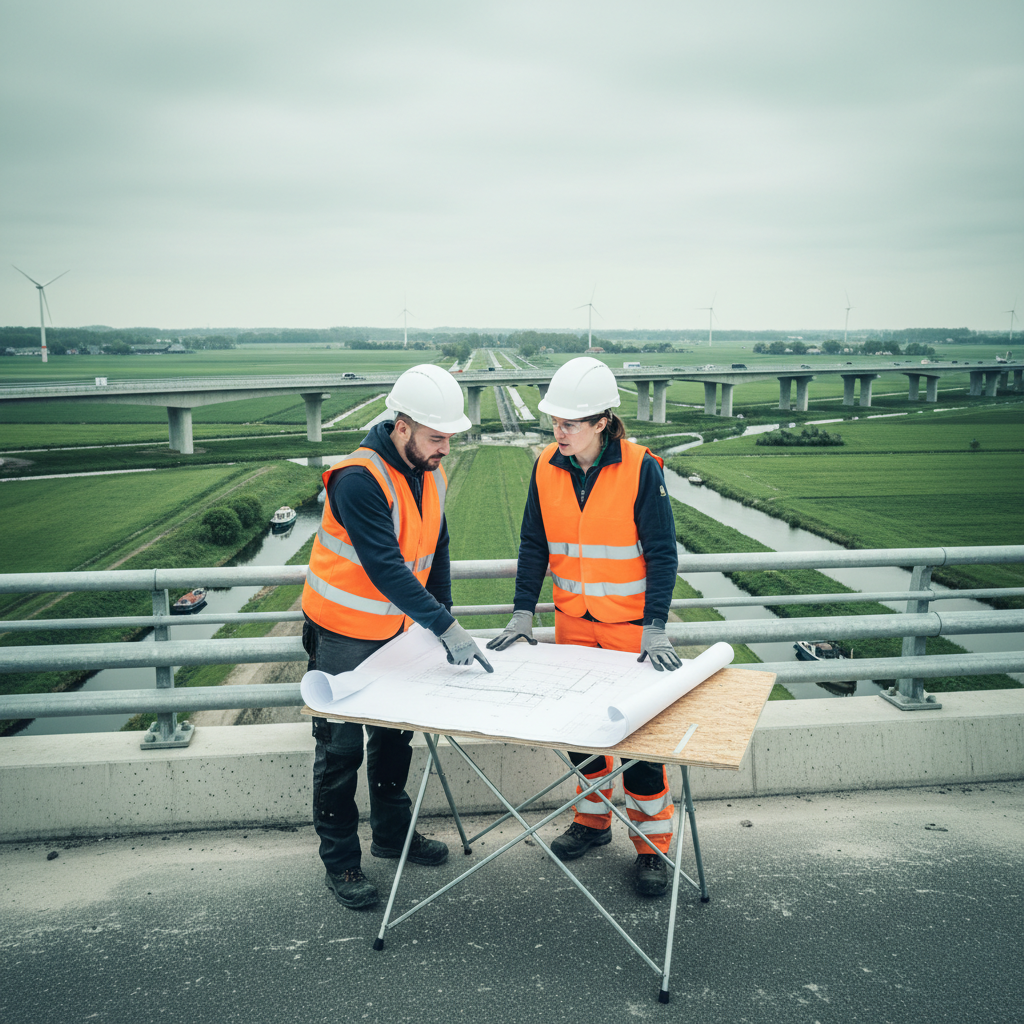

Twelve ageing bridges along one corridor. Four municipalities. A provincial road and two waterways crossing through it. And a contractor asking: can we develop one stakeholder and environmental management approach for the entire programme, rather than twelve separate ones?
It is a question that environmental managers in the infrastructure sector are hearing more and more often — and rightly so. The traditional approach, in which each structure receives its own environmental plan, its own stakeholder inventory and its own communication strategy, no longer fits the scale of the replacement task ahead. De Bouwcampus recently concluded that the current approach to infrastructure replacement and renovation falls short due to a lack of central direction and fragmentation. Decisions are still made per object, while coherence between projects is barely taken into account.
Rijkswaterstaat is responding with a new procurement strategy: bundling similar structures into portfolios and tendering them as a series, so that contractors learn from each successive project. TNO advocates for a programmatic approach based on data and standardisation. But the technical and contractual dimension is only half the challenge. The other half is stakeholder and environmental management — and that is precisely where programmatic approaches most often stall for lack of preparation.
Why the object-by-object approach falls short
In a traditional project structure, every bridge, lock or culvert has its own project team, its own environmental manager and its own communication approach. This works reasonably well when projects are far apart in time and geography. But as soon as multiple similar structures in the same corridor or region are tackled in rapid succession, fragmentation creates problems:
- The same municipalities, water authorities and regional parties are repeatedly approached as ‘new’ stakeholders — with inconsistent messages and different points of contact.
- Lessons about sensitive communication topics (traffic disruption, diversion routes, vibration and settlement impacts) are not systematically transferred from one project to the next.
- Political and administrative support, built up with considerable effort for structure one, must be rebuilt from scratch for structure two.
- Residents and businesses along a corridor experience the disruption cumulatively, while project communications inform them object by object — systematically underrepresenting the true impact.
De Bouwcampus identifies the same pattern: the task is being treated as a sum of individual asset management questions, when in reality it is a network and systems question. That distinction applies with particular force to stakeholder and environmental management.
Step 1: Conduct a programme-level environmental analysis
A serial replacement approach does not begin with the first structure — it begins with an environmental analysis at programme level. The question is not: which stakeholders are relevant for bridge 1? The question is: which parties are affected by the entire series?
In practice, this means:
- Mapping geographic overlap: which municipalities, provinces, water boards and regions play a role across multiple structures?
- Identifying structural stakeholders: parties such as Rijkswaterstaat district offices, ProRail, regional transport authorities or major employers who need to be engaged at programme level, not per object.
- Analysing cumulative impact: what is the combined effect of the sequence of interventions on traffic flows, inland shipping, commercial activity and accessibility? Only then can phasing agreements be made that genuinely reflect the interests of the surrounding environment.
This analysis is the foundation. Without a programme-level picture, any per-object approach is incomplete by definition.
Step 2: Segment stakeholders at programme level
After the analysis comes segmentation: which stakeholders are relevant at programme level, which at object level, and which at both?
Programme-level stakeholders — parties with an interest in the whole — deserve their own engagement structure. Think of provincial environmental services, regional traffic management centres, or municipalities located along multiple structures. With them, you have the conversation about the phasing of the programme as a whole: which object comes first, how are traffic effects coordinated, and who is the primary contact for the programme?
Object-level stakeholders — residents, businesses or institutions affected only by one specific structure — receive targeted, object-specific communications. But even their messaging must incorporate the programme context: when will your bridge or lock be addressed, why in this sequence, and what can you expect if your structure falls later in the programme?
A common mistake is that environmental teams fail to make this distinction and approach all stakeholders at object level. The result is that the people most affected — those who live or work along the entire corridor — receive the least attention for their cumulative experience.
Step 3: Exploit the learning curve in communication
One of the greatest advantages of serial working is the learning curve: what you learn at structure 1, you apply at structure 2. This applies to construction — but perhaps even more so to stakeholder management.
After each object, systematically document:
- Which questions and concerns arose most frequently?
- Which information channels worked best (resident meetings, newsletters, digital drop-in sessions)?
- Which communication adjustments led to less objection or better acceptance of disruption?
- Which agreements with local authorities proved most effective?
Use those lessons actively in preparing the next object. In a well-structured programme, the environmental manager for structure 3 is involved during structure 1 — not to do work, but to learn. The time investment is small; the benefit at the start of their own assignment is significant.
TNO emphasises that harmonised inspection and analysis methods enable solutions to be applied faster and at greater scale. The same principle holds for stakeholder communication: standardise the approach where possible, so that energy goes into the unique environmental context of each structure rather than reinventing the wheel each time.
Step 4: Design a layered participation strategy
Participation in a serial programme requires a layered approach: a programme variant for the big picture, and an object variant for specific impacts.
At programme level, participation is organised early — ideally in the planning phase, before the first tender is issued. The central questions here are: in what sequence do we address the structures, which phasing fits the administrative and social context, and how do we maintain contact with key stakeholders throughout the programme? This is precisely the right moment to build administrative support that remains valid across the entire programme.
At object level, participation follows the standard approach, but with reference to the programme as a frame. Residents already know that more is coming, they understand the phasing, and they do not need to relearn why this is necessary with each new structure.
The combination of both levels prevents stakeholders from being surprised — and in environmental management practice, that is the single most effective measure against objections and delays.
Step 5: Safeguard continuity and knowledge transfer between project phases
Large programmes have long lead times. Teams change, contracts expire, coordinators retire. The risk is that built-up relationships and accumulated environmental knowledge disappear with every transition.
Safeguard continuity proactively:
- Appoint a programme environmental coordinator who is available throughout the entire programme and serves as the anchor for programme-level stakeholders.
- Record stakeholder agreements in a programme environmental file that is transferable between project phases and team changes.
- Ensure that contacts at municipalities, water boards and regional authorities know who their fixed programme-level interlocutor is — even when the per-object environmental manager changes.
- Plan evaluation moments after each object, not only internally but also with key stakeholders: what went well, what can be improved?
Pitfalls in programmatic environmental management
Even with a well-structured programme, stakeholder and environmental management regularly runs aground on recurring pitfalls.
Neglecting the interim period. Stakeholders along the corridor experience the periods between objects as silence, while preparation continues. Communicate also during quieter phases: what is the programme’s current status, when is the next object scheduled?
Late involvement of the contractor. In an integrated contract, the contractor has its own responsibility for environmental management. Discussing the environmental strategy only after contract award wastes the opportunity to integrate the approach into the execution planning from the start.
Uniformity as a false standard. Programmatic working does not mean every object is treated identically. Each structure has its own environmental context. Ensure that the standardised approach leaves room for local differentiation.
Underestimating cumulative disruption. A corridor of twelve bridges renewed over three years causes prolonged, cumulative disruption to road and waterway traffic. Communicate this honestly and early — and offer perspective on the end result.
Conclusion
The replacement task is too large for an approach that begins and ends per object. Rijkswaterstaat and De Bouwcampus conclude that greater technical and contractual coherence is needed. That conclusion applies to stakeholder and environmental management even more forcefully.
A programmatic environmental approach is not a luxury; it is the only way to combine scale, quality and social acceptance across dozens or hundreds of structures. Those who invest early in a programme-level environmental analysis, layered participation and secured knowledge transfer will avoid the recurring costs of repeated stakeholder contact, accumulating objections and parties who feel they have not been taken seriously.
The contractor’s question — can we build one environmental approach for the whole programme? — is the right question. The answer is: yes, but it requires programme-level preparation that begins before the first bridge appears on the schedule.
Sources
- De Bouwcampus — New analysis of V&R task: when the existing approach no longer works (March 2026)
- Infrasite — De Bouwcampus warns: V&R approach falls short due to lack of direction (26 March 2026)
- TNO — Keeping infrastructure renewal manageable and affordable (March 2026)
- Infrasite — Rijkswaterstaat’s new procurement strategy to accelerate replacement and renovation (11 March 2026)
- Infrasite — The Netherlands cannot tackle the replacement task by intuition alone: measurement must be the basis (27 March 2026)