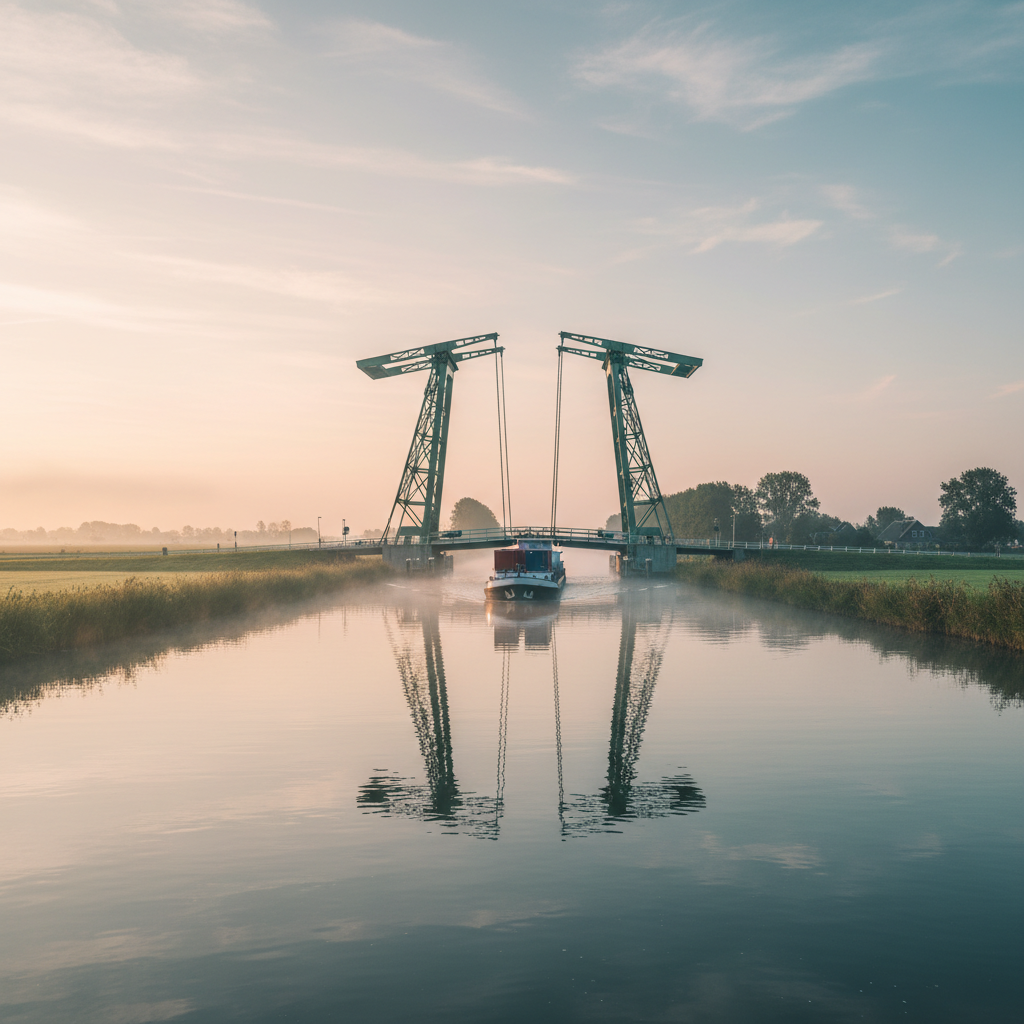
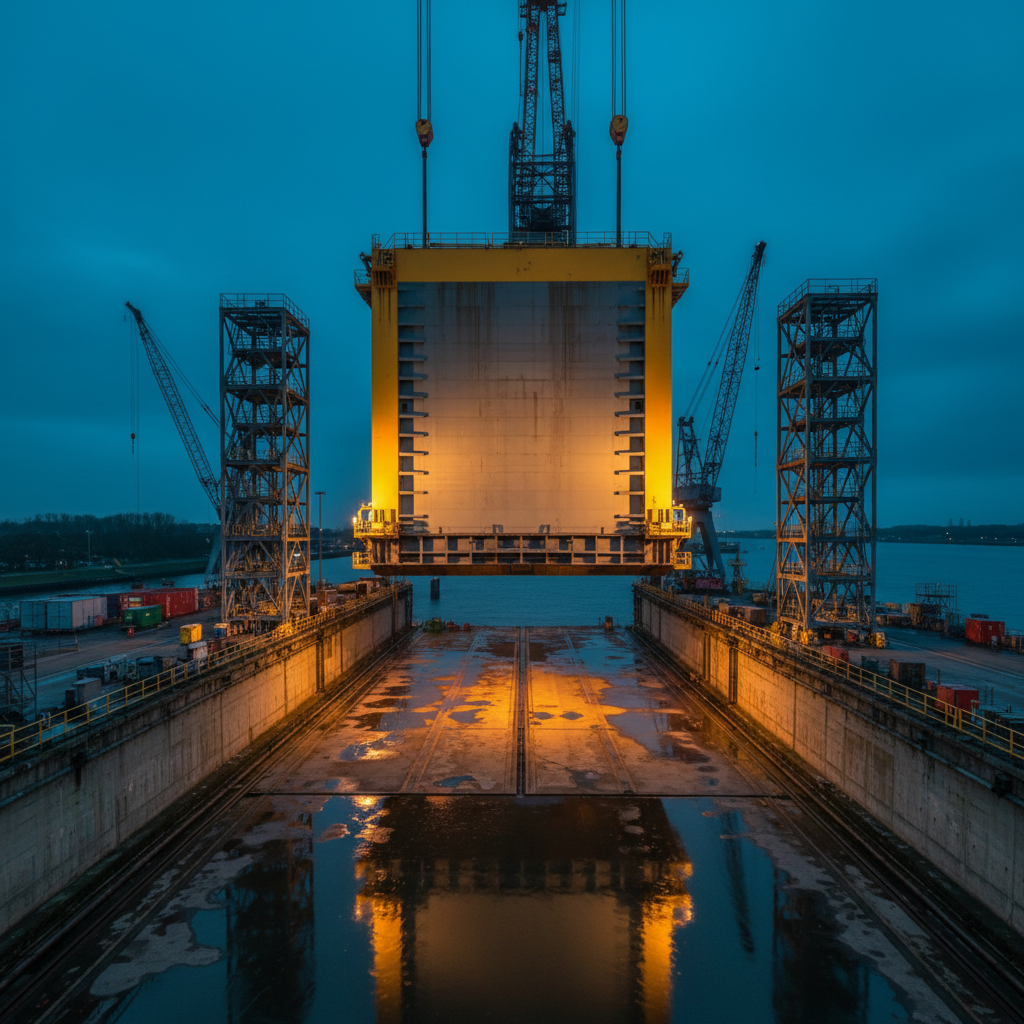
Two events in the same week, two worlds. On Monday 11 May, salvors working for Rijkswaterstaat lifted the 325-tonne northern dock door of the Maeslantkering storm surge barrier out of its dock — a meticulously prepared operation within a multi-year maintenance programme. The next day, Tuesday 12 May, waterway user organisations presented a petition to the Dutch House of Representatives titled Reliable access to the Dutch waterways. The trigger: a months-long outage at, amongst others, the Buitenhuizerbrug near Velsen, which the Royal Dutch Watersport Association attributes to the absence of repair budget and ministerial decision-making.
Both events fall under the same label — the renewal and replacement (V&R) programme for Dutch infrastructure — but the execution and stakeholder experience could not be further apart. For stakeholder and environmental managers, this contrast is instructive: the way you organise a renewal intervention almost entirely determines the room you have to work with the surrounding environment.
Approach A: planned renewal at the Maeslantkering
The Maeslantkering is one of the most visible elements of the Delta Works and protects roughly 1.5 million people in the lower-Rhine area around Rotterdam. Maintenance on the two dock doors — into which the barrier’s arms lock when the gates are closed — runs on a tight schedule. The southern door was overhauled in 2025, the northern in 2026. In both years, the work is carried out between late April and late July, well outside the storm season that runs from 1 October to mid-April.
The steel structure was lifted out of position by a floating crane and towed to the Hollandia Services yard in Krimpen aan den IJssel, where the refit takes place. The door will return at the end of summer. In parallel, Rijkswaterstaat is preparing the procurement of a full replacement of the Maeslantkering’s control and supervision system — the barrier’s digital brain, which after nearly thirty years is approaching the end of its useful life. Procurement begins in 2026; delivery is foreseen around 2030.
The pattern stands out: a multi-year planning horizon, fixed maintenance windows, pre-contracted supply chain partners, transparent publications on the Rijkswaterstaat website, and openness about the next major step (SCADA replacement). The surrounding environment — shipping on the Nieuwe Waterweg, the municipality of Maassluis, the Port of Rotterdam Authority, water boards and local residents — can plan around it.
Approach B: reactive failure management at the Buitenhuizerbrug and Algerabrug
A few kilometres north, a fundamentally different reality is playing out. The Buitenhuizerbrug near Velsen has been unable to rotate since February 2026 because of a technical defect. Shipping higher than 6.82 metres has been unable to pass for more than three months. The realistic alternative is a 180-kilometre detour via the North Sea — for much inland shipping, professional skippers, traditional sailing vessels and charter operators, not a safe or workable option. Notices to Mariners messages remain stuck on “closed pending further notice”.
The sense of urgency is amplified by what is coming. From 13 July 2026, Rijkswaterstaat will close the Algerabrug lock at Krimpen aan den IJssel for twelve weeks for major maintenance to the bascule and the fixed bridge. The road closure for vehicle traffic was, after intervention from evofenedex and local authorities, reduced from six to four weeks (10 August to 7 September). If the Buitenhuizerbrug is still not rotating by then, tall shipping on the main route between Haarlem and Rotterdam will be effectively trapped.
Here we see the opposite pattern: an unplanned outage without a clear repair horizon, a planned closure whose scope was rebalanced through political and stakeholder pressure, and a cascade risk that emerges because two trajectories were never aligned. The petition from BBZ, the Watersportverbond, HISWA-RECRON, VKZ and Motorbootsport zeroes in on this gap: not just the outages themselves, but the deficient coordination and the unclear information.
Comparison on four criteria
1. Predictability for stakeholders. The Maeslantkering approach offers shipping and surrounding parties a maintenance window that is known years in advance. At the Buitenhuizerbrug, even basic information about cause and repair date is hard to find. For a stakeholder and environmental manager, predictability is the vehicle for building trust; without it, the instrument vanishes.
2. Communication arrangements. Around the Maeslantkering there is a well-rehearsed communication apparatus: Rijkswaterstaat publishes milestones, photographs and interviews, and partners such as Hollandia communicate in parallel about their part of the work. At the Buitenhuizerbrug, communication is reduced to a thin closure notice, leaving interest groups to channel their frustration through Parliament. The difference is not in the substance — both situations have communication aspects — but in the organisation: one project has a built-in stakeholder function, the other has little or none.
3. Budget certainty and political standing. Major maintenance on a Delta Works object has its own budget line, strong political backing and clear ownership. Repairs to regional objects such as the Buitenhuizerbrug end up in the waiting room as soon as Rijkswaterstaat’s maintenance budget comes under pressure — a pattern that has been widely understood since the Multi-year overview of the renewal task 2026-2030 was published. Stakeholder management without budget certainty quickly turns into the kind of expectation management that erodes trust.
4. Effectiveness of stakeholder management. During a planned intervention, the stakeholder manager is a designer of the process: he or she helps shape the phasing, the communication moments, the nuisance reduction and the alignment with other road and grid operators. In reactive failure management, the stakeholder manager is forced back onto the minimum: notify, explain, soothe. The room to add value shrinks as control moves elsewhere — or disappears altogether.
When each approach fits
No organisation can fully prevent outages; the Maeslantkering itself has needed unplanned repairs in recent years. But the comparison shows that the transition between “planned renewal” and “reactive failure management” is not just a technical reality — it is also a choice in how a network operator organises itself. Three observations matter in particular for stakeholder and environmental management.
First: it pays to lock V&R interventions into a multi-year calendar early, and to secure financing later. Stakeholders, especially inland shipping and professional operators, can only plan around an intervention if they know it is going to happen — not only when everything has been finalised.
Second: cascade risks demand active network thinking. Anyone looking only at their own bridge, lock or tunnel sees the Buitenhuizerbrug-Algerabrug combination only when the ships are already trapped. A stakeholder management function that operates at corridor level — rather than object by object — picks up that interaction.
Third: unplanned outages deserve a dedicated stakeholder management protocol. Not only once a petition arrives, but as a standard component of the maintenance organisation. A fixed working method for information provision, a single point of contact for the shipping sector and clear arrangements on when to escalate would prevent the Watersportverbond or BBZ having to ring the bell in The Hague.
The Maeslantkering and the Buitenhuizerbrug are both part of the same challenge — and both mirrors for it. The first shows what is possible when funding, organisation and political standing are aligned. The second shows what is left when one of the three is missing.
Sources
- Rijkswaterstaat — Dock door Maeslantkering lifted out for maintenance
- Vaarmarkt — Waterway users to Parliament: keep the Netherlands accessible by water
- Rijkswaterstaat — Buitenhuizerbrug closed for tall shipping
- Rijkswaterstaat — Algerabrug: four weeks closed instead of six; 10 August - 7 September 2026
- Hollandia — Major maintenance on the Maeslantkering: dock door south successfully removed
- Rijkswaterstaat — Multi-year overview of the renewal task for bridges, tunnels and locks 2026-2030
- Watersportverbond — Column: monument of mismanagement