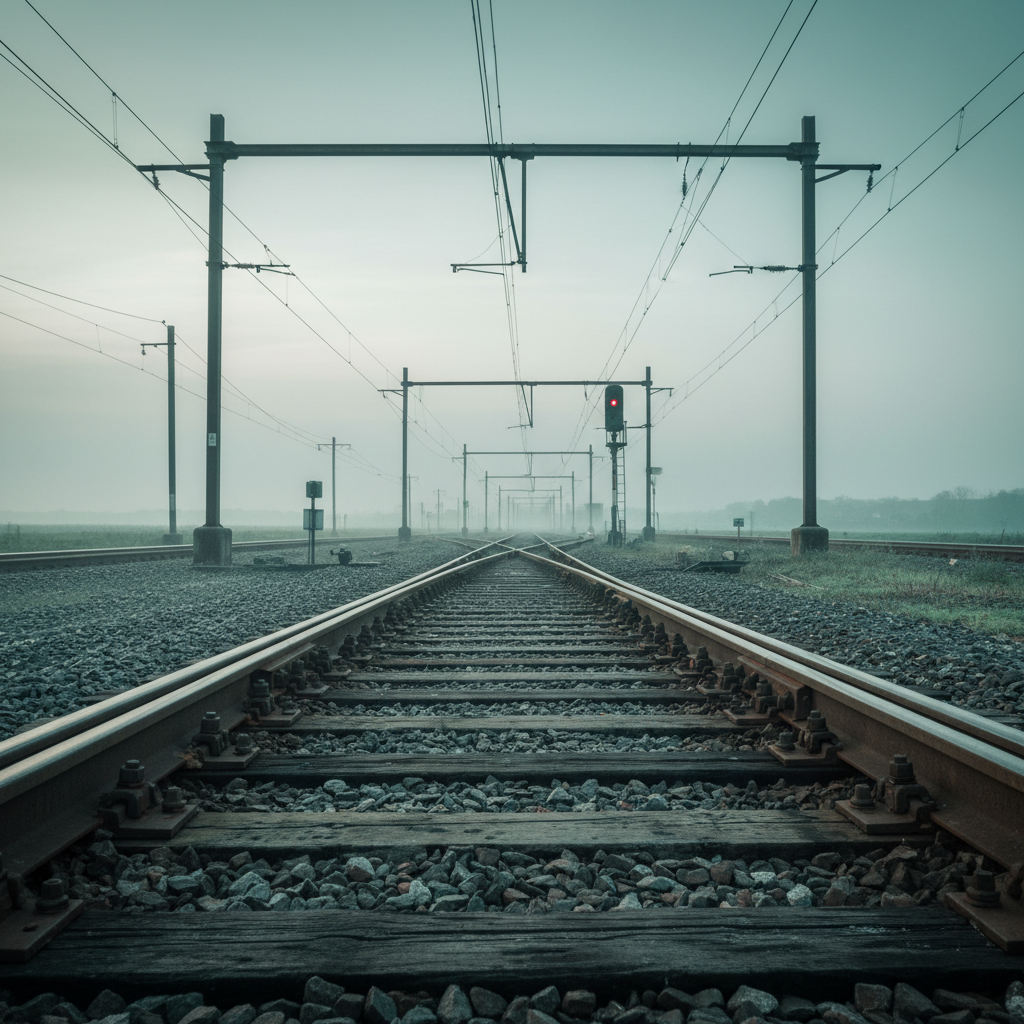
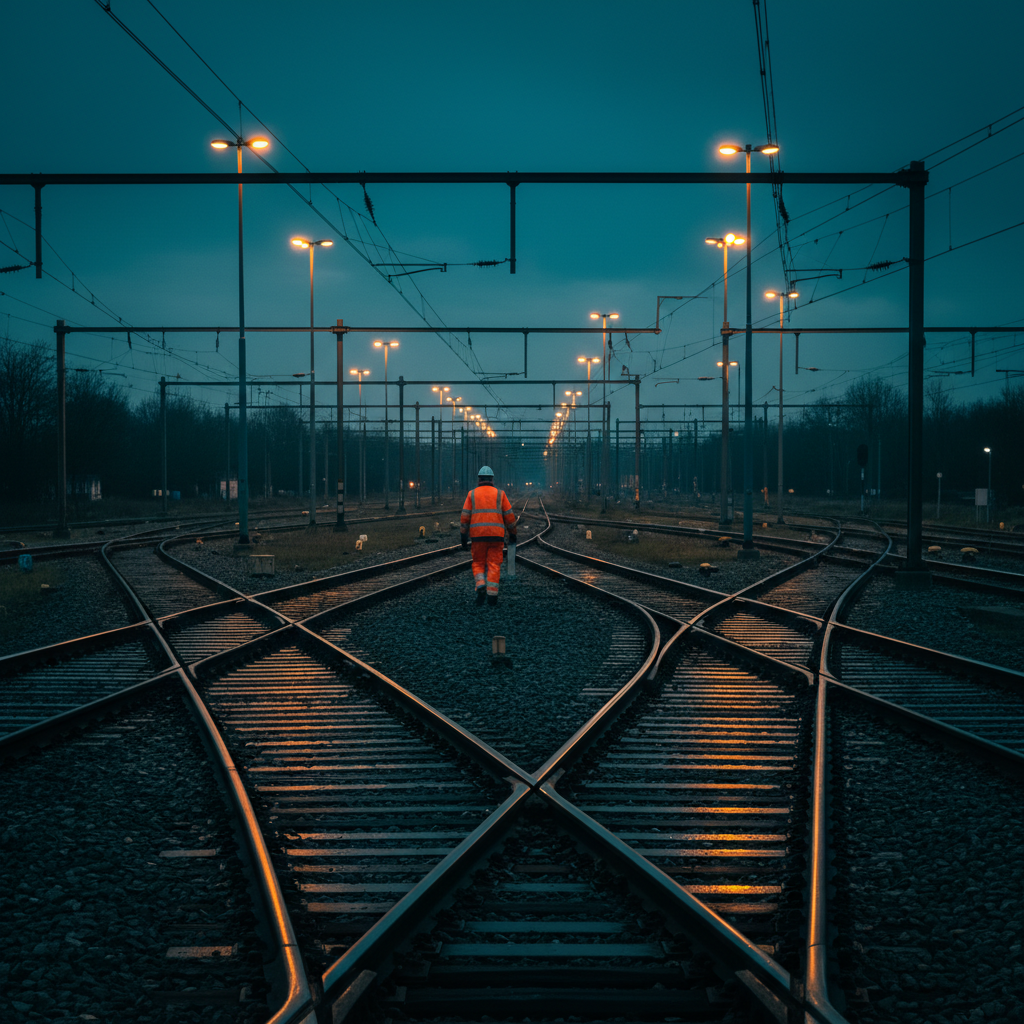
In the week of 14 to 19 February 2026, no trains ran in the evenings and at night between Haarlem and Amsterdam Sloterdijk. Three switches at the Haarlem rail yard were replaced — not because they had failed, but because they were technically at end-of-life and would have failed in 2028 if they were not removed before then. ProRail had to make the decision back in late 2025: replace one-to-one, or do nothing and accept that part of the train traffic around Haarlem would come to a standstill.
It became one-to-one replacement. And precisely with that decision, this project opened a file that will shape Dutch rail renewal for years to come: how do we deal with the hundreds of assets that will reach the end of their service life within ten years, while the Mobility Fund offers no room for future-proof renewal? The Haarlem file is not a local incident. It is a blueprint for the decision-making bottleneck that every major ProRail project will run into in the coming years.
What is on the ground: a junction from the eighties
The Haarlem rail junction serves three corridors: the IJmond branch towards Beverwijk and Uitgeest, the Coast Line to Zandvoort, and the main line to Amsterdam. The yard itself — switches, headshunt, signals, platform ends — was largely built in the seventies and eighties. The design service life expires in large part in 2028. This is not a surprise: ProRail has known this deadline for more than ten years and has flagged it in every successive Investment Plan.
The technical replacement is not the complex issue. Switches, signals and overhead lines can be rebuilt one-to-one in the same geometry. What became impossible was the broader wish to modernise the junction at the same time: fewer but larger switches, ETCS preparation, a more generous headshunt that would also enable intercity services between Haarlem and IJmond, and a layout that accommodates the housing development ambitions along the railway line. That is what the Grinwis motion asked for on 4 February 2026: renew the rail in Haarlem in a future-proof way in one go, rather than tearing it up twice in the years to come.
The motion was adopted. ProRail responded nine days later that it could no longer be carried out.
Why the motion came too late
ProRail’s letter to State Secretary Aartsen on 13 February 2026 is an uncomfortable document. The core message: a future-proof approach to the Haarlem rail junction would require an additional design, a new permit route, an extensive stakeholder process with the municipality of Haarlem, NS and residents, and above all extra funding that is not available within the current Mobility Fund. For an intervention that must be operational in 2028, the planning horizon is simply too tight.
ProRail had already been forced in late 2025 to take an irreversible decision to launch the tender for the one-to-one replacement. By the time Parliament asked for “future-proof renewal” in February 2026, the contracts were already with the market. Reversing that decision would mean replanning the entire project, with the very real risk that part of the Haarlem infrastructure would no longer be safe to operate in 2028.
What makes this file uncomfortable — and what lifts it out of the “local project problem” category — is that Parliament asked the right question, just not at the right moment. For a future-proof junction, the decision should not have fallen in February 2026, but in 2022 at the latest. And that goes directly to the way the Netherlands organises its rail replacement task.
A task of 400 projects and 1.8 billion
The ProRail 2026 work programme covers more than 400 major projects with a total investment volume of approximately 1.8 billion euros. That sounds like a lot — and it is — but it does not cover the actual replacement need. ProRail has repeatedly warned in recent years that maintenance funding is insufficient to renew all assets on time, let alone to combine that renewal with capacity expansion.
The largest projects of 2026 illustrate both the scale and the pattern: rail bridges in Amsterdam, signalling around Rotterdam, the underground track in Vught, electrification of the Maaslijn, renewal of the bridges over the Amsterdam-Rhine Canal, the Waal bridges and the Rhine bridge. Each of them is a project where the structures are at end-of-life and where new requirements at the same time — heavier axle loads, higher frequencies, ETCS — call for adaptations. And each of them is a project where the question “do we replace one-to-one or take it on as a future-proof project right away?” sooner or later forces itself to the surface.
In Haarlem, the answer became one-to-one by necessity. For every junction that is not yet in decision-making, that same choice is still open — and the ministry and Parliament must make that choice earlier than they have done so far.
What this means for stakeholder and environmental management
At first glance, this is an administrative-financial story. The stakeholder and environmental manager only enters the picture later, in execution. But that is precisely the misconception that the Haarlem file exposes.
Defining the scope is a stakeholder decision, not a technical one. The choice of one-to-one replacement instead of a future-proof junction has direct consequences for the surroundings: the municipality of Haarlem must reconsider its housing plans around the station, NS cannot schedule extra peak-hour services to IJmond for the time being, and residents will face two service interruptions in ten years instead of one. Anyone who only sees these trade-offs after the scope decision has been taken misses the place where stakeholder and environmental management could have added the most.
Permit procedures and participation are the planning horizon, not the design. ProRail could not implement the Grinwis motion because the time required for an additional permit, an EIA update and a stakeholder process no longer fitted within the 2028 deadline. That is not a failure of ProRail — it is an illustration of what happens when stakeholder and environmental procedures are not treated as critical-path elements in planning. For every next major replacement, the rule is: anyone who only starts stakeholder and environmental management one year before tender has already given away the future-proofing of the project.
The municipality is not a listener, but a co-owner of the scope question. Haarlem has substantial housing ambitions along the station area. Greater turnaround capacity and an adapted platform layout would support those ambitions. But without early and formalised consultation between ProRail and the municipality — not about execution, but about scope — those interests inevitably end up outside the project. For the next junction scheduled for 2032 or 2035, this must be different.
Which junctions follow
ProRail has not announced in 2026 which other rail junctions will end up in the same position as Haarlem in the coming years, but the contours are not difficult to draw. Junctions with installations from the seventies and eighties — such as parts of Utrecht Central, The Hague HS, Eindhoven, Amsterdam South and Arnhem — will reach their end-of-life point in the next ten to fifteen years. For each of them, the scope question will arise again.
In Eindhoven, the Internationale Knoop XL programme is running in parallel — a major station area redevelopment with a new bus station, renewed platform and thousands of new homes. There, ProRail, the municipality, the province and the regional public transport partners have been at the table together since 2018. That is the model that Haarlem started on too late — and that the rest of the Dutch rail junctions will have to move towards as quickly as possible.
Status and outlook
The three switches in Haarlem have been in their replaced position since February 2026. The full one-to-one replacement of the rail yard is in tender and must be operational in 2028. According to ProRail, the chance that there is still room for a partial modernisation before that date — for example an adapted switch geometry or preparations for ETCS — is small but not excluded if the contractor that wins the tender sees an option for it.
The Grinwis motion has formally been concluded with the letter of 13 February. In practice the file lives on, because it forces Parliament to determine before the next Spring Budget Note whether structurally more funding should go to rail maintenance. The answer to that question determines whether the rail junctions due in 2032 or 2035 will receive a future-proof approach.
For stakeholder and environmental managers in the infrastructure sector, the lesson is simpler than the Haarlem file might suggest. A replacement project is not a technical job that later acquires a stakeholder process. It is a stakeholder process with a technical execution. Anyone who keeps that order the wrong way around will get the Haarlem answer further down the line: we wanted to, but it was no longer possible.
Sources
- Dutch government – Parliamentary letter on Grinwis motion future-proof rail junction Haarlem (13 February 2026)
- Treinreiziger.nl – ProRail forced to cut back on essential rail renewal
- SpoorPro.nl – ProRail to Aartsen: Haarlem motion cannot be carried out
- ProRail – Replacing switches at Haarlem rail yard
- ProRail – 2026 works per province
- Dutch Parliament – Grinwis motion document Haarlem rail junction