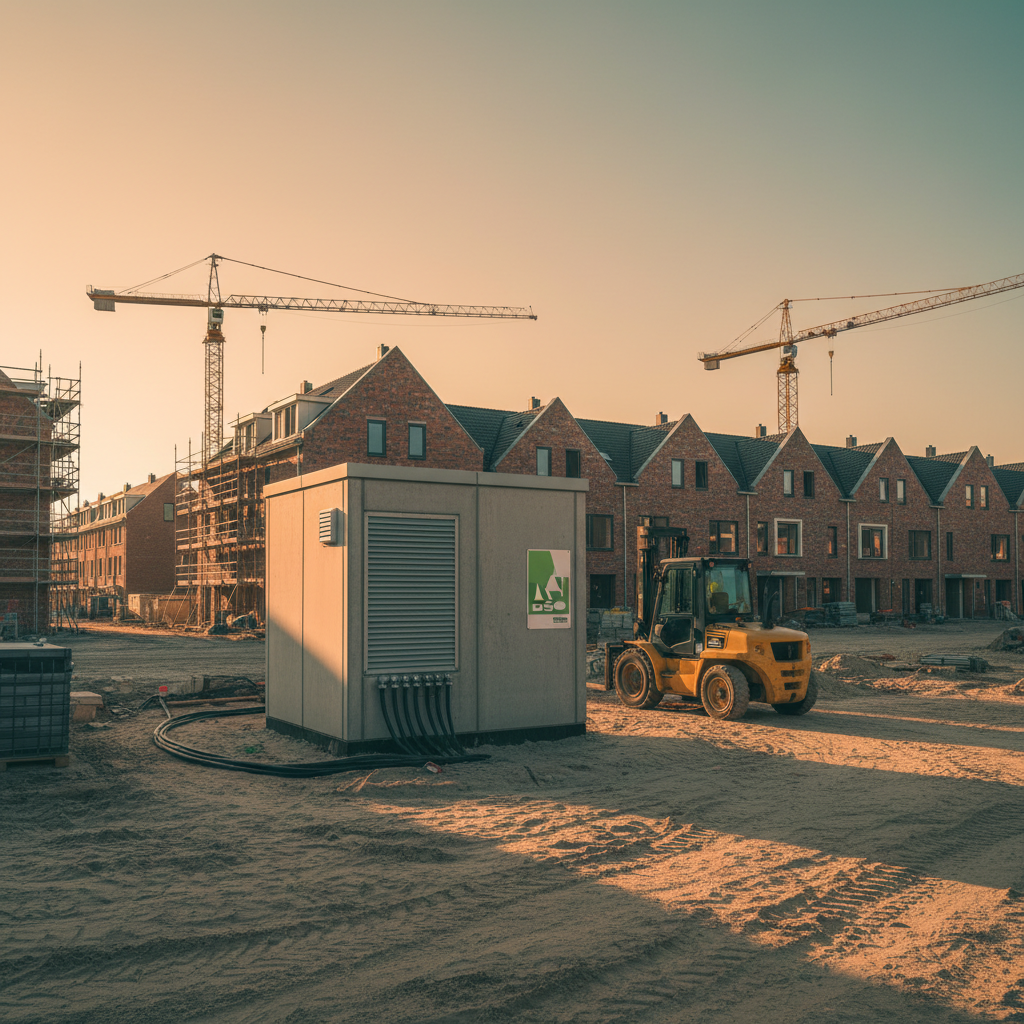

More than half of all municipal housing projects in the Netherlands are being delayed or cancelled because there is no transport capacity available on the electricity grid. That figure, shared earlier this year by the Association of Netherlands Municipalities (VNG), captures Dutch grid congestion in a single line. From 1 July 2026, the way that scarcity is allocated changes fundamentally. And with it, the venue where conversations about grid connection take place: no longer at the network operator’s drawing board, but in the council chamber, around the resident’s kitchen table, and at the project steering committee.
The Code Decision on Prioritisation Capacity in Transport Requests, issued by the Dutch Authority for Consumers and Markets (ACM), has been in force for large consumers since 1 January 2026. From 1 July, the automatic priority that small consumers (households, small businesses, schools) currently enjoy in congestion areas comes to an end. They, too, will join the waiting list. It marks the end of an era in which “applying for a connection” was still essentially an administrative formality. For stakeholder and environmental management, it means that a file that was previously primarily technical and legal moves squarely onto the political and societal agenda.
What changes on 1 July 2026
Until 1 July, the old rules apply: small consumers automatically receive reserved transport capacity, even in congestion areas. From that date, that certainty disappears. Anyone applying for a new or upgraded connection, regardless of size, joins a single waiting list. The order on that list is no longer determined by who applied first, but by societal importance, codified in the three categories of the ACM’s prioritisation framework.
Between 1 July 2026 and 1 January 2027, the previously reserved capacity is gradually redistributed among parties with priority status. From 1 January 2027 onwards, the reserved space for non-prioritised small consumers disappears entirely. From that point, grid capacity in a congestion area is no longer an automatic right but a scarce good, allocated according to a ranking established by the regulator.
For network operators, this is a shift from a role as technical service provider to one of scarcity allocator, a role that until now has played out behind the scenes of congestion management maps and connection processes, but which in day-to-day practice will become increasingly visible to customers and residents.
The three categories, and the debates that come with them
The ACM framework recognises three groups that receive priority on the waiting list:
Congestion relievers. Projects that directly create space on the grid: through battery storage, smart charging, or the return of capacity at peak moments. They receive the highest priority because they shorten the queue for others. In practice, this means parties offering a flexible connection or a congestion service get to the front of the line ahead of those with a fixed capacity demand.
Safety. Police, fire services, defence, the judiciary, drinking water supply, acute healthcare, blood supply, traffic safety and water authorities. Functions that society cannot do without if public order or public health is to be preserved.
Basic needs. Education, public transport, waste management, heat supply and housing. The most politically charged category, because the debate is sharpest here: what counts as a “basic need”? A new housing district does, but a data centre that supplies the same district with residual heat does not automatically. A vocational school does, but the expansion of a sports complex also used by schools may or may not, depending on how the project is defined.
What is conspicuously missing in this categorisation is economic activity that does not directly qualify as a “basic need”: logistics hubs, manufacturing, data centres, retail. The Industrial Cluster Kampen warned in April 2026 that the consequences for businesses in congestion areas will be significant. The regulator assumes that scarcity will drive innovation here too, through collective solutions or energy hubs. Whether that is a reasonable assumption will have to be borne out by practice.
”Early application”: a new ten-year planning horizon
One of the most far-reaching elements of the new framework is a change that takes place before the connection request itself. From 1 October 2026, municipalities will be able to request transport capacity for housing and schools up to ten years in advance: at an early stage of the construction process, before a building permit has been granted or even an executive decision has been made.
That sounds like a formality, but it is in fact a reversal of the planning logic that has shaped Dutch area development for decades. Until now, a municipality first arranged the zoning plan, then the implementation contracts, then construction, and only somewhere in the final year before completion the grid connection. From late 2026, that will no longer be possible. Or rather, it will be possible, but the project will end up at the back of the queue. Anyone wanting to secure capacity will have to reserve it ten years before completion, at a moment when design choices have not yet been made and financing is not yet in place.
For stakeholder and environmental management, this means that grid connection becomes a strategic design parameter, on a par with land acquisition and nitrogen deposition. An environmental manager who in the exploration phase does not know how many kilowatts a project will draw, or who has not had a conversation with the regional network operator about available capacity, is effectively planning a project that may not get a connection seven years out. The VNG is currently developing guidance to help municipalities prepare for this new role.
What this requires of municipalities and developers
Under the old regime, the municipality was the first gatekeeper of area development: no zoning plan, no project. Under the new regime, a second gatekeeper is added: the regional network operator. That has three consequences that are not all written into law or code, but that will be relevant in practice.
First: for its own land development and housing programming, the municipality needs to know which districts fall within which congestion area, and what status those areas have at any given time. That requires up-to-date congestion maps in the planning process, not as a late-stage annex, but as a base layer at the start.
Second: any municipality or housing corporation now planning ten years ahead for capacity cannot avoid a multi-year investment overview in which housing, mobility, heat and economic activity are considered on a single agenda. For many smaller municipalities, this is a new discipline. The provinces and the Inter-provincial Council are exploring how they can play a coordinating role here, comparable to the steering function they already have in the Regional Energy Strategy process.
Third: developers and housing corporations must recognise that a project without an early capacity reservation now carries a significantly larger delivery risk. Aedes notes that this has consequences for the pace at which social housing can be delivered, particularly in the locations where congestion is greatest, often the same locations where housing demand is highest.
The stakeholder dimension: communicating about what (cannot yet) be done
The technical and legal dimensions of the prioritisation framework are relatively manageable. The societal dimension is not. What does an alderman say when a data centre receives a connection while a housing project in the same district must wait three years? How does a corporation explain to future tenants that their flats will not be ready in 2028 but in 2032, because the prioritisation worked out differently than expected? And how does a network operator avoid carrying the blame for a choice deliberately made by the legislator?
These are the questions that stakeholder and environmental management will need to answer in 2026 and 2027. Three principles seem load-bearing.
Make the framework explicit early, not at the moment of the first disappointment. A residents’ meeting about a new development plan in which the word “grid congestion” is never mentioned becomes a crisis-communication exercise three years later when delivery slips. It is better to say upfront, during the information rounds around the zoning plan, that the connection is a separate track with its own risks and its own timelines.
Make the choices traceable, even when they hurt. Residents and entrepreneurs in a congestion area are entitled to an honest account of why their request sits at position 4,218 and not 217. A prioritisation framework that cannot be explained undermines itself. That is not an argument against the framework: it is an argument for investing in clear, retrievable public communication about the queue.
Connect the waiting list to the solution. A municipality that only reports that the wait is long will collect blame. A municipality that in the same conversation shows where the local 50 kV substation is being upgraded, which energy hub is in preparation and what the regional planning looks like, offers perspective. The waiting list is not an end state but an intermediate phase, and stakeholder communication should make that intermediate phase legible.
Conclusion
The ACM prioritisation framework is not abstract regulation. It is the codification of a choice that Dutch society has effectively been making for some years already, but had until now refused to face explicitly: that grid capacity is scarce, that scarcity must be allocated, and that the allocation cannot be left to the market. From 1 July 2026, that choice becomes visible: to housing corporations, to entrepreneurs, to local politicians and ultimately to residents.
For the environmental manager, this is not a file that runs alongside the existing work, but one that cuts across all of it. The question is no longer whether a project gets a connection, but when, on what priority, and on the basis of what societal narrative. Anyone who does not prepare that narrative themselves will at some point have it handed to them by someone else, and usually in the least favourable form.
Sources
- ACM - Priority for societal projects remains possible under new prioritisation framework
- ACM - Code Decision on prioritisation capacity in transport requests
- VNG - ACM prioritisation framework for grid capacity
- VNG - ‘Early application’ in the planning process
- Aedes - Prioritisation framework grid capacity: consequences for housing corporations
- IPO - Grid congestion and new approach for housing projects
- RVO - Priority during electricity grid shortages