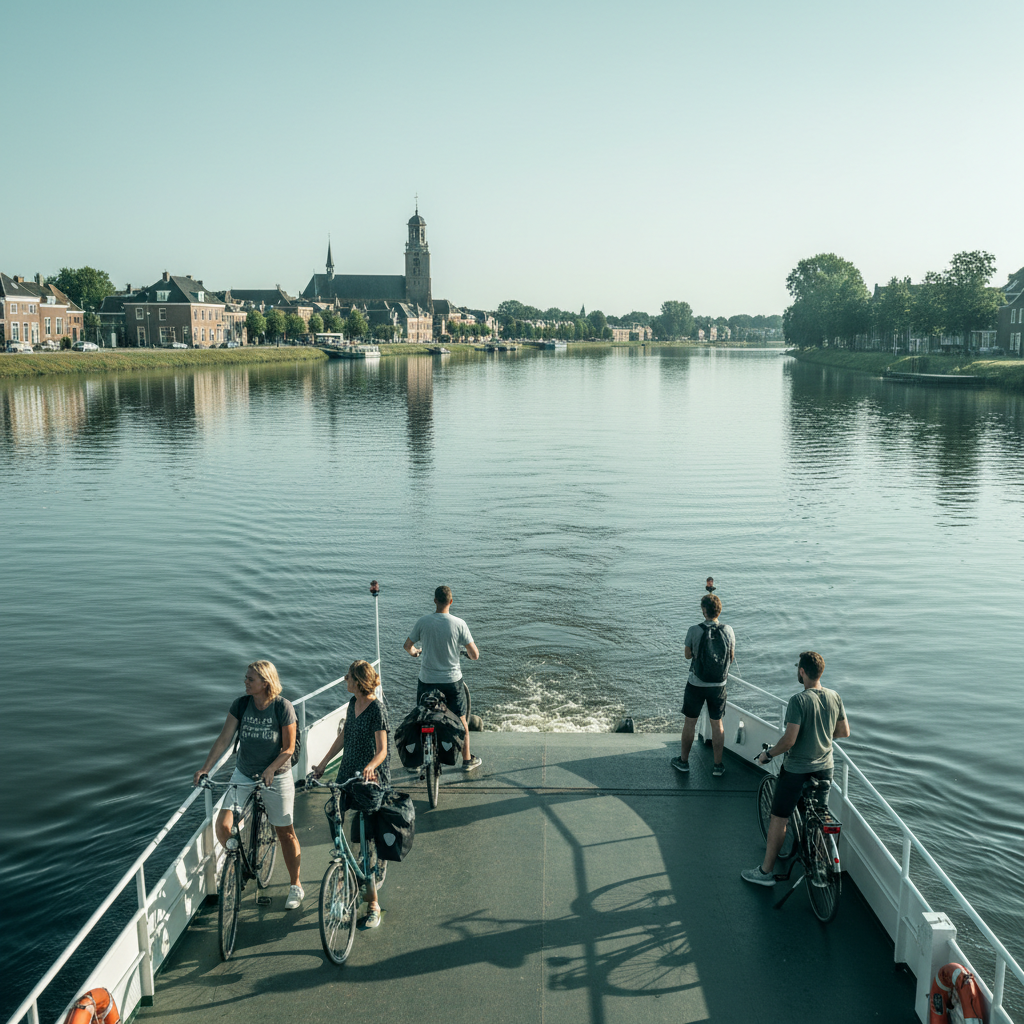

Nine months closed. From 17 July 2026 to 21 April 2027, no car, bus or truck will cross the Papendrechtsebrug (N3) while Rijkswaterstaat — the Dutch infrastructure agency — replaces the movable section. Traffic is diverted onto the A15 and A16 motorways, with an expected 30 to 60 minutes of extra travel time during peak hours. For cyclists and pedestrians there will be two ferry connections across the Beneden-Merwede, the bus network will be adapted, and discount schemes will encourage off-peak public transport use. Tall vessels — the bridge is the only access to the shipyards on the Beneden-Merwede, with no alternative route by water — will be allowed to pass roughly once a month for more than fourteen months.
This is not an isolated event. In March 2026 Rijkswaterstaat published a Top 20 of road works of which the Papendrechtsebrug is just one: the A2, A12, A58, A10, A15, A9 and A27, plus a series of bridges and tunnels built in the 1950s and 1960s that have all reached the end of their service life at the same time. That changes the nature of the renewal task. Where until recently the focus was mainly on the engineering and scheduling of the structure itself, in 2026 the equally pressing question is: how do we keep the area accessible while it is closed?
That question is not a side issue to the works — it is a stakeholder and environmental management discipline in its own right. “Minder hinder” (less disruption) and accessibility management are being handled ever more professionally by Rijkswaterstaat, within partnerships such as Zuid-Holland Bereikbaar and Amsterdam Bereikbaar, and by consultancies. The six principles below summarise what that approach looks like in practice — and where it usually goes wrong.
1. Start with the traveller, not the diversion route
The instinct when facing a closure is to draw the diversion first: which motorway absorbs the traffic, where do the signs go. That is necessary, but it is not where accessibility management begins. It begins with the question of who used that bridge, and why.
A commuter who drives to Rotterdam every morning, a truck making a just-in-time delivery to a factory, a home-care worker visiting eight addresses a day and a pupil on a bicycle all need entirely different alternatives. The diversion via the A15/A16 partly solves the commuter’s problem, but not the cyclist’s or the care worker’s. Only when you break the traffic down by origin, destination, time and mode do you know which measures actually take pressure off the network. A useful rule of thumb: every closure has a handful of user groups that together make up the bulk of the flow, and for each of those groups a credible alternative has to be in place before the first barriers go up.
2. Spread the load across modes — multimodality is not a buzzword but a capacity requirement
It is mathematically impossible to absorb a closure of this scale entirely on the surrounding road network. If every motorist piles onto the diversion, it grinds to a halt and the problem simply moves. The only way out is for a share of travellers to do something different: cycle, take public transport, travel at another time, or not travel at all.
That is exactly why the Papendrechtsebrug approach combines ferry connections, extra shared bikes, an adapted bus network and discount schemes. Mobiliteit.nl called 2026 a tipping point for good reason: the scale of simultaneous works forces accessibility to be organised multimodally, door to door, and no longer from the perspective of the car alone. The less-disruption approach demonstrably works — but only if the alternatives add real capacity and are not merely symbolic. One ferry carrying thirty cyclists an hour is no substitute for a cycle bridge that carried a thousand.
3. Communicate behaviour, not just information
The classic pitfall is to confuse communication with the supply of information. A press release, a roadside sign and a page on the project website tell people that the bridge is closing. They do not yet change any behaviour.
Behavioural change requires something else: a concrete, personal course of action, delivered at the moment the traveller makes their choice. Research around major works in Amsterdam and elsewhere shows that roughly half of travellers actually change something — travelling off-peak, switching to public transport or taking the bike — provided they know in good time and in concrete terms what their best alternative is. That means not just “the bridge is closing”, but “for your trip from Sliedrecht to Dordrecht, the ferry plus a shared bike is five minutes faster than the diversion”. The closer the message is to the individual journey, the greater the effect. Discount schemes and trial tickets follow the same logic: they lower the threshold to try the new behaviour once, after which it usually turns out to be manageable.
4. Reserve capacity for those who have no alternative
Not everyone can switch. Emergency services, shipping with no alternative route, freight on just-in-time schedules and people who depend on care at home have no “just travel off-peak” option. For them, accessibility management is not a behavioural question but a hard precondition.
At the Papendrechtsebrug this is visible in two choices. The Baanhoekbrug becomes the emergency route for emergency services — and is even closed to ordinary cyclists for that purpose. And shipping, despite the closure, is given a passage window roughly once a month, because otherwise the shipyards on the Beneden-Merwede would be unreachable for large vessels for fourteen months. This is the part of the plan that is hardest to schedule and demands the most governance attention: the exceptions. An environmental manager who only maps them after the main scenario is fixed is guaranteed to run aground on a safety region or a port authority brought in too late.
5. Coordinate with the neighbours — disruption does not stop at the project boundary
A single closure is rarely on its own. In the Drechtsteden the Papendrechtsebrug runs in parallel with an entire portfolio of bridge and tunnel renovations, and regionally, projects compete for the same diversion routes and the same public transport. If two projects independently designate the A16 as their diversion, they undermine each other’s measures.
This is why coordination within partnerships such as Zuid-Holland Bereikbaar is not overhead but the core of the approach. Here construction schedules are overlaid, two major closures are prevented from opening at once on the same network, and mobility measures — extra buses, shared bikes, spreading agreements with large employers — are procured collectively rather than per project. For the environmental manager this means the stakeholder field is larger than the project itself: municipalities, the province, the safety region, transport operators, neighbouring project teams and major employers all belong to it, ideally from the planning phase onward.
6. Make “temporary” an honest promise
The word “temporary” does a lot of work in the communication around closures, and that is exactly where trust can break. Nine months is no small matter for a commuter losing an extra hour every day. And as an analysis on Mobiliteit.nl rightly noted: with the stacking of infrastructure and housing projects, the sum of all that “temporary” disruption is, for residents, not so temporary at all.
The honest approach is to acknowledge that rather than paper over it. Give a firm end date and stick to it; communicate openly about overruns as soon as they threaten; and show what the disruption delivers — a bridge fit for another few decades. Accessibility management is ultimately expectation management: not the promise that there will be no disruption, but the promise that it will be bounded, predictable and worth it. Those who deliver on that keep the community on board — even in month eight of nine.
Conclusion
During major closures the centre of gravity of stakeholder and environmental management shifts from the construction site to the network around it. The engineering determines how long the bridge has to be closed; the disruption strategy determines whether the community accepts it. The six principles above — start with the traveller, spread the load multimodally, steer on behaviour, safeguard those without an alternative, coordinate with the neighbours and be honest about “temporary” — are not a checklist to tick off at the end. They belong on the table while the closure is still a line on the schedule. Because accessibility is not something you organise once the barriers are already up. By then it is too late.
Sources
- Rijkswaterstaat — N3: renovation of the movable section of the Papendrechtsebrug
- Rijkswaterstaat — Renovation of the Papendrechtsebrug (N3) in 2026 causes major disruption
- Mobiliteit.nl — Rijkswaterstaat publishes Top 20 road works 2026
- Mobiliteit.nl — 2026 as a tipping point: organising accessibility with smart mobility
- Mobiliteit.nl — Large housing and infrastructure projects: how temporary is temporary disruption?
- NM Magazine — The less-disruption approach to road works works
- Zuid-Holland Bereikbaar — N3: Papendrechtsebrug